
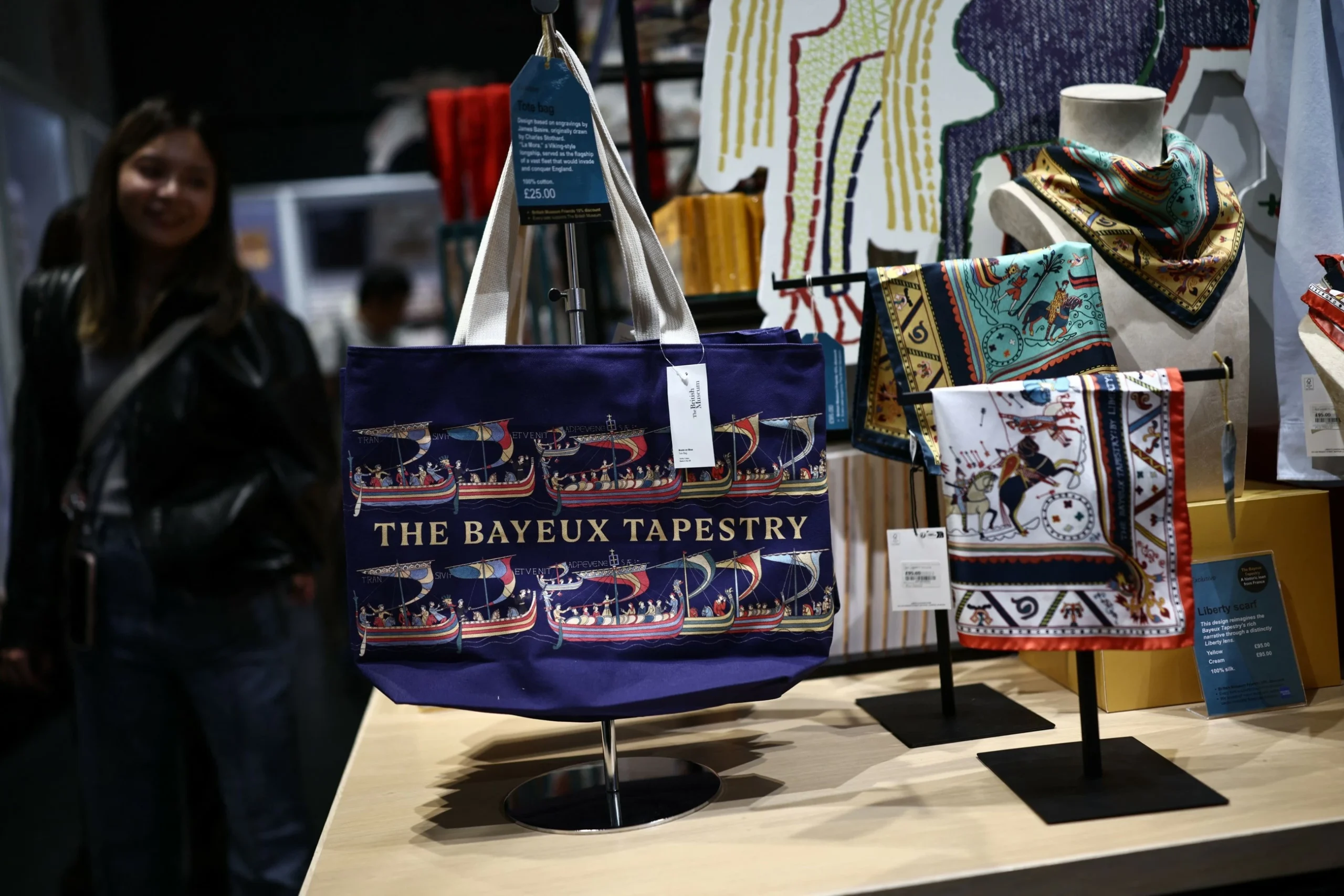
The British Museum has officially opened its highly anticipated exhibition featuring the Bayeux Tapestry, marking the first time the medieval masterpiece has been displayed outside France in 950 years. The sold-out event has triggered a wave of public excitement, with visitors gathering early on Thursday to witness the 70-metre-long artwork that chronicles the 1066 Norman conquest of England.
For many attendees, the arrival of the tapestry is a landmark cultural event. Catherine Pitt, 46, described the experience as a “big bang moment in our history” while waiting in line to enter. The exhibition, which is scheduled to run until next July, represents a significant diplomatic achievement, with observers like The Times calling the display a “spine-shivering experience” and The Economist labeling it the “hottest ticket” in London.
The tapestry, which is believed to have been crafted in England nearly a millennium ago before its long tenure in Bayeux, depicts the invasion led by William the Conqueror. Despite its age, the embroidery remains in remarkable condition. Retiree John Heys, 74, noted his amazement at the piece’s survival through the centuries. Other visitors, such as 58-year-old Mela Prasens, praised the modern feel of the illustrations, suggesting the display will likely resonate more effectively with younger generations than traditional history lessons.
The British Museum has managed overwhelming demand, selling over 100,000 tickets at prices ranging from £25 to £33. The exhibition layout allows attendees 40 minutes to view the tapestry, which is displayed flat in a raised glass cabinet rather than hanging vertically as it is in France. Digital animations are projected onto the walls to provide context, zooming in on the 627 figures and 700 animals depicted in the intricate embroidery.
The journey to London was a complex logistical operation. In July, the artifact was transported from northern France in an air-conditioned, anti-vibration crate under police escort. Although French officials recently reported the discovery of two minor broken threads during a condition check, the British Museum has maintained that the embroidery remains “virtually unchanged” and that the damage is negligible. King Charles III and French President Emmanuel Macron were among the initial visitors, with the King describing the loan as a “precious symbol of trust” between the two nations.
The cultural impact of the exhibition has extended well beyond the museum walls. Businesses across the UK are capitalizing on the fervor, with luxury retailers like Liberty offering themed cushions and bakery chain Greggs introducing an embroidered “Ta-Pastry.” Meanwhile, other institutions are seeing renewed interest, including a Reading museum that houses a Victorian-era replica and the Battle of Hastings site, which expects a surge in foot traffic.
Curator Michael Lewis noted that the intense public fascination stems from the tapestry’s foundational role in British history. Previous attempts to bring the tapestry to London, including during the 1953 coronation of Queen Elizabeth II and the 1966 anniversary of the Battle of Hastings, were ultimately unsuccessful. Now that it has arrived, the exhibition serves as a centerpiece for both historical reflection and a celebration of cross-Channel relations. The report also notes that it is widely thought to have been made in England almost 1,000 years ago before being transferred to Bayeux in France. The report also notes that fifty-two-year-old Jenny said it was “moving,” perusing the museum shop stocked with tapestry-themed mugs, dish towels and puzzles. The report also notes that where some staff had donned period costumes, excited visitors who had tickets for the first day of the sold-out exhibition queued outside the British Museum ahead of the opening. The report also notes that with death on both sides,” she added, not wanting to share her last name, it is real people in a battle. The report also notes that “It was beautiful, an emotional experience,” added Prasens, who lives in New York. The report also notes that students who learn about the artwork in history classes are gearing up for school trips, while businesses are bidding to capitalise on some of the fervour, around the country. The report also notes that priced at £165 each, while budget bakery chain Greggs has unveiled its own embroidered “Ta-Pastry.”, luxury store Liberty has released cushions inspired by the artwork.








Comments