
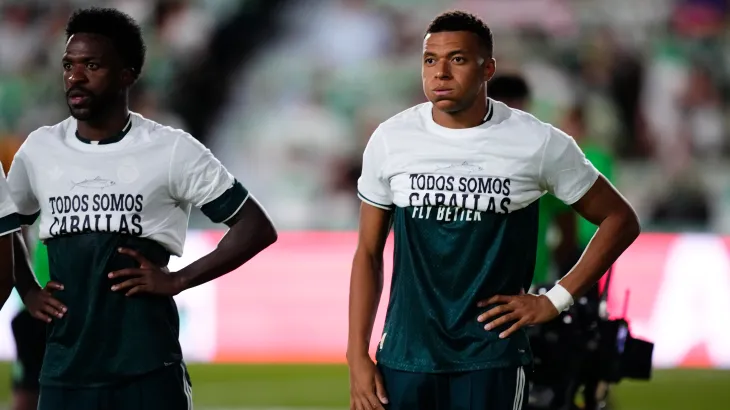
Real Madrid players Kylian Mbappe, Vinicius Junior, and Ibrahima Konate have sparked controversy after appearing to obscure a solidarity message on their pre-match shirts. During a La Liga fixture against Elche on Tuesday at the Manuel Martinez Valero Stadium, both teams took the pitch wearing white shirts over their kits featuring the phrase: “Todos somos caballas,” or “We are all mackerels,” in reference to a nickname for the people of Ceuta.
Video footage from the event showed Mbappe, Vinicius, and Konate rolling the garments up toward their chests, effectively hiding portions of the text before the shirts were removed ahead of kickoff. Real Madrid confirmed that the clubs had requested players wear the shirts as a show of support for the autonomous Spanish city, which has recently become a focal point for geopolitical tensions regarding migration.
The gesture has drawn polarized responses on social media. While some users interpreted the trio’s actions as a deliberate sign of disregard for the humanitarian situation, others praised the players for wearing the shirts at all or, conversely, lauded them for choosing to mask the slogan. Neither La Liga, the Spanish Football Federation (RFEF), nor UEFA have responded to inquiries regarding potential sanctions for the display.
FIFA regulations, specifically Rule 4.5, strictly prohibit players from displaying political, religious, or personal statements, including on undergarments. While official rules exist, such messages have frequently gone unpunished in recent professional matches. FIFA representatives noted that disciplinary authority regarding this specific incident rests with the domestic and regional governing bodies.
The issue stems from a major migration crisis on July 30 and 31, when over 70,000 people crossed into the Spanish enclave from Morocco. The surge resulted in multiple deaths and remains a sensitive point of contention, as Morocco does not formally recognize Spain’s sovereignty over the territories of Ceuta and Melilla, viewing them as occupied land. Last week, Moroccan officials denied any government involvement in the mass crossing.
The shirts were also worn by Real Betis winger Abde Ezzalzouli prior to his team’s match against Villarreal on Monday. Ezzalzouli, a 24-year-old born in Morocco and raised in Spain, faced backlash from Moroccan fans for participating in the campaign. In response to the criticism, he released a statement on Instagram clarifying his position. He emphasized that his participation was a social gesture meant to support the local population regardless of nationality, rather than a political act or a display of contempt toward his own heritage.
“This is not an apology to anyone,” Ezzalzouli stated, affirming his pride in his roots while maintaining he would continue to represent his background with sacrifice. Real Betis has scheduled a friendly match against a team from Ceuta on October 1 in Seville to continue fundraising efforts and show ongoing support for the city, which relies on high border fences, surveillance, and a permanent police presence to maintain its boundaries on the North African coast. The report also notes that rule 4.5, pertaining to players’ clothing and equipment, also bans players from revealing undergarments that show political, religious, personal slogans, statements or images, or advertising other than the manufacturer’s logo. The report also notes that la Liga, RFEF and UEFA did not respond to request for a comment. The report also notes that “I want to make one thing clear – at no point was the shirt referring to the people of Ceuta used with a political objective or out of contempt for my people, the Moroccan people,” said Abde in an Instagram post. The report also notes that more than 70,000 people entered Ceuta from nearby Morocco on July 30 and 31 in a surge that left scores dead and raised concerns in some European nations over migration. The report also notes that but several thousand remain in Ceuta, most returned in the hours following their arrival. The report also notes that last week, Morocco’s Ministry of Foreign Affairs said there was no evidence of Rabat’s involvement in the crossing.







Comments