
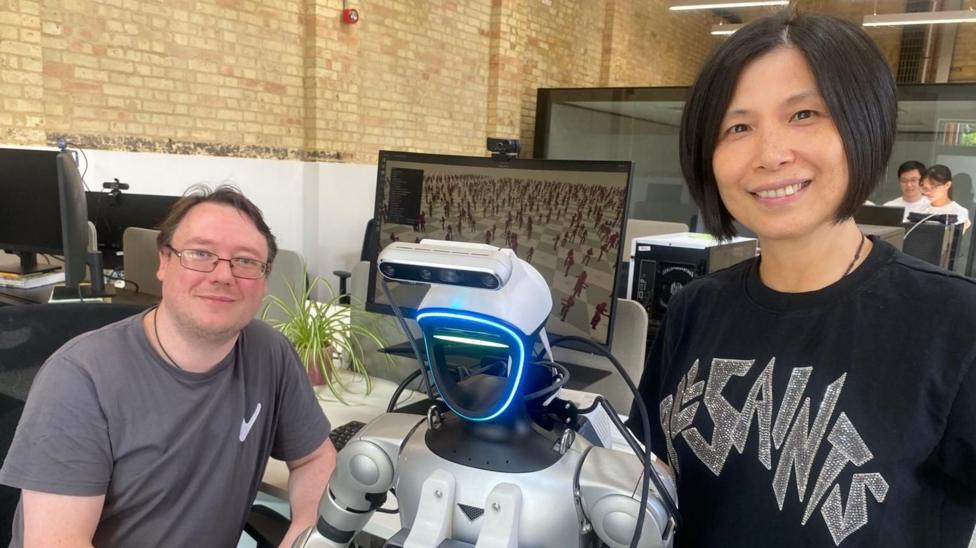
Freddo, a robot currently being tested at the British start-up Vsim in Cambridge, can walk across a room and grasp a plastic bottle offered by a staff member. While modern robotics has seen machines surpass human records like the 100m sprint, Freddo’s accomplishment lies in the speed of its learning: the robot acquired these specific tasks in only a few minutes. Developers at Vsim suggest that similar tasks might require days to master using traditional rival systems.
Founded in 2022 by Michelle Lu and Kier Storey, Vsim aims to create software capable of controlling robots for domestic and workplace tasks. According to the founders, robots often master complex movements like gymnastics relatively easily, yet struggle with the fine dexterity that humans find intuitive. Their approach focuses on virtual environments where robots can perform tasks millions of times until they develop an optimum solution, or policy, which is then uploaded to the hardware.
Vsim optimized their software to utilize the capabilities of modern graphics processing units (GPUs). Storey noted that many existing robotic simulations rely on algorithms dating back to the 1970s and 1980s, which are not ideal for current hardware. Eighteen months into development, Lu confirms they have produced a high-performance simulator. The software is efficient enough to run directly on Freddo’s hardware, allowing the robot to perform tens of thousands of simulations while navigating its environment.
This capability allows the robot to anticipate potential outcomes roughly one second into the future across 20,000 different scenarios. Lu emphasizes that this responsiveness is vital in unstructured settings like a home, where unexpected actions from humans or animals require the robot to adjust its strategy rapidly to remain safe. To further this research, the team plans to introduce a second robot named Nacho, which will help test their software across different machine types.
On a larger industrial scale, Nvidia operates at the opposite end of the sector with hundreds of engineers working on robotics software. While the company does not build the robots themselves, it provides a suite of tools, including virtual training systems and a “world model” known as Cosmos that simulates real-world physics. Spencer Huang, Nvidia’s director of product for robotics, acknowledges that while grabbing a single object is manageable, long-horizon tasks—such as filling a bottle and pouring its contents—remain challenging.
Nvidia is currently integrating AI agents to help build and validate these virtual training environments. Huang explains that this shift helps overcome the manual labor typically required to scan and create virtual worlds, essentially providing the company with a massive automated workforce. This method complements other training strategies, such as teaching robots by having them observe human movements or video demonstrations.
Academic research also plays a significant role in this field. Rika Antonova, an associate professor at the University of Cambridge’s Department of Computer Science and Technology, has been involved in robotics since 2015. She frequently utilizes MuJoCo, an open-source training system acquired by Google’s DeepMind in 2021. Antonova notes that because the software is user-friendly and accessible, it is highly valuable for small start-ups and research groups.
Antonova views Vsim’s focus on high-speed simulation as a promising development. By processing hundreds of millions of samples in mere seconds, a robot can theoretically refine its motions in real-time. However, she cautions that even advanced simulations remain approximations of reality, making it difficult to model specific interactions like cutting or manipulating highly deformable objects. Both Vsim and Nvidia continue to address these limitations, with Lu stating that their goal is to minimize approximation so that models trained in simulation function just as effectively in the real world. The report also notes that it’s not the most startling achievement, given that a robot recently beat Usain Bolt’s 100m sprint record. The report also notes that tech giant Nvidia has a system called Isaac Sim which works that way – Lu and Storey both worked on an early version of it. The report also notes that within months they realised their system could work much faster than anything they had seen before. The report also notes that or so, ahead into the future for 20,000 different kind of combinations of things that might happen,” Storey explains, it can look about a second. The report also notes that vsim is a start-up with 10 engineers working on its tech. The report also notes that with hundreds of engineers, it dominates the market for computer chips used for AI and has a leading robotics software division. The report also notes that but he’s confident that good progress is being made.









Comments