
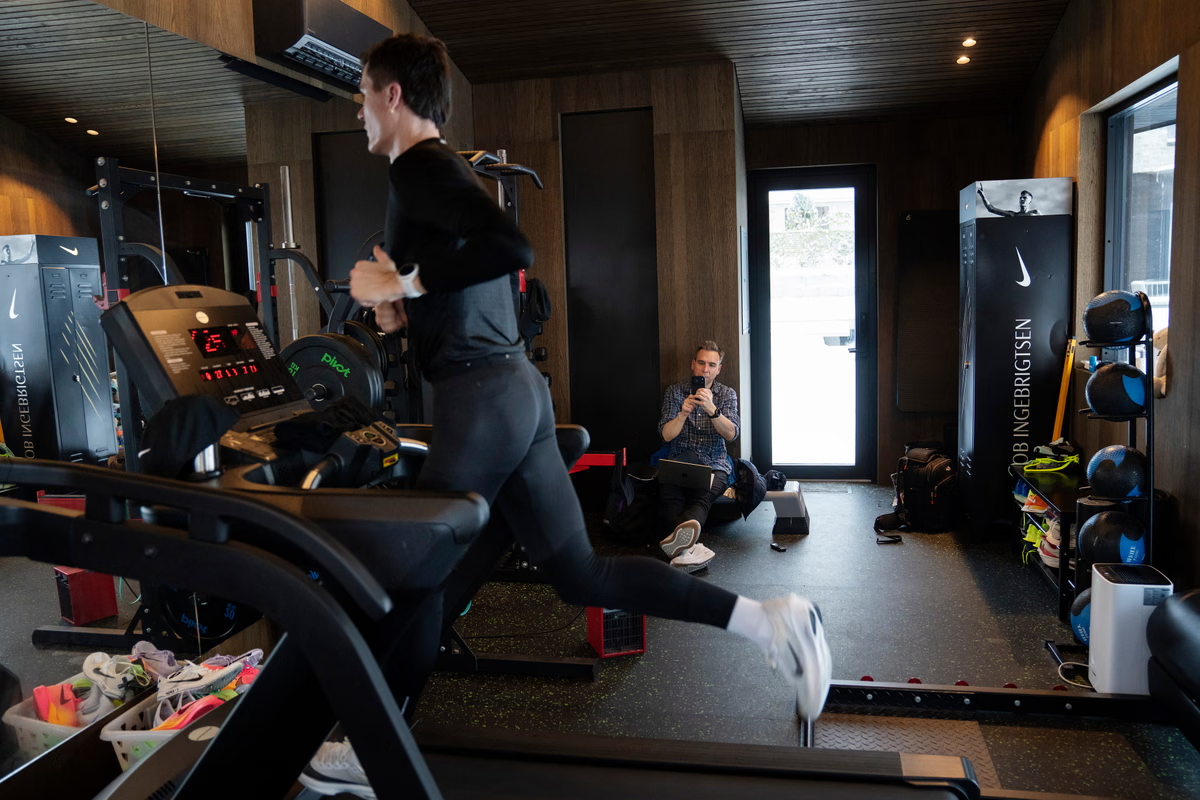
Jakob Ingebrigtsen has cemented his status as one of the world’s most formidable athletes. In recent weeks, the 26-year-old added a European 5,000m gold, a World Ultimate 5,000m title, and a world road silver medal to his collection, all while overcoming February achilles surgery and a lingering flu that persisted through May and June. During a quiet morning in January, the runner shared the meticulous training principles that underpin his success.
First, Ingebrigtsen believes that achieving peak performance requires being a total control freak. Running between 175km and 180km in a typical week, his life is entirely focused on his family and his sport. He adheres to a strict priority list: waking up, eating, and training. He admits this lifestyle is not for everyone, noting that he handles responsibilities others could not, always ensuring that nothing is left to chance because if something is out of his control, he considers his job unfinished.
Second, he maintains a strict policy of no days off. He argues that missing a day results in losing 20-25km of training volume, and he even continues to run when feeling moderately ill. He believes taking time off due to sickness or travel disrupts the body’s consistent load, increasing the risk of injury when training resumes because the body has lost its adaptation to the impact.
Third, consistency is his guiding principle. His schedule includes twice-daily runs, Saturday hill work, and a 20km Sunday run, supplemented by mobility drills and core work on Mondays and Wednesdays, plus weights on Fridays and Sundays. He emphasizes that this methodical approach, combined with a gradual increase in load, is a lesson that amateur runners should adopt.
Fourth, he remains committed to hard work through double threshold sessions on Tuesdays and Thursdays. These workouts target fatigue without reaching brutal exhaustion, such as 5×6 minutes with one-minute recovery intervals in the morning, or 25 circuits of a 400m track at 5km-10km pace with 30 seconds of recovery in the afternoon. By spreading volume across more sessions, he avoids the physical spikes that lead to injury.
Fifth, he does not take breaks even on holidays; last Christmas, he completed two runs totaling 22km, jokingly noting he only had to monitor his digestion after a traditional, fat-heavy Norwegian meal of pork ribs and sausages.
Sixth, Ingebrigtsen relies on treadmills year-round to maintain absolute control over variables like wind, temperature, and incline. Even during the summer, he conducts morning threshold sessions indoors, usually accompanied by a playlist featuring Green Day, Blink-182, and Black Sabbath.
Seventh, he utilizes modern, cushioned running shoes like the Nike Zoom Fly 6 to support recovery. By reducing impact, he can train at higher volumes while maintaining 95% fatigue levels, allowing him to repeat the cycle the following week with consistent quality and added intensity.
Eighth, he dismisses traditional trail or cross-country running. He argues that training in mud or on uneven surfaces is a pointless, unnecessary risk to his ankles that offers no practical benefit.
Ninth, he encourages questioning the traditional coach-athlete dynamic. Following a 2025 court case involving his father and former coach Gjert, he prefers collaborating with his brothers, Henrik and Filip. He criticizes the ‘priest-like’ relationship some runners have with coaches, warning that relying blindly on an ex-professional’s past experiences can be dangerous and stunts an athlete’s development.
Finally, Ingebrigtsen stresses the importance of self-accountability. He maintains that every athlete must build their own personal ‘toolbox’ based on their specific strengths and weaknesses, noting that taking personal responsibility is the key to both professional success and life in general. The report also notes that 1) To be the best it helps to be a control freak. The report also notes that around 175-180km in a typical week, ingebrigtsen runs a lot. The report also notes that that is his sole focus. “I prioritise the absolute crucial,” he says. “That is to wake up, to eat, to train, apart from his family. The report also notes that o n a snowy Norwegian morning in January, Jakob Ingebrigtsen was on his treadmill, shooting the breeze about his running philosophy before our more formal interview. The report also notes that so now seems as good a time as any. The report also notes that some of Ingebrigtsen’s opinions were a little hardcore.





Comments