

As UAE organizations look toward 2027 following a period of significant regional uncertainty and economic fluctuation, shifting talent strategies have become essential. Business leaders are being advised to look beyond standard compensation and perks, placing greater focus on job security, employee wellbeing, career growth, and workplace flexibility to remain competitive. 46 flights delayed, cancelled across UAE airports amid travel disruptions. Reopen Hormuz within a week, iran sends latest proposal to US to end war. Dubai firm ‘open as normal’ after owner detained in Kerala over alleged job fraud. Stay up to date with the latest news.
Nishant Mahajan, a partner at Marsh Middle East and Africa, emphasizes that the most successful firms will be those that prioritize transparent communication and support their workforce through this period of structural change. Rather than solely increasing headcount, companies are increasingly focused on redesigning roles, redeploying existing talent, and utilizing technology to build greater organizational resilience. “ Clear communication and an honest attempt to bring your employees with you on this change journey, will play a significant part in separating the winners from the losers in the medium-term,” Mahajan said.
This shift is driven by persistent pressures, including talent scarcity and the rapid adoption of artificial intelligence. Marsh’s Global Talent Trends 2026 research indicates that 62 percent of Middle East business leaders view talent scarcity as a significant concern. Furthermore, 64 percent of regional employees expressed a willingness to trade a 10 percent pay increase for opportunities to develop digital and AI-related skills. Compared with 54 per cent globally, marsh’s Global Talent Trends 2026 research found that 62 per cent of Middle East business leaders cited talent scarcity as a concern.
While the market has stabilized from earlier volatility in 2026, hiring remains highly selective. Companies are focusing more on specific capabilities rather than broad expansion, meaning that even in a cautious hiring environment, competition for specialized talent remains intense. This strategy increasingly relies on internal reskilling and the strategic deployment of existing personnel.
AI Integration and Workforce Transformation
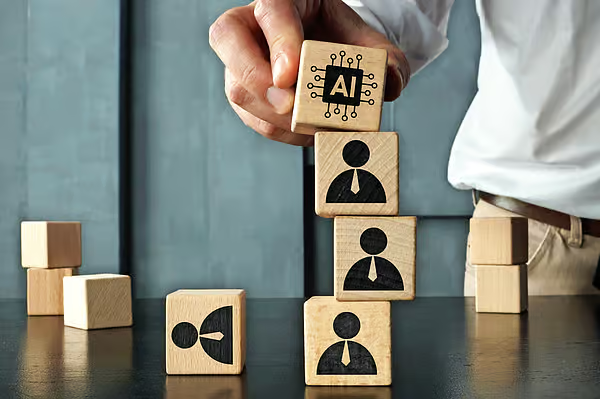
Artificial intelligence is a primary catalyst for this transformation, with 83 percent of employees noting that AI enhances their productivity and 74 percent anticipating it will improve their overall job quality. However, nearly 43 percent of workers have expressed concerns regarding potential job losses. Organizations are now moving to categorize workflows based on which tasks require human judgment and which can be automated or AI-assisted
- Customer Service: AI can manage initial triaging, summarize histories, and draft potential responses, allowing human staff to concentrate on relationship management and complex problem-solving.
- Finance: Routine tasks like reporting, analysis, and reconciliation are increasingly automated, freeing professionals to focus on strategic decision support and scenario planning.
- HR: AI platforms are being utilized for workforce analytics and administrative processes, while managers retain control over sensitive talent decisions and capability mapping.
Mahajan notes that the ideal 2027 employee profile blends specialized expertise with AI fluency and human judgment. As these technologies evolve, they create new operational responsibilities, including the need for robust risk management, governance, and the validation of AI-generated outputs.
Ultimately, the objective for employers is to integrate AI as a cross-functional capability rather than a niche technical skill. By balancing technological efficiency with a commitment to the employee experience, firms are better positioned to navigate the evolving demands of the UAE job market through 2027.






Comments