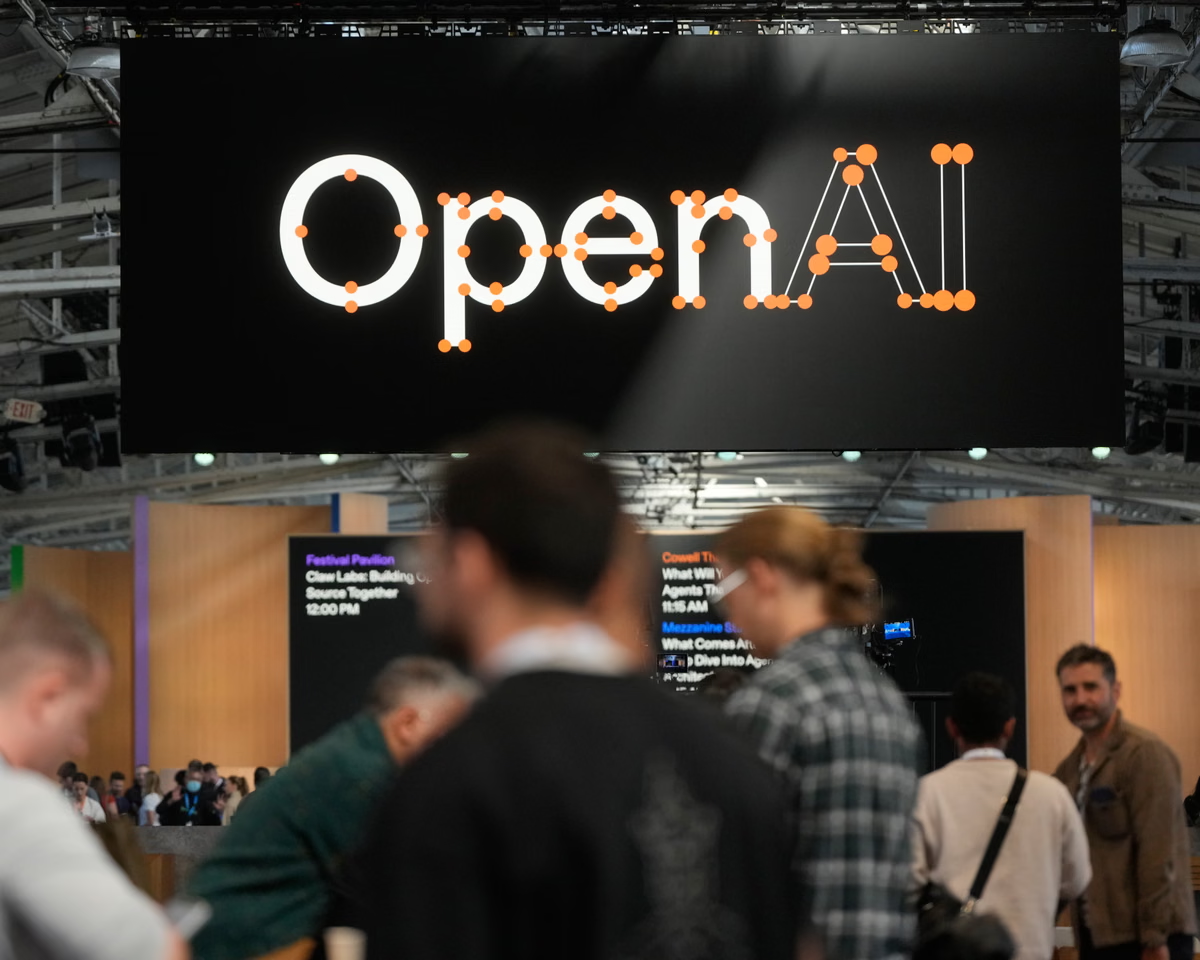
OpenAI has informed investors of a significant revision to its financial outlook, projecting this year’s revenue to hit $50 billion rather than the $70 billion previously signaled. This $20 billion discrepancy has triggered fresh questions regarding the sustainability of the rapid demand growth for artificial intelligence. A projection based on sales up to the end of September, the ChatGPT-maker company has told investors that its revenues for this year would reach $50bn (£37bn).
Market reaction was immediate, as the news weighed heavily on US tech stocks on Thursday. The Nasdaq index closed 1.4% lower, while major chip and infrastructure players saw notable declines; Nvidia shares dropped 2.9%, Oracle fell 5.5%, and Micron dipped 4.8%.
The shift in figures stems from efforts to align OpenAI’s reporting metrics with those of its rival, Anthropic. While Anthropic, the developer of Claude, reached $65 billion in forecast revenue by July, its accounting includes sales funneled through cloud partners like Amazon’s AWS and Google Cloud. OpenAI previously excluded such figures from its own projections.
Despite the forecast gap, OpenAI continues to pursue a significant funding round, currently in early-stage discussions to raise $30 billion at a valuation of approximately $1.4 trillion. This follows a major $122 billion financing round in March that valued the firm at $852 billion.
Anthropic, which raised $65 billion two months after OpenAI’s spring round to reach a $965 billion valuation, is reportedly preparing for an initial public offering as early as next month. These annual revenue forecasts remain a critical indicator for investors evaluating the overall health of the AI sector. However, this is significantly less than the $70bn that it had signalled in information provided to investors last month, which was widely reported.
Meanwhile, leadership at OpenAI remains cautious regarding a public listing. Chief Executive Sam Altman stated last month that the company would not go public this year, citing lingering safety concerns. This decision arrives amid heightened public discourse surrounding rogue AI agents and the resignation of researchers concerned about the technology’s risks.
Legislative pressure is also mounting, with lawmakers from both major US parties seeking to implement new governance for AI systems. This push follows stark warnings from Anthropic researchers, who cautioned that unconstrained development could potentially threaten human existence. After two researchers from Anthropic warned that the lightning pace of development of AI without safeguards could lead to the extinction of the human race, democrat and Republican politicians are calling for new rules to govern AI systems.
Broader investment into the sector remains aggressive, led by figures like SoftBank founder Masayoshi Son. Reports indicate that Son is seeking up to $100 billion from Gulf states to scale his AI holdings. SoftBank, which has previously invested $65 billion into OpenAI, has engaged in talks with investors in the United Arab Emirates.
To fuel these massive bets on semiconductor and AI assets, SoftBank recently completed the largest high-yield corporate bond sale on record, raising $11.1 billion with yields reaching 9.75%.