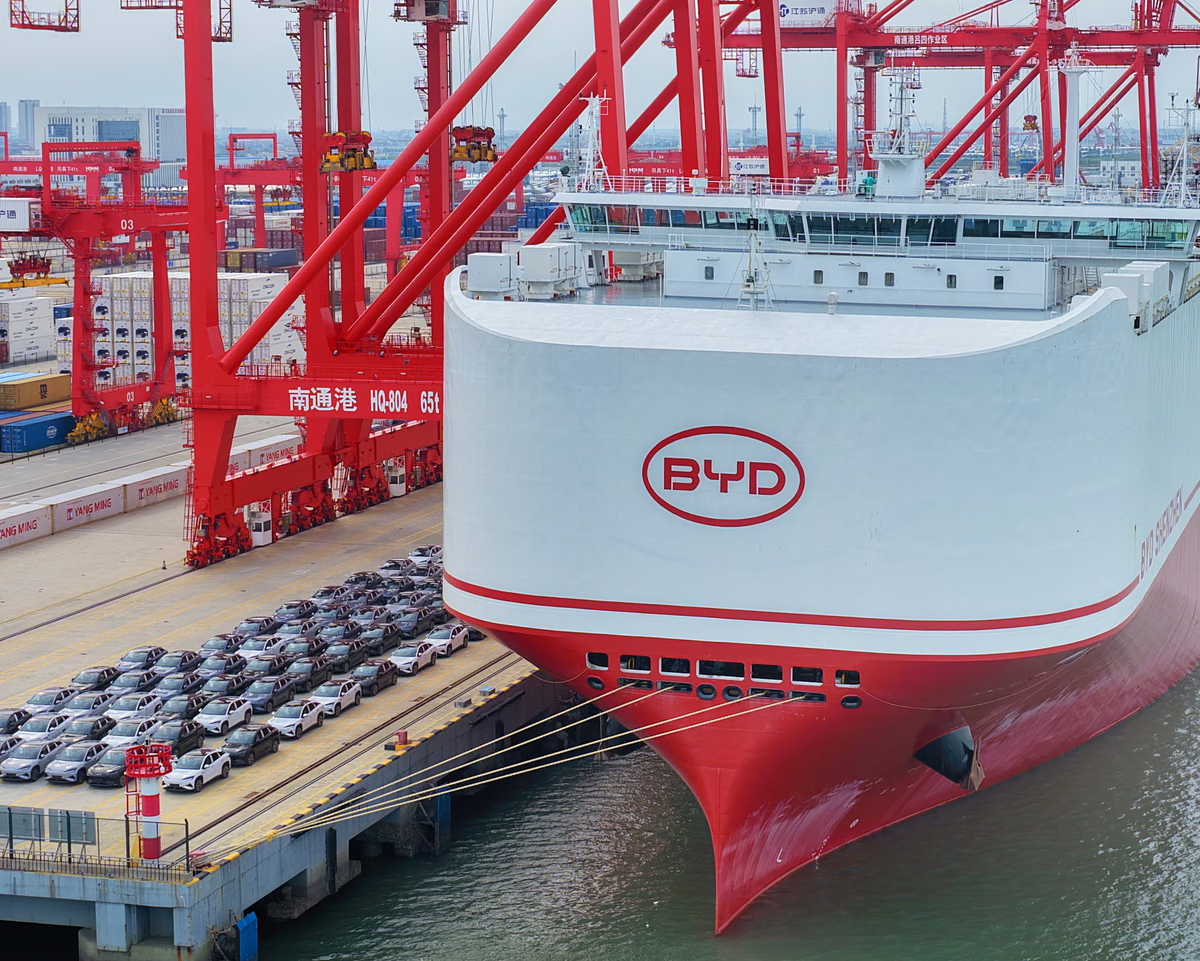
The European Union has secured a significant agreement with China to reduce the volume of hybrid car exports into the bloc by roughly half. This move comes as Brussels seeks to mitigate the impact of surging imports that European officials fear could undermine the domestic automotive industry and lead to widespread job losses. According to the EU, It has reached a landmark deal with China to “halve” its sales of hybrid cars in the bloc amid fears surging sales could kill off parts of the European car industry.
Trade commissioner Maroš Šefčovič, who led intense negotiations in Beijing since June, stated the arrangement serves as a crucial pilot scheme. By addressing a daily trade deficit of €1.18bn, the deal aims to prevent a full-scale trade war. Šefčovič noted that the agreement is unprecedented because China has agreed to moderate exports without the typical preceding trade tensions or lengthy investigations usually required under World Trade Organization (WTO) rules. “It is the first time that China has accepted to moderate its exports without going through the phase of prior trade tension,” he said, a reference to the usual investigations that must take place before safeguards under WTO trading rules are put in place.
The agreement is expected to result in a reduction of several million plug-in and battery-powered hybrid vehicles entering the European market over the next four years. While hybrids, which integrate internal combustion engines with batteries, are currently viewed as a transition technology toward full battery electric vehicles, their rapid influx has faced growing political pushback from EU member states concerned about manufacturing stability.
Addressing reporters in Beijing, Šefčovič emphasized that the Chinese authorities recognized the mounting political pressure across Europe, where thousands of jobs in sectors such as chemicals, textiles, and automotive manufacturing are currently at risk. He stated that the outcome proves the effectiveness of negotiated solutions when both parties acknowledge the necessity of stable trade relations. “I am glad to say that the Chinese partners appreciated this very strong political argument, and therefore, we can proceed through the negotiated solution,” he said.
The broader 16-point pact includes provisions for ongoing discussions regarding vehicle commerce, restrictions on the export of critical rare earth elements, and increased market access for European food and beverage producers. Specifically, the Chinese ministry of commerce signaled a willingness to streamline export licenses for rare earths and permanent magnets required by European industries. According to he, EU leaders were “clearly expecting very fast action” from the European Commission and the Chinese recognised that.
To manage the flow of hybrid cars, both sides have committed to procedures involving company price undertakings, a mechanism that will likely involve establishing higher minimum price points for Chinese-made vehicles sold within the European Union. This serves as a primary method to curb volume without imposing immediate, harsh tariffs. They are sold by carmakers as a transitional step towards BEVs.
While acknowledging persistent differences between the two economic powers, the agreement marks a shift toward a new model for balancing bilateral trade. Šefčovič plans to present the details of the agreement to EU diplomats this Sunday, ahead of a high-level leaders’ summit scheduled for next Thursday.
This framework is viewed as a foundational step for future trade relations. EU officials expressed optimism that this proof of concept could eventually be expanded to address other industrial areas currently facing intense competition from Chinese imports.