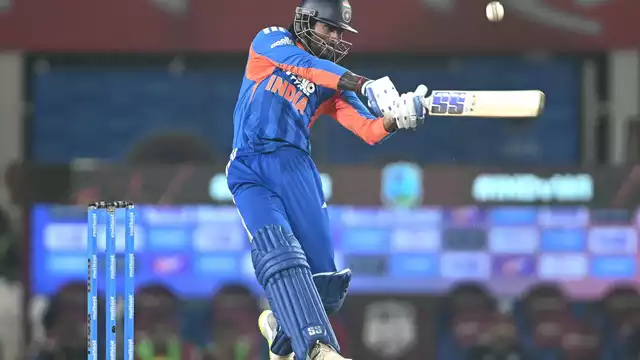
Tilak Varma has demonstrated his versatility throughout his short T20I career, showcasing an ability to adapt to varying tactical needs. While he established himself as a powerhouse at No. 3, scoring 651 runs at a strike-rate of nearly 151—including consecutive centuries of 107* at Centurion and 120* at Johannesburg in November 2024—he has since transitioned into a more fluid role within the squad. And they made the No, those hundreds came in successive innings: 107* at Centurion and 120* at Johannesburg in November 2024.
The shift became evident during the 2026 T20 World Cup. After a loss to South Africa prompted a lineup reshuffle for the must-win match against Zimbabwe, Varma was moved to No. 6, where he delivered a quick-fire 44* off 16 balls. Since that adjustment, he has only batted at No. 3 on one occasion, though he maintains he still loves to bat there.
Speaking ahead of the fourth T20I in his hometown of Hyderabad, Varma explained the tactical shift. He noted that while the top order enjoys the freedom of batting with fewer fielders outside the circle, the middle-order positions of No. 4 and No. 5 carry different pressures. He now views himself as a utility player capable of anchoring if early wickets fall—specifically targeting the middle phase of overs 5, 6, and 7—or accelerating from the first ball if the top order bats deep into the 14th or 15th over. As an anchor, he has soaked up early wickets and taken the game deep, most famously in the Asia Cup final against Pakistan. According to 3. “I have, Many times,” he quickly added at the press conference in Hyderabad, his home ground and the venue for the fourth T20I against West Indies. With only two or three overs left, sometimes you know you will have to hit from the first ball.
The 22-year-old emphasized that mental strength is the core component of this adaptability. “If the team needs it, I want to step up for that role,” Varma stated. “I have been practising for that, especially the mindset. It is really important to play both games. When the team is under pressure, you should take it deep. And when the team needs it from the first ball, you should go. For that, I am really ready.” Especially with so much competition for the top four spots that even Vaibhav Sooryavanshi can’t find a place, he doesn’t “want to disturb” any role. So you can swing freely, and you don’t have any expectations.
Taking on the vice-captaincy for this series adds another layer of responsibility, one he finds both challenging and rewarding. “It is a really proud moment that I am leading the Indian side as vice-captain and playing in front of the Hyderabad crowd,” he said, describing the upcoming match as a special milestone in his career.
Addressing questions regarding his recent unconventional run-out in Indore, Varma clarified the confusion between him and batting partner Axar Patel. The pair stopped mid-run, wrongly assuming the ball had reached the boundary after noticing a flash from the digital hoardings. “I saw a flash and personally felt that the fielder touched the hoarding with his hand while flicking the ball in,” Varma explained, noting that the team was shouting to continue running, but the messages were missed in the heat of the moment.
Ultimately, Varma remains focused on the team’s requirements rather than personal accolades or preferred positions. He stressed that success is built on self-confidence and the ability to win games from any situation. “Whatever position I go in at, I just see how I can win it for the team from there,” he added. “Since childhood, my coach has taught me that whatever the role, whatever situation you are in, if you win the game for the team, it’s a different kind of fun.”