Filmmaking duo Alex Huston Fischer and Eleanor Wilson have returned with “Wicker,” a darkly comedic and provocative medieval fable. Their latest project follows their well-received 2020 science fiction comedy debut, “Save Yourselves!,” and draws its inspiration from “The Wicker Husband,” a 2008 satirical short story by Ursula Wills.
The narrative opens with introductory musings from the Basket Weaver, played by Peter Dinklage. He recounts a parable about a fish that mistook its own ice reflection for another fish, tried to mate with it, and died. This eccentric story sets a clear, absurd tone before introducing the central character: a lonely Fisherwoman who, weighed down by the distinct odor of her trade, feels that love is more of a burden than a prize following a local village wedding. According to “Then,”, The Basket Weaver in this little serving of narration, “it tried to (expletive) itself and died. It’s certainly a tone-setter, if not a road map for the story to unfold. It will have great ramifications for the once-happy couple at the centre of this narrative, and regardless of whether that outside-the-box offer is accepted by the village newcomer.
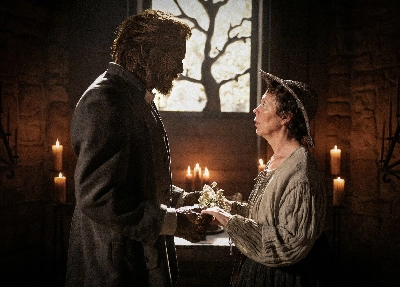
Seeking companionship, the Fisherwoman travels to the Basket Weaver’s secluded home and asks him to construct a spouse for her out of craftable, highly flammable materials. The artisan agrees, and the newly fashioned Wicker Husband awkwardly makes his way to the local church the following morning to meet his waiting bride.
As time passes, the Fisherwoman develops a deep bond with her woven spouse, triggering intense envy throughout the medieval village. Among those troubled by the union are the gossipy Tailor’s Wife, played by Elizabeth Debicki, who harbors growing frustration toward her husband, the Tailor, portrayed by Nabhaan Rizwan. The relationship also sparks marital friction between the local Baker, played by Ben Ashenden, and the Baker’s Wife, played by Ella Bruccoleri. While drinking near the Innkeeper, played by Kiell Smith-Bynoe, the Baker presents the Wicker Husband with an unconventional proposition that carries significant consequences for the central couple.
The lead cast delivers standout performances that anchor the production. Olivia Colman balances strength and vulnerability as the Fisherwoman, demonstrating her signature consistency. Opposite her, Alexander Skarsgård portrays the Wicker Husband as steady and sturdy without coming across as robotic, capturing the character’s emerging thoughtfulness as he learns about his surroundings. His distinctive appearance is further elevated by impressive prosthetics and costume work. Colman (“The Favourite,” “The Lost Daughter”) is about as consistent a performer as you’ll find, and she brings a mix of strength and vulnerability to the Fisherwoman. Meanwhile, manages to be sturdy and steady but somehow not robotic as the Wicker Husband, who proves to be increasingly thoughtful as he soaks up the new world around himself. (And, yes, the c, skarsgård (“The Northman”). You may find yourself involuntarily smiling several times throughout the course of “Wicker,” a delightfully dark, often humorous and, well, downright horny fable about a man who’s seemingly such a good husband that it causes problems for an entire community. Of course, the efforts are aided by all the top-tier onscreen talent here.
Supporting cast members make strong impressions despite limited screen time. Peter Dinklage brings a noticeable presence when he reappears during the film’s climax, leaving viewers wishing for earlier scenes. Similarly, Richard E. Grant offers an entertaining turn as the village’s incompetent long-time doctor, who is also the father of the Tailor’s Wife. You can’t help but wish Fischer and Wilson had found a bit more screen time for Dinklage (“Game of Thrones,” “The Station Agent”), who isn’t seen much until the film’s climactic stretch.
Guided by Fischer and Wilson’s clever screenplay and lively direction, “Wicker” echoes classic artificial-life narratives ranging from the Pygmalion myth to “The Adventures of Pinocchio.” The film successfully explores human nature with flair, humor, and a subtle touch of fire.