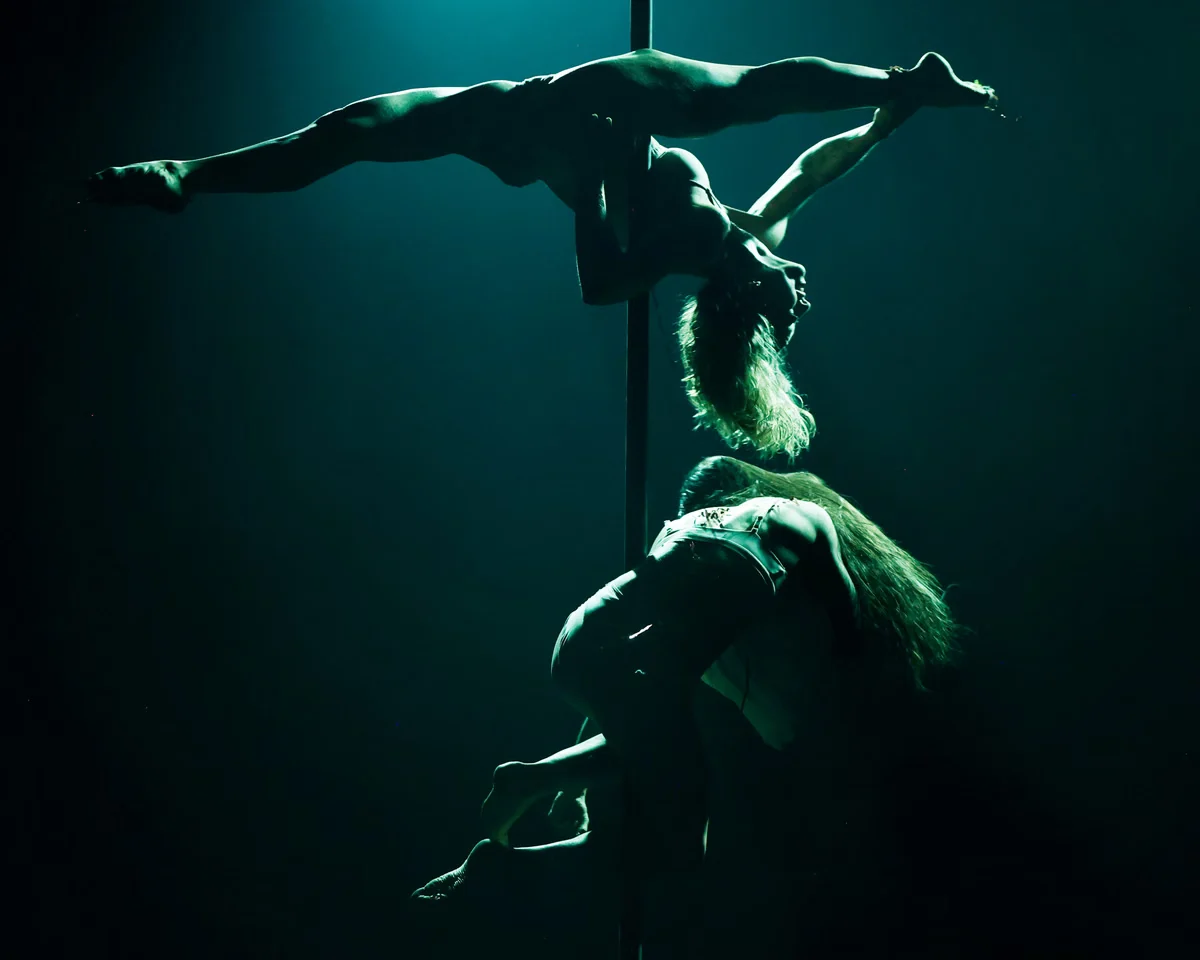
When visitors to the Edinburgh Fringe inquire about pole dancing, they are often directed toward the city’s strip clubs in the so-called “Pubic Triangle.” However, this year’s festival highlights a significant shift: pole dance is increasingly being presented as a sophisticated, physically demanding, and narrative-driven art form. Since the 1990s—when television presenter Zoe Ball famously kept a pole in her living room—the discipline has evolved from cabaret stages into dance studios and competitive arenas, with ongoing campaigns to secure its inclusion in the Olympic Games.
Gina Alm, who discovered pole dancing through a YouTube video at age 15, describes the experience as deeply moving. After receiving a pink aluminium pole for her 16th birthday, she pursued the sport as a lifelong athlete. “It’s a visually stunning thing,” Alm explains, noting that the physical exertion and exhaustion are central to its appeal. She emphasizes that the medium contains multitudes, serving as a platform for both athletic feats and complex dance theatre.
At this year’s Fringe, Alm is performingDusk/Night/Dawnalongside US national pole art champion Donna Carnow. Their performance features a hanging pole that swings five meters above the stage, though Carnow has performed as high as 15 meters in other productions. The physical toll is immense; Carnow notes that while the work is joyful, it is taxing on the nervous system to be suspended by only a few skin cells. Despite the grueling nature of the work, which often involves performing under precarious conditions for as little as $250, the duo remains committed to exploring the labor and reality of a dancer’s life.
Yvonne Smink, a former climber who transitioned into pole dancing, views the discipline as a form of movement therapy. A multiple-time Dutch champion, Smink describes the experience as a way to silence her thoughts and sync with the music. Her showPolesutilizes a custom-built frame with vertical, horizontal, and diagonal bars, which director Guilherme Miotto describes as a “spider”-like apparatus. Smink, who has practiced for 15 years, focuses on “instinctive performance” that allows for constant improvisation within the show’s framework.
The physical demands of the sport are evident in the “battle scars” performers carry. Smink points to calluses and skin discoloration as evidence of the friction involved in the sport. Similarly, Sadiq Ali, a “pole-trained circus go-go boy and dancer,” notes that while he began with the Chinese pole—a rubber-coated apparatus that requires full clothing to prevent friction burns—the transition to chrome poles requires bare skin for traction. Ali, who has performed in clubs from Scotland to Ibiza, now focuses on narrative-driven theatre, such as his pieceTell Mewhich explores the emotional response to a neurodiversity diagnosis.
For Ali, the pole serves as a tool to bypass intellectual narrative, allowing the audience to experience a story through the visceral physicality of the body. This sentiment is echoed by Tamsin Shasha, who is turning 60 this year and incorporates pole work into her showForgive Me. Shasha, who has a background in ancient Greek drama and shibari, views the pole as a way to reach beyond the ceiling and explore unconventional storytelling. She finds the practice to be a comprehensive full-body workout and embraces the community aspect of the sport in Brighton.
While performers like Shasha are open about the industry’s roots in the sex trade, they are also pushing back against stereotypes. Shasha notes that she still encounters skepticism, with some men dismissing her work as mere calisthenics. However, the performers remain focused on the artistic potential of the medium. As Alm and Carnow put it, their work is about navigating the “underbelly of night into the dawn,” transforming a stigmatized practice into a rigorous, high-flying discipline that continues to expand the boundaries of the stage. The report also notes that but there’s more to pole dance than that – and it’s popping up in theatre shows across the fringe this year. The report also notes that they also tell stories that range from one woman’s HIV diagnosis, to the relationship between a neurodivergent mother and son, not only do these acts show off amazing physical feats. The report also notes that it’s an impressive and fiendishly difficult art. The report also notes that you can do things that appear to defy physics. The report also notes that immediately, as an art form.”, it’s magnetic to watch and I saw a lot of potential in it. The report also notes that “I can just shut off my thinking and move with the music. The report also notes that having been in the industry a long time, it’s like time stops.” Smink calls herself a dinosaur. The report also notes that now it’s like a whole revolution happening.