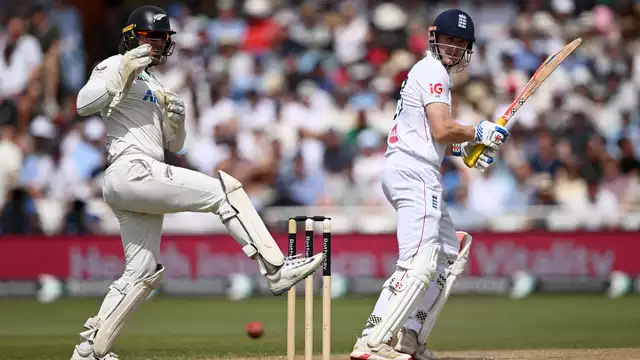
New Zealand’s recent series turnaround against England, which culminated in a 2-1 comeback victory, highlighted a significant tactical shift in how to dismantle the aggressive Bazball batting approach. After trailing 1-0 following the first Test, the Black Caps leveled the series at The Oval, where fast bowler Matt Henry claimed match figures of 11 for 109. Henry credited much of his success to wicketkeeper Tom Blundell, who stood up to the stumps for nine of his dismissals.
Reflecting on the strategy, Henry noted the necessity of having a high-caliber wicketkeeper, stating, “Having a world-class operator like Tom (Blundell) is huge, and he’s always up for it. You can’t do it unless you’ve got someone so good behind the stumps. We were just trying to keep guys in their crease for as long as we could because they wanted to walk out and get busy.” This adjustment effectively neutralized England’s tendency to advance down the pitch.
The statistical impact of this move was profound. During the series, England’s batting average against pace dropped from 25.36 when the keeper stood back to just 15.26 when the keeper moved up. Their dismissal rate also improved for New Zealand, shifting from 43.8 to 27.8. This trend is not limited to one series; since the winter Ashes, England’s average against pace has fallen from 24.48 to 19.0 whenever the keeper stands up to the stumps.
England’s batting philosophy relies heavily on manipulating the length of deliveries. By moving across their stumps, advancing, or retreating deep into the crease, their batters force bowlers to constantly adjust their line and length, turning good-length balls into half-volleys or pull opportunities. This constant movement disrupts a bowler’s rhythm and forces them to lose their discipline.
Harry Brook, in particular, has built his game around this crease manipulation. Since June 2022, he has scored 384 runs with an average of 96 and a strike rate of 184.6 while moving against pace. However, when the keeper stands up, Brook’s proactive movement nearly vanishes, with over 96% of his shots played from orthodox positions. Consequently, his average plummeted from 47.75 to 28.8, and his false-shot percentage increased, proving that the keeper’s presence effectively removes one of his primary weapons.
For years, England’s ability to dominate the 6-8 metre good-length corridor has been the engine of their success. By forcing bowlers to change their lengths, they have consistently dictated the pace of matches. However, New Zealand’s approach in the 2026 series changed this dynamic. England averaged only 16.78 against good-length deliveries during that series—their lowest return in the Bazball era—compared to 48.09 on their previous tour of New Zealand and 69.0 in Pakistan in 2024-25.
The split in performance based on the keeper’s position was stark. When the keeper stood back, England averaged 21.15 against good-length balls, but that figure dropped to 11.1 when the keeper moved up, resulting in ten wickets falling from just 272 deliveries. New Zealand did not rely on a magical delivery; they simply prevented England from manipulating the length.
Pakistan now looks to replicate this success, and in Mohammad Abbas, they possess a bowler perfectly suited to the task. Abbas is renowned for his relentless precision and his refusal to deviate from a consistent line and length. Tracking data from 29 of his 30 Test appearances shows that he lands 51.1% of his deliveries in the ideal good-line, good-length corridor, the highest proportion among all pace bowlers who have bowled at least 50 overs in those matches.
Abbas’ career statistics reflect this method, with 66 of his 118 Test wickets coming from good-length deliveries at an average of just 17.39. His effectiveness is bolstered by his experience on the English county circuit, where he has represented Hampshire, Leicestershire, Derbyshire, and Nottinghamshire. Across 80 Championship matches, he has claimed 302 wickets at an average of 20.64, including a strong performance as Nottinghamshire’s second-highest wicket-taker during their 2025 title-winning campaign.
While Abbas is approximately 7-8kph slower than a bowler like Matt Henry, his ability to sustain pressure over an entire series makes him a unique threat. The upcoming series presents a defining duel between two specialists: Harry Brook, who excels at manipulating a bowler’s length, and Mohammad Abbas, who has built a career on the refusal to miss that exact length. The report also notes that the subtle adjustment of Blundell standing up to the stumps proved pivotal. The report also notes that by the end of the match, New Zealand had levelled the contest and went on to complete a 2-1 comeback. The report also notes that during the New Zealand series, England averaged 25.36 at a strike rate of 57.78 against pace when the wicketkeeper stood back. The report also notes that that drops to 19.0, accompanied by lower strike rates, fewer boundaries and a higher dismissal frequency, with the keeper standing up. The report also notes that the sample size remains modest but substantial enough to suggest that The Oval exposed more than an isolated tactical success. The report also notes that a wicketkeeper standing up changes that equation before the ball is bowled. The report also notes that it is the one area where they have consistently separated themselves from every other Test side. The report also notes that offering the uncertainty of whether to play forward or back, conventional wisdom dictates that the 6-8 metre length is a fast bowler’s happiest hunting ground.