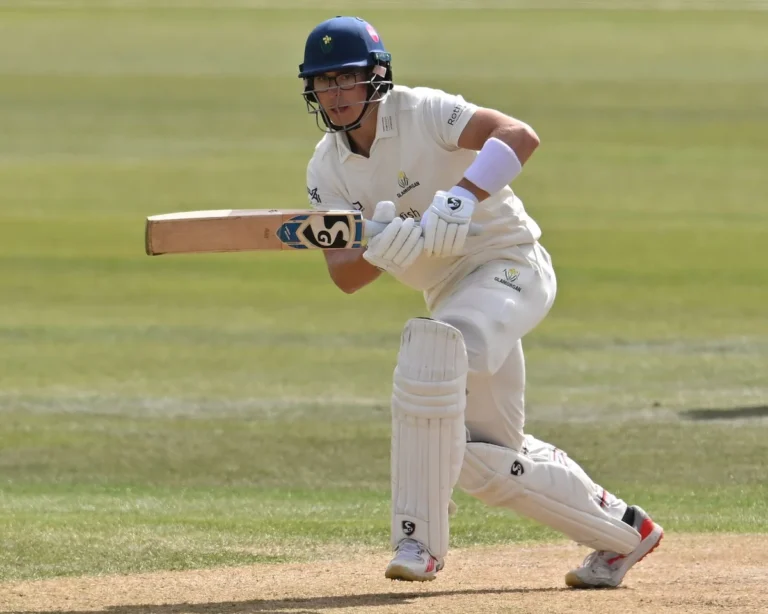
At the highest level of cricket, the contest between a bowler and a batter is fundamentally an exercise in dictating terms. A bowler possesses the ball, the field settings, and a strategic plan, while the batter has the crucial advantage of time to react. The balance of power often shifts with subtle changes: a well-timed step down the pitch, a sweep played against the turn, or a shot directed into a space the bowler believed was well-covered. Much like a chess match, each movement invites a calculated response. Inviting the batter to go down the wicket against the turn, should he wish to take it on, the mid-off fielder is usually kept inside the circle.
This dynamic defines the rivalry between New Zealand’s Daryl Mitchell and India’s wrist-spinner Kuldeep Yadav. Mitchell consistently attempts to force one of the world’s elite spinners to abandon his preferred line and length, while Kuldeep aims to bait the batter into an unforced error. Their duel is not determined by a single decisive stroke, but rather a sequence of persistent adjustments where each player tests the other’s resolve. Kuldeep’s stock ball turns into the right-hander.
Mitchell has emerged as a significant threat to India in the ODI format. He remains the only batter to score a century against India’s formidable and in-form bowling attack during their undefeated run to the 2023 World Cup final, achieving this feat in both the league match and the semifinal. Furthermore, earlier this year, his performance was instrumental in helping New Zealand secure their maiden ODI series victory in India.
A critical factor in that series was how effectively New Zealand managed the spin threat, with Mitchell playing a central role in neutralizing Kuldeep during the middle overs. Statistically, the two have faced each other nine times in ODIs, with Mitchell accumulating 184 runs at a strike rate of 111 while losing his wicket just twice. Only Shai Hope has scored more runs against Kuldeep in this format.
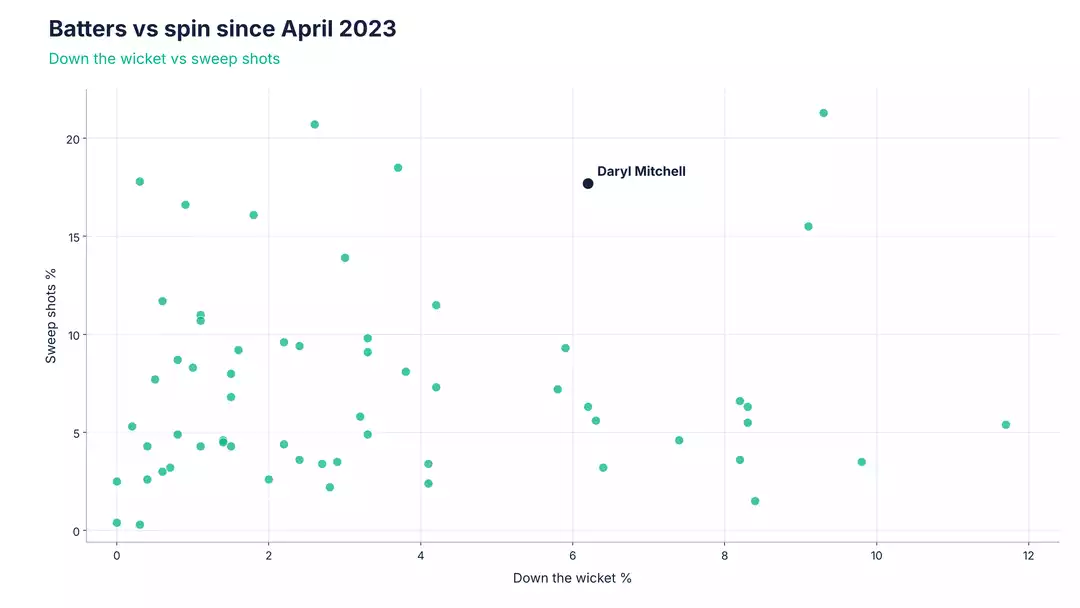
Mitchell’s dominance against spin is highlighted by his recent form. Since April 2023, a period marking his ascent in ODI cricket, 62 batters have faced at least 500 balls from spinners. None boasts a higher average than Mitchell’s 88. His strike rate of 96 ranks eighth among that cohort. Among full-member batters who strike faster, Shubman Gill is the only one whose average approaches Mitchell’s mark at 59.06. And none has faced even 60% of the volume that Mitchell has, just four batters have a higher strike rate.
His approach is two-fold: he uses his reach and footwork to hit straight down the ground, and when unable to reach the pitch, he employs the sweep to disrupt lengths. He executes the sweep on 16.7 percent of deliveries—approximately once every six balls—and charges down the wicket on 6.2 percent of deliveries. These figures are higher than those of almost all his peers, with only Tom Latham surpassing him in both metrics.
These aggressive tactics force Kuldeep to frequently alter his lengths. While batters generally charge Kuldeep on 2.6 percent of deliveries, Mitchell does so 4.5 percent of the time. This frequency increases to 5.5 percent during Kuldeep’s first spell and 4.2 percent in the second. Conversely, he rarely employs this tactic in the third spell, often after the 40th over, when boundary fielders are more readily available.
By forcing Kuldeep away from his attacking, stump-to-stump line, Mitchell’s sweeping becomes a disruptive tool. He sweeps Kuldeep on 25.1 percent of the balls he faces, compared to the 11.1 percent average for other batters. While this carries risk—Kuldeep has trapped Mitchell LBW twice by beating him in flight—the reward for Mitchell has been substantial. This time, he found conditions that allowed him to take away Mitchell’s preferred method of disruption.
His footwork patterns reveal a calculated game plan. Mitchell attacks 70.7 percent of deliveries played off the front foot, including those involving charging the bowler, while limiting his back-foot play to 30.3 percent. When forced onto the back foot, 64.2 percent of his shots are used for strike rotation rather than aggression. Against just 5.3 per cent off the back, the false-shot percentages underline the difference: 16.8 per cent off the front foot.
The rivalry intensified in Dharamsala during the 2023 World Cup. Mitchell targeted Kuldeep early in his first spell, knowing India lacked a sixth bowling option. By using his long reach to strike down the ground, Mitchell forced Kuldeep to abandon his rhythm, leading to faster darts on the leg stump and wide googlies. Although Kuldeep conceded 48 runs in his first five overs, he returned later to bowl wider, ultimately taking 2/25. Despite this, Mitchell scored 43 runs off 28 balls against him—a figure rarely conceded by the spinner in an entire innings. With Mitchell facing 17 of those balls, kuldeep conceded 0/48 in his first five overs. Before he had fully settled, making him slightly less judicious than usual, mitchell had to face Kuldeep earlier in his innings in both games. Allowing Kuldeep to stick to his lengths without offering the batter pace in the air to work with, mitchell’s customary ploy of using his feet early in a spell became less likely. Across 32 balls in the two games, Mitchell managed just 16 runs off Kuldeep, without a boundary. In the first ODI in Vadodara, Mitchell largely sat on Kuldeep as wickets fell around him, scoring 15 at a run a ball. As he did against Will Young for most of the match, he often begins with three boundary riders on the leg side and a sweeper on the offside to cover the googly. Deep square-leg came in and a sweeper moved squarer to backward point. The head-to-head score read 32 balls, 50 runs, four fours and a six – the most anyone had scored off Kuldeep in an ODI, surpassing Mitchell’s own effort at Dharamsala. With 15 balls to spare; Kuldeep recorded his third-most expensive figures, his unbeaten 131 took New Zealand to a seven-wicket win. Mitchell made a career best 137 as New Zealand wrapped up the series 2-1. Since April 2023, Mitchell has scored at a strike rate of 117 against Kuldeep in the middle overs. He has also been off the boil across formats since Mitchell’s assault in January.
The 2025 Champions Trophy in Dubai provided a contrasting challenge. On slower surfaces, Kuldeep successfully restricted Mitchell by limiting the opportunities for early aggression. However, when the two sides met in the recent three-match ODI series in India, Mitchell successfully reset the narrative. In the decisive Rajkot encounter, while chasing 285, Mitchell lofted Kuldeep for a six in his second spell and paddled a four into the fine-leg region, proving that the contest remains a living, evolving tactical battle. Whether Kuldeep can force a new response or Mitchell continues to dictate terms remains the central question of their next encounter. During a chase of 285 with the series at stake, the decisive exchange came in Rajkot. And perhaps a different challenge for both, the next chapter will bring a different set of conditions. With Hardik Pandya absent, India have often played three frontline seamers in SENA conditions in the dispensation under Gautam Gambhir, leaving Kuldeep warming the bench.