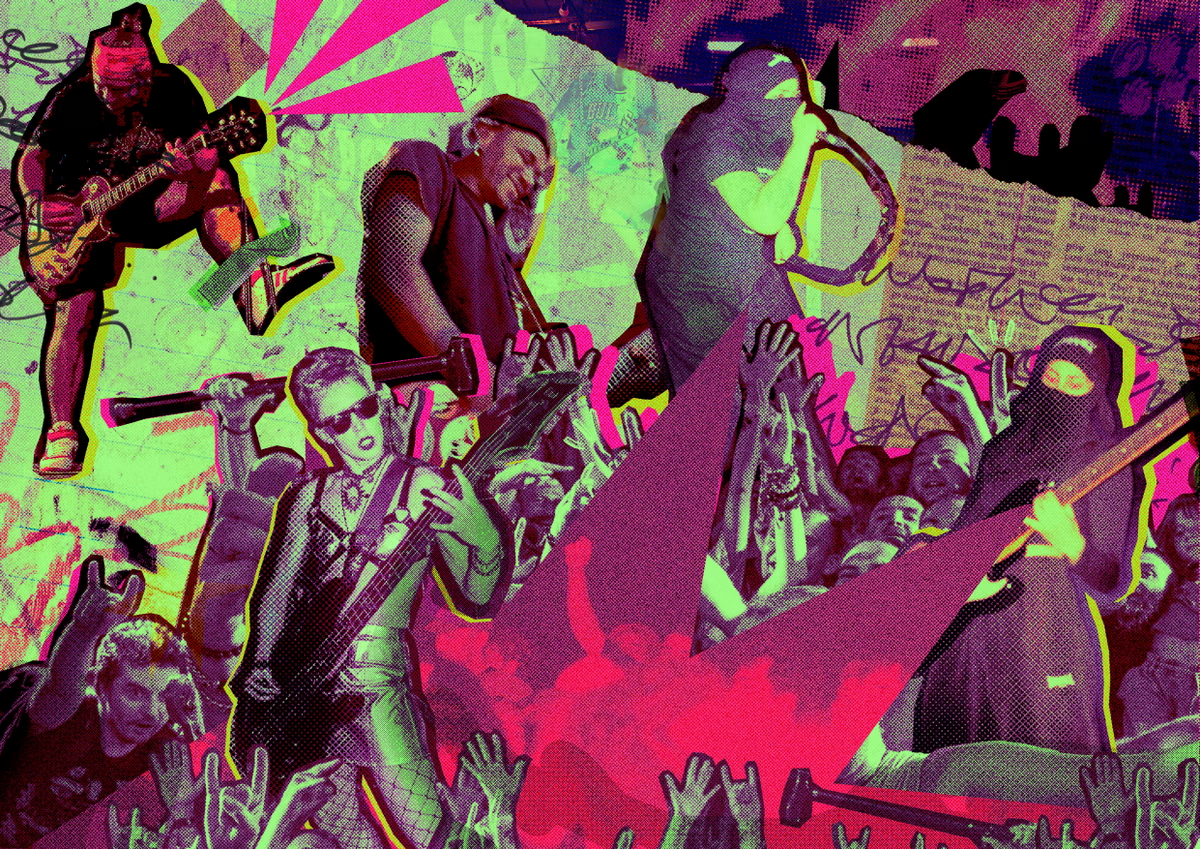
Half a century after its inception, punk rock remains a potent vehicle for dissent and personal liberation. Across diverse landscapes—from war zones in Ukraine to underground scenes in China and Greenland—artists continue to utilize the genre to navigate societal pressures, express rage, and challenge the status quo. We were attacked many times and on at least four occasions I was lucky not to die. Sometimes I need silence, although I play punk rock.
In Ukraine, Andriy Zholob of the band Beton traces his musical roots to the arrival of MTV, where he discovered the influence of Nirvana, The Offspring, and Bad Brains on the punk movement. Zholob and his drummer initially performed in a ska-punk outfit, but after their vocalist became pregnant, they formed Beton in 2017. The realities of war drastically shifted his life when he began service as a frontline surgeon in 2022. Carrying guitars to the front, Zholob played to sustain morale during harrowing experiences. Since finishing his service two years ago, he transitioned away from medicine to support veterans, who now frequently attend their shows. He describes their concerts, often featuring attendees with prosthetics slam dancing, as a manifestation of punk unity. I had guitars with me on the frontline and every evening we’d play just to relax. Slam dancing, singing along and everything, there are guys and girls with prosthetics.
For others, punk serves as a direct antidote to cultural oppression. Nao, the vocalist for Taqbir, explains that in the conservative Muslim community of Morocco, punk is often viewed with hostility. For years, she performed anonymously to avoid potential harm. Having discovered bands like Crass at age 13, she found their lyrics resonant with her own experiences of feeling stifled by religion. Performing in Madrid allowed her to shed her hijab and embrace the punk aesthetic. She describes fronting Taqbir as a vital, cathartic release of long-held rage. Morocco and Spain: ‘People would tell me: you love Satan’.
In Johannesburg, Abdula Skink of Twenty One Children highlights how punk provides a platform for the marginalized. Influenced by bands like Black Flag and Suicidal Tendencies, he notes that living in Soweto is inherently political. The band follows a strict motto of lyrical honesty. Their track Scab recounts an experience where Skink was stopped by police while skating through a historically white area; when confronted by an officer who accused him of being on drugs due to his green hair, the encounter cemented his resolve. Similarly, Aditya Naik of the Indian band Punk on Toast emphasizes the necessity of satire. Growing up on a diet of NOFX, The Clash, and the Sex Pistols, he formed his band at 17 to critique the political climate. Following the release of their song Modified, which criticized right-wing agendas, the band faced intense online harassment, including threats and attempts to dox their members. These experiences led them to participate in the recent Cockroach protests in Mumbai, which Naik describes as a transformative moment of collective hope. At one point, my commander gave me eight days off to record a battle song for our brigade and Beton did a cover of the Clash’s London Calling – Kyiv Calling – to raise money for the Ukrainian resistance.
The genre’s global reach is equally felt in Brazil, where Henrike Baliu of Blind Pigs and Armada connects the spirit of his work to the legacy of 1980s resistance against the country’s military dictatorship. Baliu’s interest was sparked by his father, a naval engineer who became obsessed with the UK punk scene in 1977 after seeing The Boomtown Rats on television. Today, Baliu continues to create bilingual music, navigating Brazil’s turbulent political landscape through song. I wanted to use punk rock to stand against evil.
In Latvia, Evisa Petrovska of Depustūtes views punk as a necessary vessel for lyrical depth. Inspired by the Ramones and the Sex Pistols, she channels her frustration into raw stage performances. Her lyrics often challenge societal expectations of women; for example, their track Mrs Pieklājība sarcastically critiques the pressure for women to remain polite and obedient. Despite the band’s longevity, Petrovska notes that audience members often struggle to perceive the depth of their female members’ contributions.
The impact of punk persists even in regions with strict censorship. Wu Wei, who founded SMZB in Wuhan in 1996, recalls the early days of receiving mixtapes containing Sex Pistols and The Clash tracks from the US. Despite having albums confiscated, performances prohibited, and contracts terminated by authorities in recent years, the band maintains a diverse, cross-generational following.
In Greenland, 38-year-old Jenseeraq Olsen of the band Uummat views punk as a lifelong identity. Inspired by the pop-punk explosion of the late 90s, particularly Blink-182, he found a sense of belonging that resonated with his own experience. Today, as a father and a youth center manager, he continues to play, noting that his 11-year-old son has also taken up the guitar, keeping the fire of the genre alive across generations.