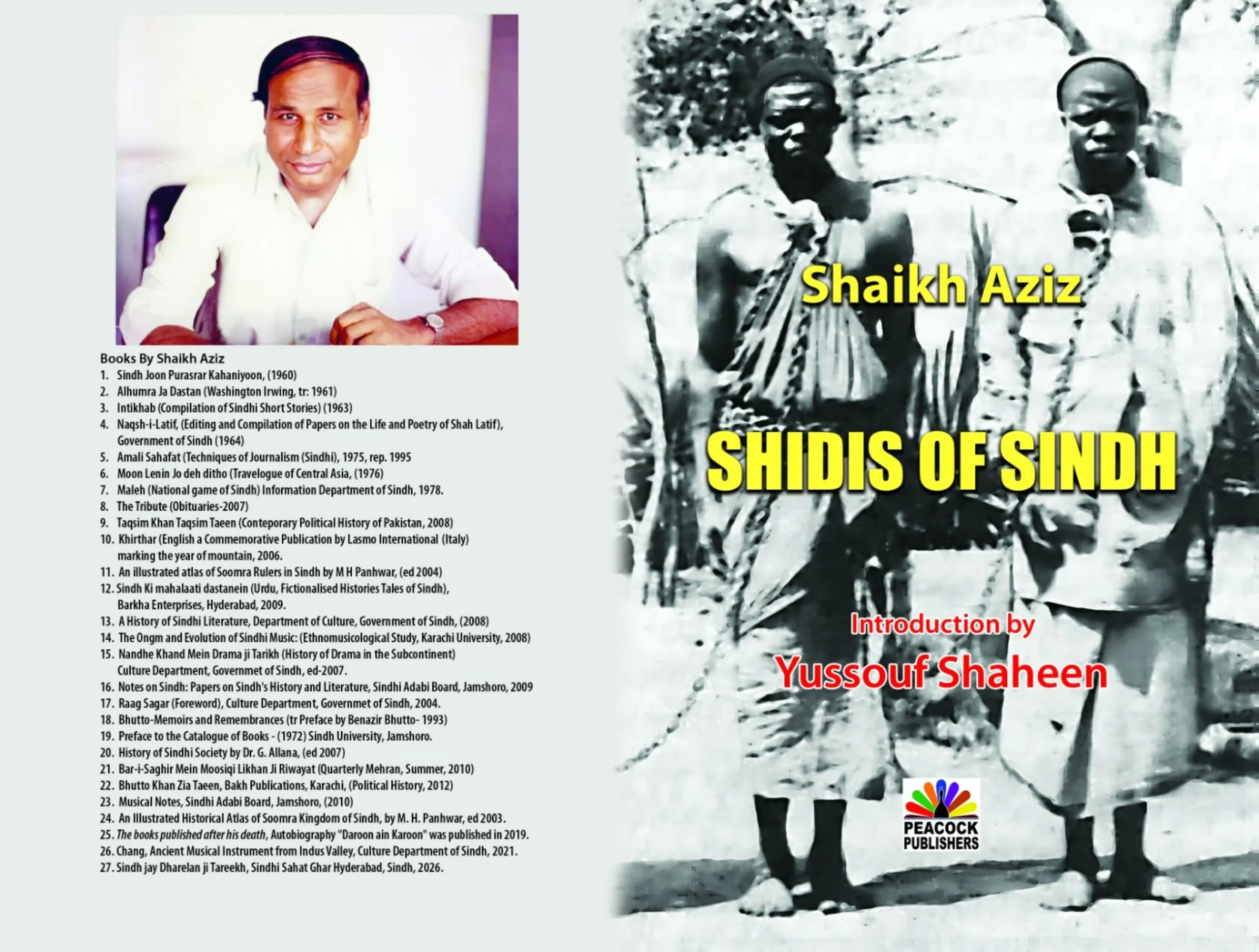
Late veteran journalist Shaikh Aziz is set to be honored with the upcoming launch of his research book, Shidis of Sindh, scheduled for October 9, 2026, at the Karachi Press Club. The work, which draws on his extensive career, examines the historical experiences of the Shidi community—the term commonly used for people with dark skin in Pakistan’s Sindh province. Aziz, who left behind a legacy of over 3,000 articles covering diverse socio-political and cultural topics, aimed to provide readers with a profound, albeit painful, exploration of human history through his research. Nabidad Khan, Senior Sub-Editor/Reporter. It is a fact that a researcher faces constant mental pressure and long hours of solitary work. Research requires deep and uninterrupted focus.
Central to his work is an analysis of global slavery, a systemic practice that endured for over 5,000 years. The historical trajectory toward abolition began in 1416 when the Republic of Ragusa in Croatia became the first European nation to prohibit the trade. This was followed by France’s emancipation efforts throughout its empire in 1794, then Denmark and Norway in 1802, and finally the United States in 1865. Aziz’s research characterizes the era of kingship and imperial rule as a period defined by the exploitation of defeated populations, wherein monarchs claiming divine rights treated human beings as mere property to bolster their wealth. History shows that the sale and purchase of human beings under the cover of ‘slavery’ continued for over 5,000 years until 1416, when a small state ‘Republic of Ragusa (Croatia)’ became the first European country to ban the slave trade. The revolutionary France abolished slavery throughout its empire in 1794, after a gap of about four hundred years.
The book also details the unique cultural heritage of the Shidi community. In Pakistan, thousands of Pakistani-Africans gather annually at the shrine of Manghopir in Karachi for the Shidi Mela. During this event, practitioners engage in rituals including drum dancing and crocodile feeding. Scholars have noted that these traditions bear a resemblance to the ancient Egyptian worship of Sobek in the 4th century BC, suggesting a possible link through historic African migration patterns.
Today, a population exceeding one million Shidis resides across Karachi, the Arabian Sea coastal belt, Balochistan, and various regions of Sindh. While the community has maintained its distinct identity, many individuals have also entered into interracial marriages, resulting in a diverse range of physical features. Members of this diaspora are also found across India, where they are identified as Sidis or Sidhis, and in parts of mainland China.
The research emphasizes how these populations, having moved through the trauma of historical enslavement, found refuge in Pakistan. This context illustrates the nation’s role in preserving their rituals and traditions within a society that allows for independent cultural and religious expression. The forthcoming book by Shaikh Aziz promises a detailed account of this journey, weaving together narratives of suffering and resilience alongside historical references to rulers and crusaders who shaped the Shidi experience over generations. Research on any historical subject or phase of human life provides valuable wisdom to present and future generations, in the literary world. Often alone, which can reduce a person’s social life, conducting research on any aspect of human life involves reading massive amounts of text and analysing data. Exhaustion, and burnout, this high mental demand can often lead to stress.