In 2021, photographer Rhiannon Adam was one of eight civilians chosen for the dearMoon Project, a free SpaceX Starship flight funded by Japanese billionaire Yusaku Maezawa. The selection process, which plucked her from obscurity, felt like an entry into an almost impossible reality; at the time, only 24 white American men had ever orbited or landed on the moon. For Adam, the mission became an all-consuming focus, dominating her professional life and personal identity as she prepared for a journey originally slated for 2023. The flight, originally scheduled for 2023, completely took over my life. For me, the story also became about being plucked from obscurity and planted in this very surreal world I could never have imagined being a part of in a million years. Being selected for something like that changes your life and your perception of your worth in the world. It took the air out of every room – I couldn’t talk about anything else. People stopped commissioning me because they assumed I was busy going to space; every conversation I had was about it. But it was made to sound like the disappointment should be only equal to finding out your favourite TV show was cancelled, we were told that they were not continuing the project. Born: Cork, Ireland, 1985 High point: Being selected for dearMoon. Going to space feels futuristic and grandiose but there are still the practical problems – like people wiping dust off their windows. I wanted to change how we collectively feel about who is selected to go to space.
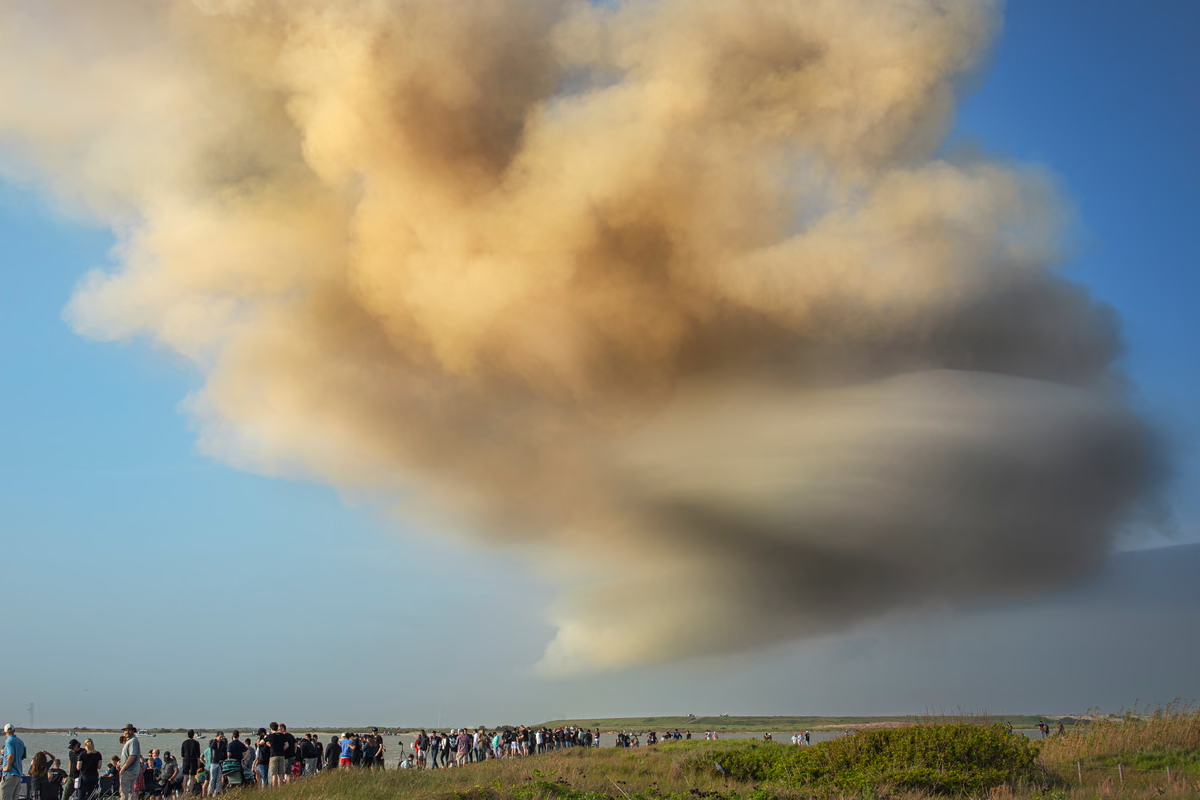
The dream began to fracture on 20 April 2023. Adam was in the VIP section of the SpaceX launch viewing area on South Padre Island, Texas, watching the Integrated Flight Test 1. While the initial liftoff appeared successful, the vehicle broke apart just four minutes into the flight, an event engineers termed a “Rapid Unscheduled Disassembly.” Witnessing the destruction of the rocket, she realized the physical risks were no longer just theoretical. The power of the engines obliterated the launchpad, sending debris into nearby houses and triggering a four-month reconstruction period for the facility. Looking out from South Padre Island, Texas, towards Boca Chica, a nature reserve near the Mexican border which is home to, t his photograph was taken on 20 April 2023 from the VIP section of SpaceX’s launch viewing area. The dust cloud in the image emerged from the concrete launchpad and tower – obliterated by the power of the raptor engines. This photograph marked the beginning of the end of dearMoon, unbeknown to me.
Though the participants maintained a brave public front, the explosion signaled deeper instability within the dearMoon initiative. Unbeknownst to the crew, faith in the project’s viability was already waning, exacerbated by Maezawa’s absence at the launch. By mid-2024, the reality of the situation became clear during a sudden Zoom call where the participants were informed the mission was canceled. For Adam, the termination felt like the loss of her entire identity, leaving her to process the sudden closure of a chapter that had defined her existence for years. Eventually, in mid-2024, we all received an email invite to a Zoom call. And so missed this launch, maezawa had gone back to Japan after the first launch attempt had been scrubbed the day before.
Reframing this experience, Adam developed her current project, “Rhi-Entry,” which serves as a modern-day tragic cycle. She views her story through the lens of Icarus, reflecting on the hubris of being blinded by a “poisoned chalice” of impossible dreams. Her exhibition at the International Centre for the Image in Dublin, running until 23 December, mixes facts with fiction to explore the structural abuses of power within the space industry. She hopes to challenge the persistent, exclusionary archetype of the space explorer—typically portrayed as a “chiselled-jaw GI Joe”—by offering her own perspective as a messy, queer woman from a sailing background. Gobby, messy queer who grew up on a sailing boat, i’m a 5ft 2in. I am Icarus, who flew too close to the sun and my wings melted. Moving through bathos, pathos and hamartia, it is both tongue-in-cheek and deadly serious. Brings together facts and fiction, a reflection on the past and my fears for the future, with my personal story as its spine, the exhibition combines the visual tropes of the space museum.
Beyond the Dublin exhibition, Adam’s work is featured in the “Space @ Fotografiska Tallinn” show through 17 January. She remains a prolific artist, with her book, “Polaroid: The Missing Manual,” published by Thames and Hudson. Reflecting on her journey, she emphasizes that success is often a matter of luck and timing, noting that her time as a dearMoon candidate offered a unique, if painful, lesson in resilience.
Looking back at her career, Adam notes that winning major accolades or facing professional upheaval is rarely predictable. She advises fellow creators to avoid counting their chickens, regardless of whether success arrives at age 20 or 85. For her, the path forward involves staying generous with time and maintaining humility, all while navigating the complex realities of an industry that treats space exploration as both a grand future and a site for intense ethical debate regarding ownership and colonization. And whichever way it happens, don’t count your chickens, remember that we’re all in the same boat; you can win the biggest award at 20 or at 85.