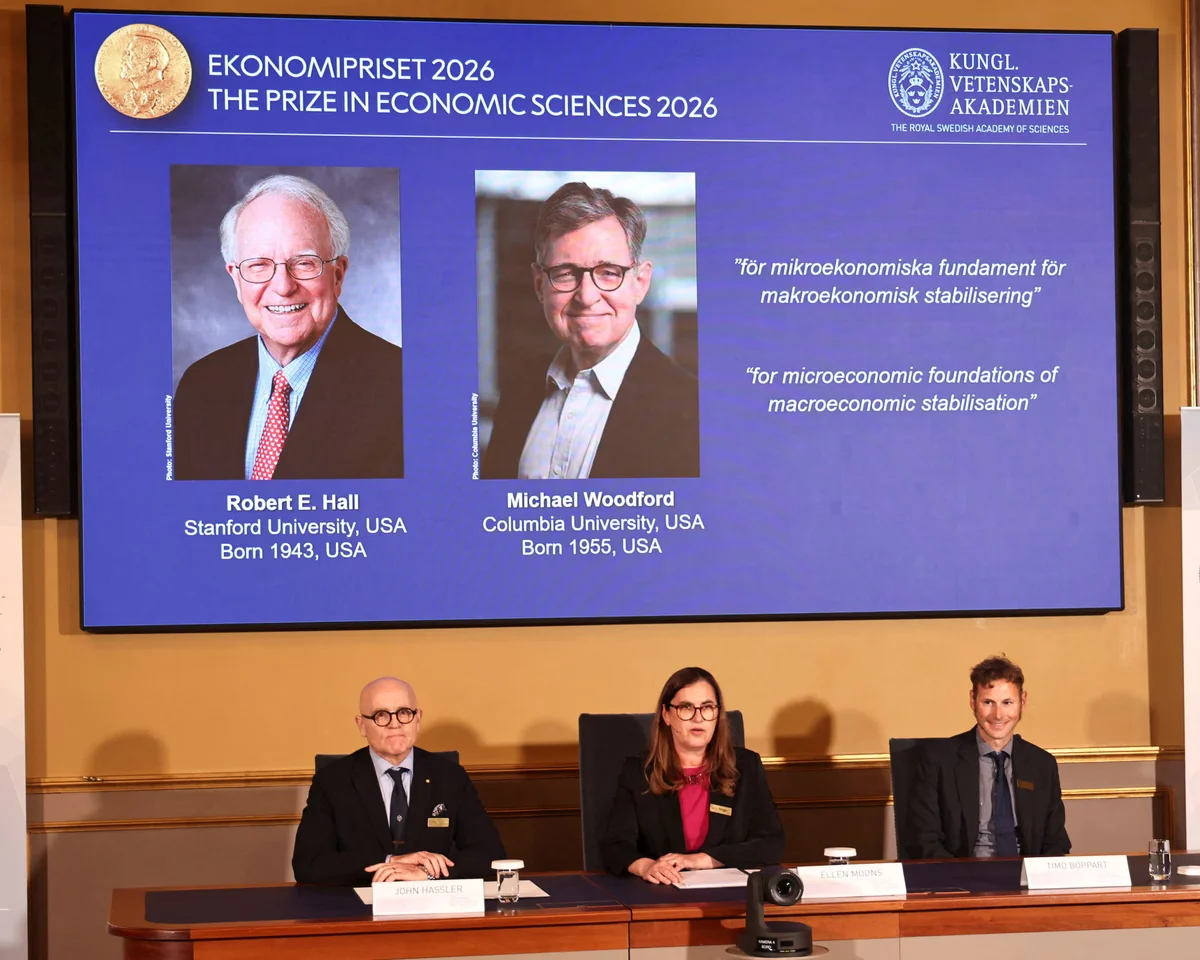
The 2026 Nobel Prize in economics has been awarded to two American researchers for their contributions to macroeconomic stabilization. Robert Hall, based at Stanford University, and Michael Woodford of Columbia University, were honored for developing the “microeconomic foundations of macroeconomic stabilisation.” Their work provides central bankers and finance ministries with the tools needed to navigate business cycles, effectively mitigating the risks of prolonged recessions and extreme inflation. A full macroeconomic stabilisation framework that is the main tool for policymakers now, woodfood built on this work to create the New Keynesian model. Believing that governments and central banks can affect demand in their economies, they tend to be Keynesians and New Keynesians.
The Royal Swedish Academy of Sciences, which bestowed the $1.2 million (£900,000) award, noted that the pair introduced a “paradigm shift in stabilisation policy.” By developing what are known as New Keynesian models, Hall and Woodford moved beyond traditional frameworks that struggled during the 1970s oil shocks, a period characterized by simultaneous high inflation and unemployment. Based on how individual households and businesses collectively affect an economy through their actions, hall and Woodford demonstrated how traditional models could be reconstructed.
These modern models improved on John Maynard Keynes’s earlier theories by grounding policy in the collective behavior of households and firms. Hall focused on forward-looking consumer patterns, while Woodford expanded these concepts into a comprehensive framework that currently serves as the primary guidance for global financial policymakers. The models proved instrumental during the 2008 financial crisis and the Covid-19 pandemic, helping officials avoid a second great depression while interest rates remained at historic lows.
John Hassler, head of the economics prize committee, stated that the laureates provided a stable theoretical basis for modern central banking. He added that these tools make governments better equipped to address economic shocks, such as energy crises or sudden shifts in consumption patterns.
A significant practical application of their research is “forward guidance,” where central banks signal their future interest rate expectations to manage economic activity. While highly influential, this practice has faced scrutiny. For instance, current US Federal Reserve chair Kevin Warsh has suggested that forward guidance should remain limited to avoid causing unnecessary ambiguity. Similarly, in 2014, former Bank of England governor Mark Carney faced criticism when his interest rate hints did not materialize, leading some to label him an “unreliable boyfriend.” Though – the current chair of the US Federal Reserve, Kevin Warsh, has argued it should only have a “limited and circumscribed” role in normal times, to avoid “creating ambiguity in the name of clarity”, forward guidance has had its critics. And in 2014, the then Bank of England governor, Mark Carney, was labelled an “unreliable boyfriend” for dropping hints over interest rate rises that never came to pass.
Reflecting on the honor, Woodford described himself as “elated” and called the recognition a tremendous surprise. Beyond his stabilization work, Hall is well-regarded for categorizing US economists into “fresh water” and “salt water” factions. Fresh water economists, typically found at inland schools near the Great Lakes like the University of Chicago, generally advocate for free markets and monetarism. In contrast, salt water economists—predominantly at coastal institutions such as MIT, Harvard, and Columbia—often align with Keynesian views on government and central bank intervention. It’s a surprise but I’m feeling very good about it,” he told reporters in Stockholm by phone after receiving the news.
The economics prize is technically the Sveriges Riksbank Prize in Economic Sciences in Memory of Alfred Nobel, as it was established by Sweden’s central bank rather than as part of Nobel’s original 1895 testament. The award remains a critical recognition of how theoretical research directly impacts global financial stability.