
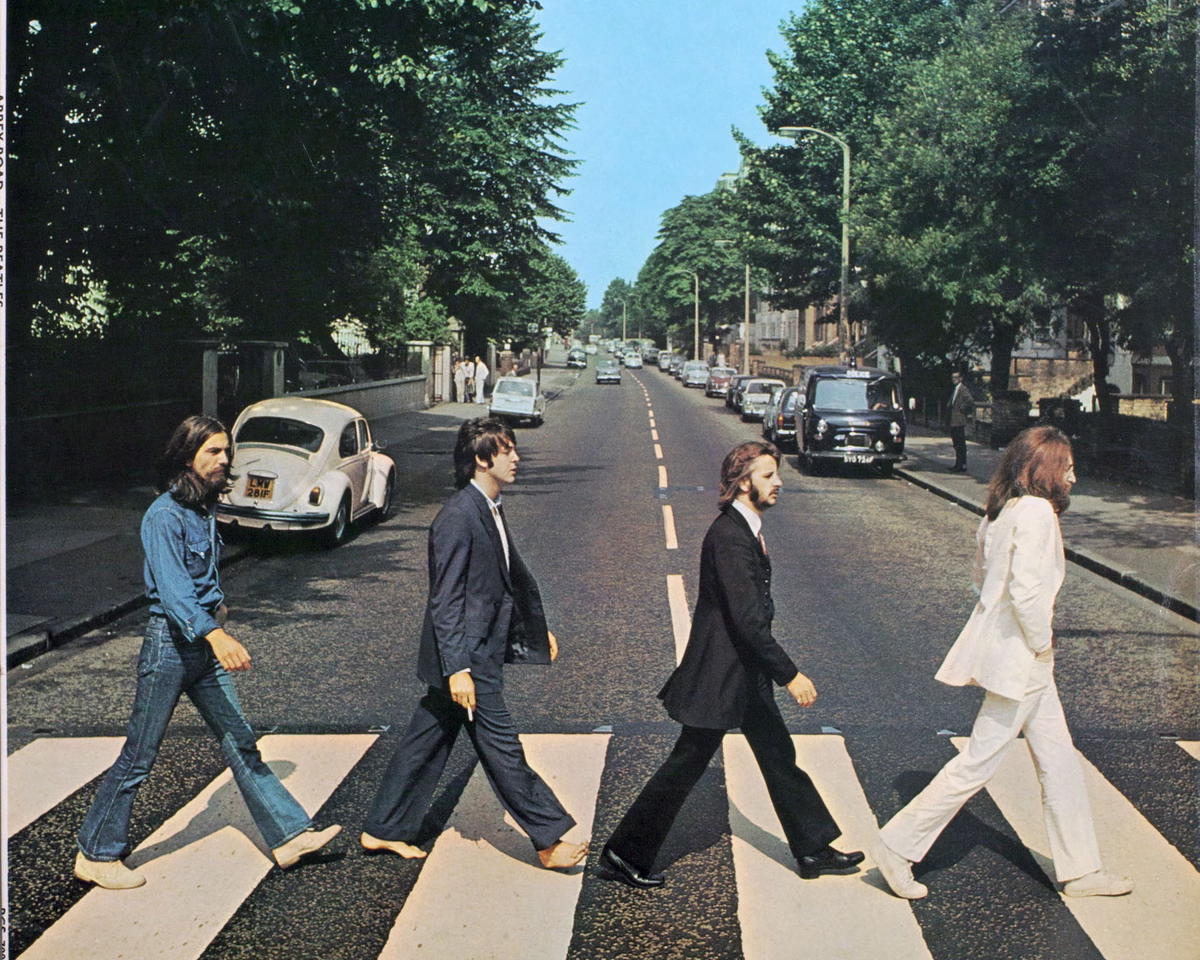
The enduring appeal of the Beatles’ Abbey Road album cover lies not just in the four men crossing the street, but in the composition of the north London landscape itself. Captured on August 8, 1969, by photographer Iain Macmillan, the image features a vanishing point that stretches toward a clear blue sky, framed by summer trees and the crisp, clean lines of the zebra crossing. The scene possesses a hyperreal quality, reminiscent of a David Hockney painting, which elevates a simple suburban street in St John’s Wood into a work of art.
By the time this photograph was taken, the band’s fame was so immense that their presence in an ordinary setting felt like a magical mystery. This fascination with the mundane was a recurring theme for the group; months earlier, in January 1969, they had performed live on the roof of Apple Corps in Savile Row, London. The Abbey Road cover further solidified this aesthetic, freezing the dynamic between the four individuals and the collective unit with an eerie, perfect precision that continues to captivate audiences today.
The image has been endlessly parodied and recreated by figures ranging from Kanye West and the Red Hot Chili Peppers to Franciscan friars and Sam Mendes, who recently utilized the iconic crossing for his series of Beatles biopics. The photograph invites endless interpretation, serving as a canvas for fans to project their own allegories. John Lennon leads the group, yet he appears distant and absorbed, perhaps signaling his desire to depart from the band—a move he would announce that September.
The photo also famously fueled the “Paul is dead” conspiracy theory. Proponents of the myth claimed that Ringo Starr, dressed in black, represented an undertaker, while George Harrison was the gravedigger. The theory was inherently flawed, however, as Paul McCartney himself was the creative force behind the image alongside Macmillan. McCartney had been collecting works by the Belgian surrealist René Magritte since 1966, and the photograph’s deadpan, haunting perspective reflects that influence.
The shoot was a deliberate piece of conceptual art rather than a spontaneous moment. After rejecting an initial plan to be photographed in Nepal, McCartney proposed the location outside the Abbey Road studios. He even drafted sketches of the band as stick figures on the crossing. On the day of the shoot, the group enlisted a police officer to halt traffic, while Macmillan captured the scene from a stepladder to achieve the desired perspective.
Ultimately, the cover serves as a celebration of a quintessentially British moment, distinct from the urban landscape of New York. As the band members walked toward their separate futures, McCartney—the most devoted believer in the group—managed to freeze them in time outside the very studios where they had spent so much of their lives. In the image, he is barefoot, perhaps suggesting he was the one least prepared to leave the place where they had created their legacy. The report also notes that the Beatles were so transcendently famous by the time Iain Macmillan took this picture on 8 August 1969 that seeing them do something as ordinary as cross the road becomes a magical mystery. The report also notes that i can picture Lennon walking away because that’s what he told the group he was going to do that September. The report also notes that with summer trees veiling in bright green what might otherwise be dour brick houses, it could be a hyperreal vista painted by David Hockney, vanishing towards a perfect blue sky. The report also notes that enhancing the clarity of this psychedelic daydream, the black and white stripes of the crossing and the white line down the middle of the receding north London road are fresh and crisp. The report also notes that of course the four blokes do play a part. The report also notes that these were not just among the group’s last appearances together; they were manifestations against London backdrops of four individuals who had become archetypes. The report also notes that yet seems absent and absorbed: he is the only one whose face you can’t fully see and if he is the pacesetter, he might also be trying to get away, john Lennon leads.







Comments