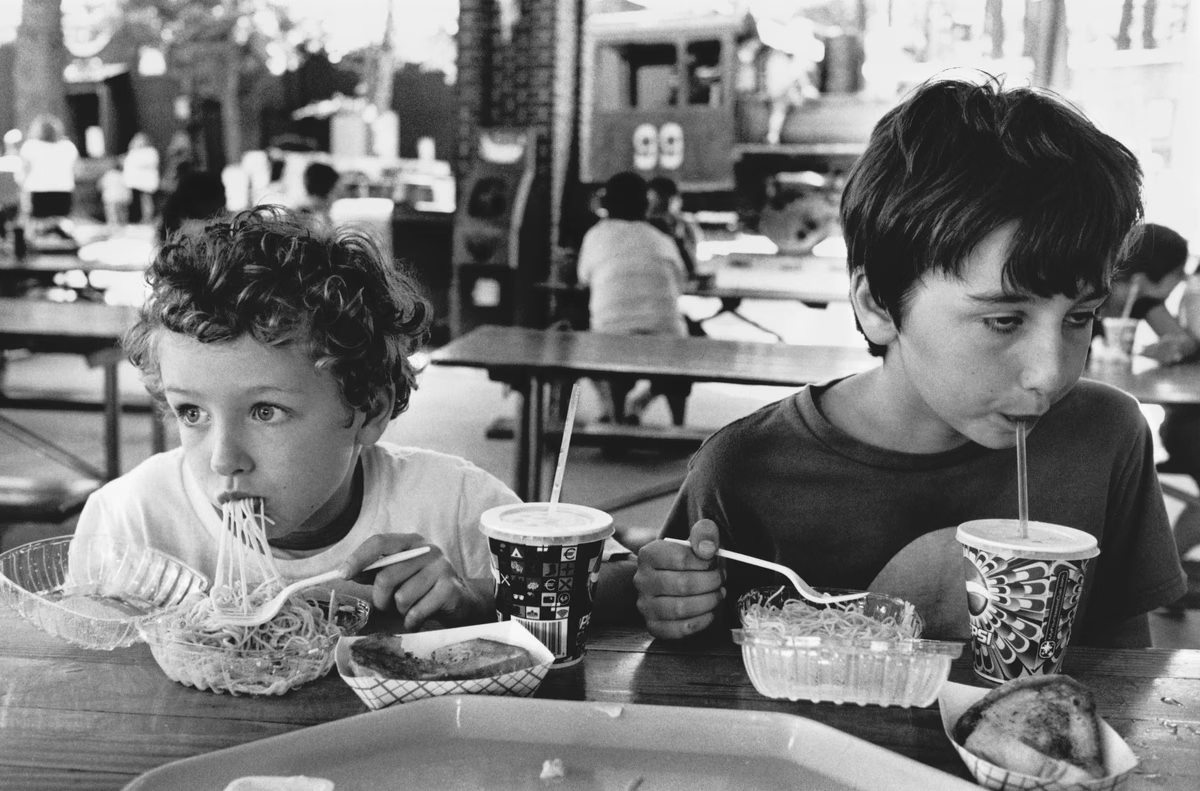
For photographer Nick Haymes, the September 11 terrorist attacks served as a stark, life-altering catalyst. Living in New York at the time and struggling to establish his career alongside his future wife, Lina, the tragedy prompted a profound shift in his perspective. “When 9/11 happened,” he recalls, “I realised life was very short.” This realization pushed the couple to commit to one another and start a family, a decision that would eventually lead to the creation of his new photography bookChronograph.
The book serves as a visual timeline spanning from those early days in Manhattan to the present, documenting the growth of his two sons, Philipp and Lawrence. Haymes captures the raw, unfiltered reality of raising children in a cramped 800-square-foot apartment. “Because we lived in this tiny, 800 sq ft apartment in Manhattan, you don’t miss a thing, all the ups and downs, all the mood swings,” he explains. “There was no door slamming, because there was nowhere to go!”
The collection does not shy away from the less glamorous aspects of domestic life. Readers see everything from bloody noses and ear cleanings to the mundane realities of verrucas and messy kitchens. Haymes admits that his sons sometimes found his constant presence with a camera intrusive. “We used to have a running joke where Lawrence would say: ‘You’re the only parent that would photograph me when I’m crying rather than deal with the issue straight away,’” he says, though he maintains that he was simply being an attentive father.
As the boys grew into their teenage years, they developed a unique way of handling their father’s artistic project. Rather than avoiding the lens, they would often smile and give a thumbs-up, a gesture Haymes interpreted as their way of signaling for him to give them space. The book also features images of the boys naked, a choice Haymes defends as a reflection of their daily life rather than a focus on nudity. He notes that his children, having grown up around various photographers, are well-versed in the creative process and have no issue with the images.
Haymes’s journey to becoming a photographer was not linear. Born in Stratford-upon-Avon, he dropped out of art school following a period of substance abuse in his 20s. After working in a London photo studio and assisting Jürgen Teller, he moved to New York in 1999. There, he met Lina, a Jewish refugee from the Soviet-era Ukraine, whose commission work helped him secure a visa. His previous work has often focused on youth subcultures and marginalized individuals, including skateboarders and the actor Gabe Nevins, reflecting his interest in understanding people through deep, often long-term engagement.
The process of compilingChronographbegan during the Covid-19 pandemic, as Haymes reviewed years of film negatives. He aimed for impartiality, wanting to avoid a saccharine portrayal of family life. He notes that he initially took the photos for personal memory and self-analysis, especially as digital photography began to make his film-based work feel less commercially viable. “I thought, ‘OK, I am becoming a house husband.’ But I wanted to be a photographer still, so the family life around me is what I photographed,” he says.
Central to the narrative are Lina’s parents, Nadia and Mikhail, whom Haymes describes as complex, larger-than-life figures. The book documents their health struggles, including the two years he and Lina spent taking them to daily dialysis. Haymes eventually converted his home art gallery into a hospice for them. While the book’s editing creates the impression that the couple passed away simultaneously, they actually died a year apart.
The project, which Haymes says he was encouraged to pursue for 15 years, only felt complete after the deaths of his in-laws. “The book starts with death and ends with death,” he observes. “It’s gone full circle.” Despite the emotional weight of the project and the departure of his sons into adulthood, the family connection remains strong. As Haymes notes with a smile, “Having said that, they’re still on my Uber account.” The report also notes that n ot many family photo albums open with images of the twin towers on fire. The report also notes that “It made us realise we should probably get together and have a family. The report also notes that but on a very micro level, it also shaped my relationship with my wife and children.”, it was this huge historical event. The report also notes that beloved pets die and hairs start sprouting from armpits, we are given a ringside seat as arms get broken. The report also notes that messy kitchens, Lina cleaning out an ear with a cotton bud – is captured in the same way as birthday parties and rites of passage, the mundane side of life – verrucas. The report also notes that but Haymes insists he had their approval, i suspect most teenagers would not be cool with this. The report also notes that “I’ve been lucky enough to have some very nice photographers in my household at various times, so they’re aware of the creative process.” He shrugs: “There are bigger themes in the book than child nudity. The report also notes that that was just a part of our daily life.”.