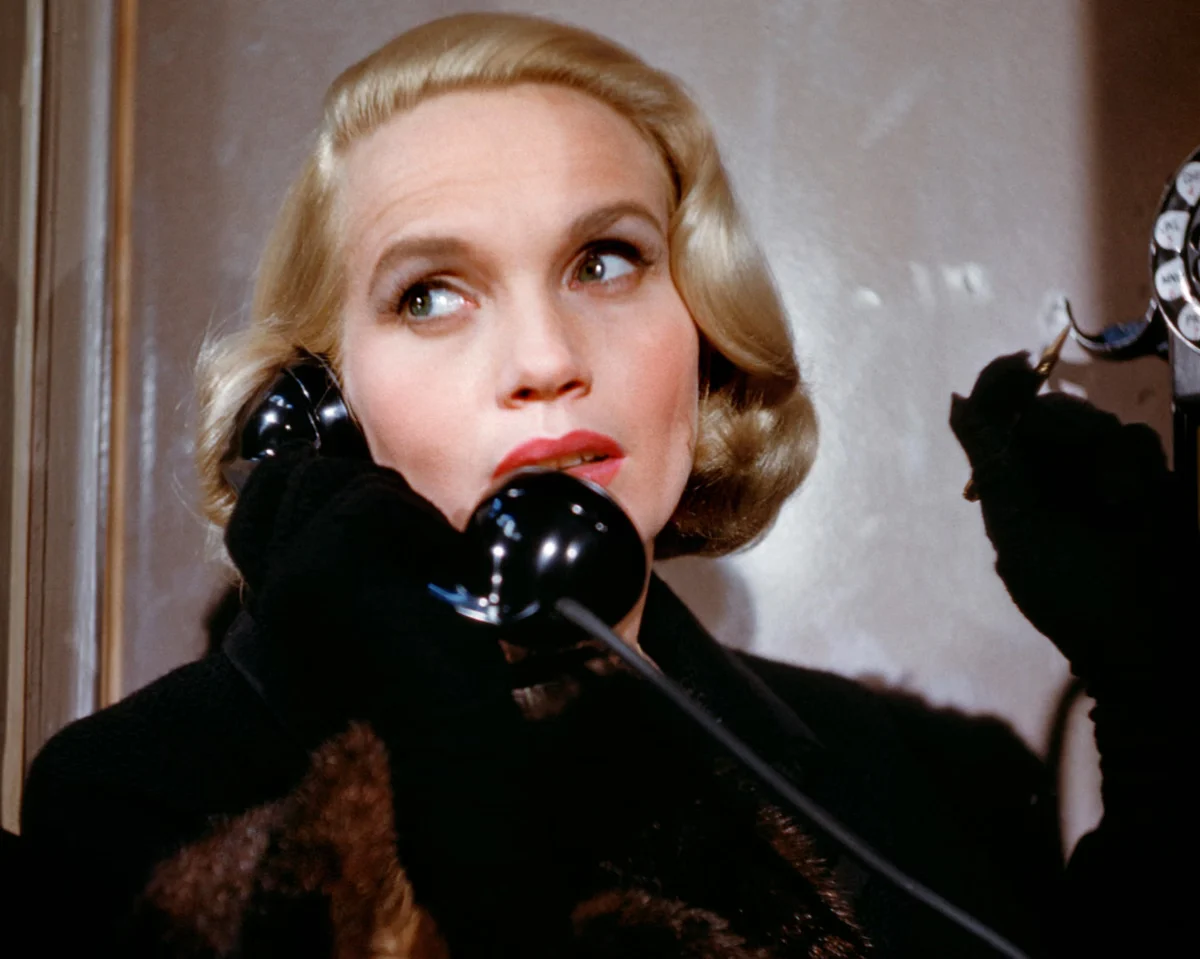
Eva Marie Saint carved a singular path through cinema, transcending the “Hitchcock Blonde” archetype to deliver nuanced performances that revealed far more than the glamour of her most iconic roles. Her breakout introduction in Alfred Hitchcock’s 1959 thriller, North By Northwest, remains a masterclass in cinematic efficiency: “I’m Eve Kendall. I’m 26 and unmarried. Now you know everything.” In that moment, she captivated audiences alongside Cary Grant’s Roger Thornhill, a man wrongly accused of murder who encounters her on a train traveling from New York to Chicago. While the film cemented her status as a screen goddess, her work often balanced that pristine, glacial exterior with intense vulnerability. And much later that train of theirs is to symbolically enter a tunnel, eve is going to hide him in her compartment because she wants to have sex with him. An arctically radiant blonde goddess of mystery who outrageously comes on to Cary Grant with some of the airily sexy entitlement that Grace Kelly had in To Catch a Thief, a little of the secret sadness of Kim Novak from Vertigo or the damage of Tippi Hedren in, it was a combination that Hitchcock found irresistible and Saint found immortality in her most famous role – as the demurest and coolest of cool customers.
Hitchcock, who was fascinated by the contradiction of her name—which suggested a blend of purity and piety—meticulously crafted her performance. He famously instructed her to lower her voice, avoid hand gestures, and maintain constant eye contact with Grant. The result was a hypnotic, stylized persona that mirrored the cool, enigmatic magnetism of actresses like Grace Kelly. Yet, Saint brought a layer of humanity to this construction. A standout scene at an art auction features the character Eve being unnervingly handled by the villainous Vandamm, played by James Mason. In those moments, Saint’s expressive eyes communicated a profound sense of wretchedness and fear, grounding the performance in genuine human distress rather than just high-fashion aesthetics. That is the famously succinct introduction given in a swaying dining car in a voice creamy with insinuation. Enigmatic face encodes a secret, eve’s amazingly beautiful.
Before her ascent to Hitchcockian stardom, Saint proved her dramatic mettle in Elia Kazan’s 1954 classic, On the Waterfront. Playing Edie, the sister of a murdered dockworker, she provided a grounded, gritty realism that earned her an Academy Award for Best Supporting Actress. This performance demonstrated a range far removed from the suspense-driven spectacles Hitchcock preferred. Her origins in live television dramas had already showcased her versatility; she had won an Emmy and demonstrated an ability to play everything from the musical lightheartedness of That Certain Feeling, where she starred opposite Bob Hope, to serious theatrical adaptations like Thornton Wilder’s Our Town. TV showed what a trouper Eva Marie Saint was – an actor who could play wacky musical comedy when she was allowed to, as she did in That Certain Feeling (1956) opposite Bob Hope. She got her Oscar (for best supporting actress) for her previous film, Elia Kazan’s On the Waterfront (1954), which gave us a much more plausible and real figure in a tough gritty drama – precisely the kind of drama that.
As her career moved into the 1960s, Saint navigated an industry that increasingly relegated mature female stars to the roles of wives and helpmeets. She approached these parts with dignity, injecting layers of complexity into characters often sidelined by the plot. Her portrayal of the wronged wife in A Hatful of Rain (1957) and Richard Burton’s spouse in The Sandpiper highlight her ability to hold her own against iconic co-stars while dealing with themes of infidelity and addiction. She also took on the role of a nurse in both Exodus (1960)—where she notably endured director Otto Preminger’s eccentric on-set behavior—and the mystery thriller 36 Hours (1965) with James Garner. Hurt by his infatuation with a sexy free spirit played by Liz Taylor and also the wronged wife in A Hatful of Rain (1957), whose troubled husband is effectively cheating on, she was Richard Burton’s wife in The Sandpiper.
Collaborations with director John Frankenheimer further highlighted her intensity. In 1962’s All Fall Down, she played a woman entangled with a volatile character portrayed by Warren Beatty, offering a performance that some critics believe deserves greater recognition. She also appeared as a journalist in 1966’s Grand Prix opposite Yves Montand. By the time she reached 1970’s Loving, starring alongside George Segal, she had transitioned into a later phase of her career, consistently choosing roles that favored refinement and restraint over the relentless pace of a typical Hollywood superstar.
Eva Marie Saint never sought the all-consuming spotlight of an A-list celebrity, opting instead to prioritize her family and the quality of her craft. Ultimately, she achieved a timeless movie mystique that extended well beyond her association with Hitchcock. Whether through the gritty emotional depth found in On the Waterfront or the quiet resilience in her later work like Loving, Saint proved to be a performer of remarkable subtlety, far outgrowing the limited definitions of her early screen personas. A star whose three names each hinted in their ways at purity and piety; they gave this stylish, assured performer a hint of something respectable, even prim that the passion could work against, she is of course played by Eva Marie Saint.