
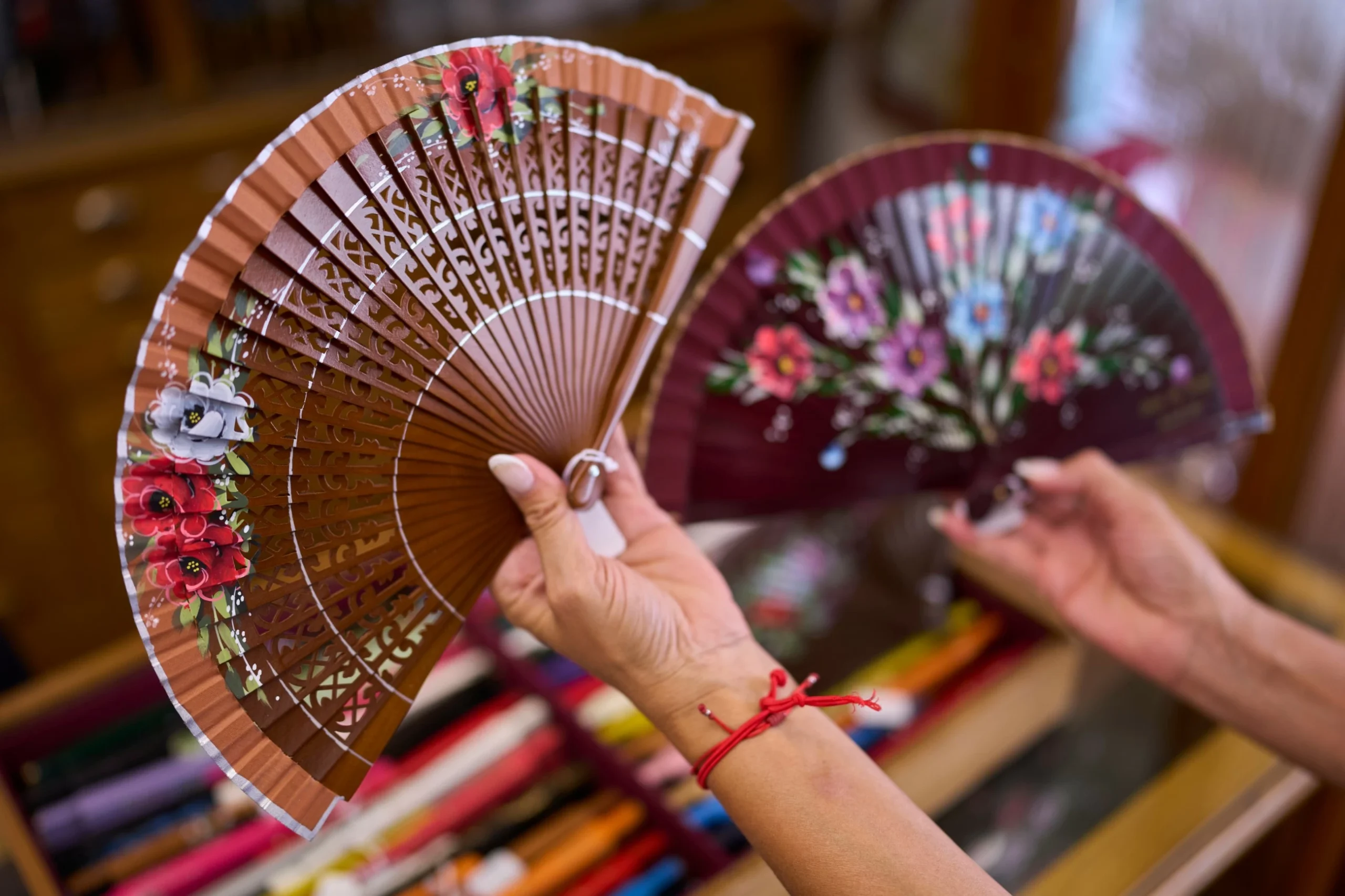
Amidst a summer of punishing heatwaves across Western Europe, the traditional Spanish folding hand fan, known as the abanico, has cemented its status as an indispensable accessory. Whether in packed subway cars or bustling public squares, the simple device—which snaps open into a semicircle with a quick flick of the wrist—is being embraced by a diverse demographic, including younger generations and an increasing number of men.
During a recent August day near Madrid’s Puerta del Sol square, 20-year-old Ana Feliu utilized a paper abanico, a gift from a Valencian festival, to shield herself from the sun. She noted that she carries it everywhere throughout the summer months. “This one is my favorite, but I have many,” she remarked. Her reliance on the fan comes as the Spanish capital faces temperatures forecast to reach 39 degrees Celsius (102 Fahrenheit).
The trend is also shifting perceptions among men. David González, 53, was seen using an abanico decorated in shades of red, purple, and pink. “At first, I felt a little self-conscious, because it’s something that’s mainly associated with women, but I have to admit it serves a purpose—and it brightens my day,” he explained.
Historical records suggest the folding fan arrived in Europe during the 15th and 16th centuries via Portuguese maritime trade routes with Asia. By the mid-1600s, the accessory had become a cultural fixture, famously depicted in Diego Velázquez’s painting, “The Lady with a Fan.” As the item gained popularity in European courts, Spain established a dedicated production industry, with Madrid serving as a primary hub and Valencia eventually becoming the nation’s fan-making capital by the 18th century.
By the 1800s, the abanico was so deeply integrated into Spanish aristocratic life that it developed its own non-verbal “language of the fan,” allowing women to signal flirtation, interest, or disapproval. The fan later spread to Latin America, where it became a quintessential element of flamenco dance, used as an expressive prop to evoke the heat and humidity of Cuba while highlighting a performer’s coquettish flair.
For Javier Llerandi, whose family has operated the wood-paneled Casa de Diego shop in Madrid for over 150 years, the current heatwave is a boon for business. “We live from the heat,” he stated. His inventory ranges from simple two-tone wooden models to elaborate, hand-painted mother-of-pearl pieces with intricate floral designs. Prices reflect the level of craftsmanship and materials, starting at 30 euros ($35), rising to between 200 and 500 euros (up to $580), and reaching as high as 6,000 euros (nearly $7,000) for high-end items.
Llerandi notes that foreign tourists are increasingly purchasing these fans, often preferring them over electric alternatives. “Battery-run items eventually run out of power, and always at the worst possible moment,” he said, adding, “Without a doubt, heat waves are good for this business.”
The market also caters to more casual consumers, with plastic, printed fans available at souvenir kiosks for just a few euros. Near a major bullfighting ring in Madrid, vendor Juani Duran sells wooden fans with traditional floral patterns for five euros each. She noted that the accessories are a staple for spectators attending events in open-air stadiums.
“You’ll usually find a hand fan in any woman’s pocket—and in some men’s, too,” Duran observed. While acknowledging that her stock may not represent the highest quality, she emphasized their practical value: “They’re not the best quality, but they’ll get you through the summer.” The report also notes that flamenco dancers began using the abanico as an expressive prop, as Cuban song and dance styles such as the guajira influenced the dance form, in the 19th century. The report also notes that on the one hand, it evokes the heat and humidity of Cuba – that heavy, oppressive feeling,” said Carmen Torres, a 44-year-old flamenco dancer in southern Spain, the fan is a perfect element because. The report also notes that it gives us a way to bring out the seductive, coquettish quality.”, and at the same time. The report also notes that it creates a surprisingly strong breeze, with little more than a flick of the wrist. The report also notes that at concerts and at music festivals, women – and a growing number of men – unfurl them on public transport. The report also notes that in July, rainbow-colored abanicos were everywhere during Madrid’s raucous Pride celebrations. The report also notes that even more so, the workmanship involved, he said, prices vary based on the materials used and. The report also notes that there, too, a salesperson reported strong sales this summer.



Comments