
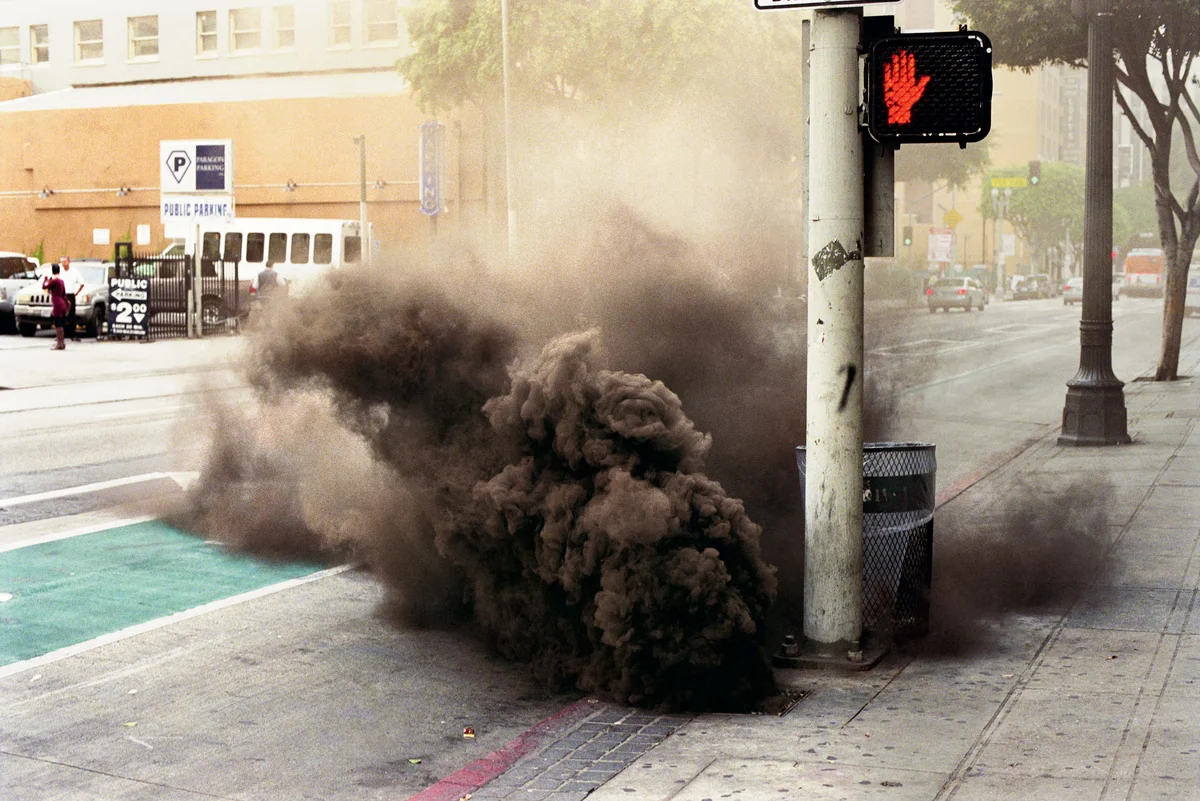
Captured between 2011 and 2012 shortly after he relocated to Los Angeles, one of Jerry Hsu’s most striking photographs depicts a plume of black smoke rising from a street grate. The scene, which he describes as “hilariously cinematic,” felt as though a devil might emerge from the subterranean fire. For Hsu, the image encapsulates the eerie, spontaneous nature of urban environments and the sense of surrender he experiences while photographing, a practice he equates to submitting to the authority of ignorance.
Born in San Jose, California, in 1981, Hsu spent 25 years as a professional skateboarder after turning pro at age 16. He credits skateboarding with shaping his unique perspective on the environment, teaching him to view mundane objects like handrails or benches as elements to be manipulated. This background fostered a constant curiosity and the ability to enter a flow state, allowing him to process information rapidly and make quick, life-altering decisions. Skateboarding essentially granted him the permission to interpret reality on his own terms, a skill that proved vital to his photography.
Hsu moved to Los Angeles to escape the sprawling, suburban nature of San Jose and to start a new chapter with his future wife. He characterizes Los Angeles not as a single city, but as a collection of hundreds of distinct places where one can transition from the beach to the mountains in a 15-minute drive. Despite the pervasive sunshine, he finds a noir quality in the city’s darker corners, seeking out a “transgressive pulse” and moments of intimacy. His latest bookHow About Neverfunctions as a dreamlike exploration of his subconscious, collecting images of destruction, fire, and water alongside more compassionate, smaller details.
The book also serves as a chronicle of his marriage, spanning from the time he met his wife until their separation earlier this year. While the collection includes vulnerable images—such as a final, poignant photograph of his wife in a hospital bed—Hsu views the project as a fantasy of what he sought in a relationship and the contradictions inherent in human connection. He admits that while he is naturally shy, photography provides a necessary bridge to the world. Although he initially feared the isolation of the creative process and the potential for misunderstanding, he felt compelled to tell this story.
While some viewers perceive the work as bleak, Hsu insists there is significant hope embedded within the pages. He points to the final image of a cat exiting the frame as a symbol of moving forward and continuing to live despite life’s inherent cruelties. Published by MACKHow About Neverrepresents a high point in his career. For aspiring artists, Hsu offers a simple piece of advice: always conduct thorough research and copy the artists who resonate with you, as your own unique voice will eventually emerge from that process. The report also notes that and at 16 I turned pro, i started skateboarding at 12. The report also notes that an area I don’t go to that much, walking around with my camera, i was downtown. The report also notes that spontaneous things that happen in a city, it was really just one of those eerie. The report also notes that there is a very powerful feeling of surrender when I am photographing. The report also notes that if you let it take you, there’s a weird sentience to the city. The report also notes that i get an inexplicable desire to just get in the car and go. The report also notes that there is a noir that is pervasive here, despite the fact it’s sunny every day.




Comments