
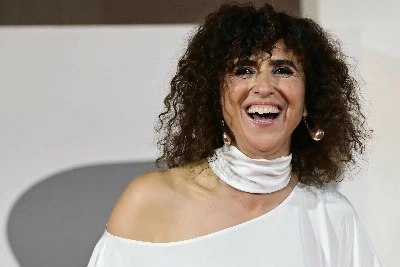
Danish director May el-Toukhy faced a striking irony when she arrived at the Venice Film Festival in July as the only woman among 20 filmmakers competing for the top prize. Her film, “Woman Unknown,” explores themes of invisibility and objectification, mirroring the very environment she currently navigates. During a press conference on Sunday, el-Toukhy noted that the progress regarding gender representation following the 2017 #MeToo movement appears to be stalling. She remarked that while the industry was once acutely aware of these imbalances, there has been a regression in recent years that demands urgent attention.
“Woman Unknown” centers on a bride-to-be who attempts to conceal a secret relationship with a Nazi soldier during the German occupation of Denmark in World War II. The film depicts the harsh reality for women accused of collaborating with the enemy, who were often subjected to public humiliation, including having their heads shaved and swastikas painted on their bodies. El-Toukhy described the project as a study of being both objectified and rendered voiceless, noting that she faced significant skepticism during the pitch process. She observed that potential financiers often dismissed the project as “another Second World War film,” a critique she finds unfair given the historical focus on male wartime experiences.
The festival’s selection process has drawn sharp criticism, particularly after Venice director Alberto Barbera claimed in July that the 20-to-1 male-dominated competition lineup was simply a result of insufficient submissions from women. This explanation sparked widespread backlash. Since then, the festival has added a documentary titled “NAZA,” which explores the killing of civilians in Gaza and is co-directed by a woman, to the program. El-Toukhy, who previously worked on the Netflix series “The Queen,” shared that she has encountered systemic bias throughout her career, including a struggle to secure financing that she notes was significantly easier for her male counterparts.
This structural concern was echoed by jury president Maggie Gyllenhaal, who emphasized the ongoing difficulty women face in securing funding. Gyllenhaal questioned whether stories centered on the unique female experience are consistently undervalued by the industry as “high art.” Italian actress Jasmine Trinca also expressed her frustration during the festival, stating that the lack of female representation is an issue that requires immediate confrontation. These concerns are supported by data from the USC Annenberg Inclusion Initiative, which labeled 2025 a “Great Recession” for female directors in the U.S., noting that only nine women were attached to the 100 highest-grossing films that year. Historically, only Kathryn Bigelow, Chloe Zhao, and Jane Campion have secured the Oscar for Best Director.
In a separate development at the festival, South Korean director Lee Chang-dong returned to the spotlight on Sunday. His latest project, “Possible Love,” marks his first film in eight years, following his 2018 release “Burning.” Lee noted that the extended hiatus provided him with the space to reflect on his role and responsibilities as a filmmaker while revisiting a labor conflict that previously impacted his home country. The report also notes that “After #MeToo, I think all of us were really aware of this gender imbalance,” she told reporters. The report also notes that “And something has happened over the course of the last couple of years where we’re kind of returning to, you know, what it used to be – and so we have to be better,” she added. The report also notes that which drew enthusiastic applause after a press screening Sunday, is “about being objectified on one hand and on the other hand being unseen and voiceless,” said el-Toukhy, the powerful film. The report also notes that venice boss Alberto Barbera angered many observers in July when he said the initial 20-1 male domination of the top competition was because the submissions from women “were not enough to put them into the competition.”. The report also notes that “I think it took me six or seven years, whereas my male peers, they were much faster than me,” she explained. The report also notes that “My second film was really hard to get done as well.”.



Comments