
President Trump has undertaken a series of ambitious and controversial architectural projects in Washington DC, which critics characterize as a significant departure from the city’s historic character. Central to these efforts is the development of what the president has dubbed the “Magnificent Ballroom and Military Complex.” Originally pitched last July as a project that would “not interfere” with existing structures, the ballroom was intended to seat 650 guests at a cost of $200 million, funded entirely by private donations.
The scale of the ballroom expanded rapidly, eventually designed to accommodate 1,000 guests within a building three times the volume of the White House. Consequently, the projected costs have tripled to at least $600 million, with taxpayers expected to cover at least half of the total. Trump has stated that the facility will be “more beautiful” than Versailles, though former Commission of Fine Arts officials have critiqued the design for its fragmented, “kneejerk” application of classical elements.
Architectural oversight for the project shifted to the DC firm led by Shalom Baranes, known for managing multibillion-dollar federal contracts such as the Pentagon’s post-9/11 renovation. Under this leadership, the project transitioned into a fortified facility. The ballroom now sits atop a six-storey, military-grade bunker containing an emergency operations center, a hospital, and secure communications infrastructure. President Trump described the ballroom as a functional “shed” for the security structure beneath it, which is being framed as a “desperately needed National Security structure.”
The roof of the ballroom is slated to house a drone port and air-defense missile systems, giving the exterior an appearance resembling an aircraft carrier adjacent to the White House. Despite legal challenges, the Supreme Court recently issued a ruling allowing construction to proceed, though the decision did not address the underlying legality of the project. Disputes over the East Wing, which was demolished to make way for the new construction, continue to highlight the tension between the administration’s development goals and traditional preservation standards.
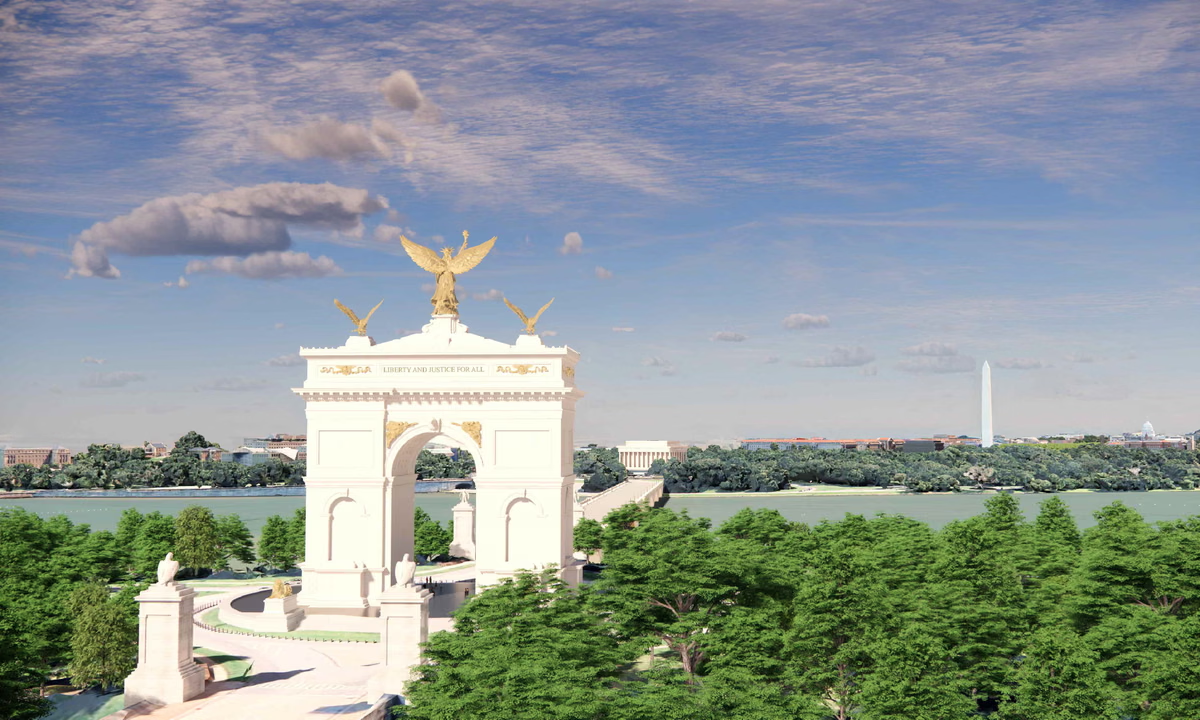
Beyond the ballroom, the president has championed a 250-foot tall triumphal arch intended for Memorial Circle. First announced last October, the arch is being designed by the Atlanta-based firm Harrison Design, under the direction of Nicolas Charbonneau. The final design, unveiled in April, features heavy gilding and a 60-foot tall golden-winged Lady Liberty statue at its summit, flanked by additional sculptural elements. The president has claimed this arch will be the “GREATEST and MOST BEAUTIFUL” in the world, surpassing existing monuments in Paris.
The National Park Service has warned that the arch will have an “adverse effect” on numerous nearby historic sites. Furthermore, a coalition of Vietnam veterans has initiated a lawsuit against the project, arguing it will be inappropriate for the area. Concerns have also been raised by sculpture experts regarding the feasibility of the project’s timeline and quality, suggesting that the massive scale of the decorative work may require production facilities currently only available in China.
These initiatives are complemented by the “Safe and Beautiful” project, which includes $76 million for new fountains and $5 million for the gilding of equestrian statues, including “The Arts of War” and “The Arts of Peace.” Additionally, $40 million has been earmarked for the National Garden of American Heroes, a planned collection of 250 statues intended to honor the country’s “timeless exceptionalism” according to Executive Order 13978. A single pedestal for a prominent statue alone cost $500,000.
The administrative costs associated with these projects are substantial, with the overall White House renovation shopping list, including marble for the Lincoln bathroom and gold drapery for the East Room, exceeding $900 million. In the Oval Office, the president has showcased a two-meter model of a $22 billion plan to overhaul Dulles airport, which features plans for gold-mirrored ceilings and what is described as the world’s largest garage. The report also notes that you might expect some zhooshing up of the capital, w hen you have a developer as US president. The report also notes that maybe some parks replanted, a few buildings renovated. The report also notes that things can get out of hand, but when you have a megalomaniac builder in charge. The report also notes that a decade ago, when Donald Trump was first elected, I asked what it might mean for the US to be led by a real estate tycoon whose career had left a trail of broken promises, angry buyers and endless lawsuits, with rules flouted, heritage trampled and the world pockmarked by a fleet of aspirational towers clad with a flimsy veneer of luxury. The report also notes that the answer is worse than I could have imagined. The report also notes that with the air of a nightmarish Hollywood sequel, Trump 2 has seen the president’s true architectural ambitions unleashed: The Blingpire Strikes Back. The report also notes that as America’s self-styled decorator-in-chief, Trump has not only overseen the gilded mutilation of the White House, but embarked on the Mar-a-Lagofication of Washington DC itself, applying his gold paintbrush to statuary, daubing ponds with flaking pool liner, and brewing plans for a colossal triumphal arch – all procured in a blizzard of no-bid contracts. The report also notes that and, in true dodgy salesman style, this programme of bauble-building is turning out to be a high-profile decoy for deeper damage being wrought elsewhere.






Comments