
Sunil Gupta, who has spent fifty years documenting queer life, views his long-term photographic practice as an ongoing experiment in perspective. Born in India and raised in Canada, he moved to the United Kingdom in 1978 after completing two years of study in New York. Throughout his career, Gupta has focused on the intersection of fiction and reality, attempting to translate private, intimate experiences into visual art. Reflecting on his journey, he admits to being very promiscuous and acknowledges the inherent risks he faced. In his early UK years, he and fellow photographer Tessa Boffin were often met with hostility, noting that curators would physically recoil from them. Despite this, he remained unapologetically upfront about his identity, rejecting the notion of shyness as they navigated social and political shifts.
Gupta is currently preparing for a retrospective exhibition at Kettle’s Yard in Cambridge, where he will present ten landmark images that define his work. One key piece, titled “No 43 from Christopher Street,” captures a rare moment of inclusion in 1970s New York. At the time, Asian representation was sparse on the street, and Gupta identified with the individual portrayed in the image. He contrasts these figures with the regular gay crowd in the background, noting the poignant sense of loneliness inherent in street cruising.
His return to Delhi in the 1980s marked a pivotal shift in his approach to his “Towards an Indian Gay Image” series. Working in an environment of complete silence regarding homosexuality, he initially experimented with headless shots because subjects were unwilling to appear on camera. This series eventually formed part of his degree show at the Royal College of Art. The work also resulted in his first published image, after he successfully pitched a story to to support his freelance career.
During the early 1990s, Gupta experimented with technology, using early low-resolution scanners and Apple computers to create the “Trespass Series 1” montages, which were displayed in a Soho coffee shop. This work emerged during debates surrounding the European single currency, a topic that held significant weight for Commonwealth migrants concerned about their legal rights. In his “Pretended Family Relationships” series, he addressed the UK’s Section 28, a policy that banned local authorities and schools from promoting homosexuality. Living in a multicultural bubble in Brixton at the time, Gupta relied on friends to pose as couples for his images, as many people felt unable to be publicly out.
His 2005 work, “Love and Light,” documents his return to India. Initially conceived as a series depicting him with a partner in various locations, the project transformed after his relationship ended. Ultimately, the series tracked his own journey, leading to a significant turning point: he met his husband, Charan Singh, at an AIDS conference in Delhi. His later project, “Country: Portrait of an Indian Village” (2007), explored his status as an outsider in Rajasthan. While he found the village dynamics claustrophobic compared to the anonymity of London, he formed deep connections, including learning a 300-year oral history from an uncle.
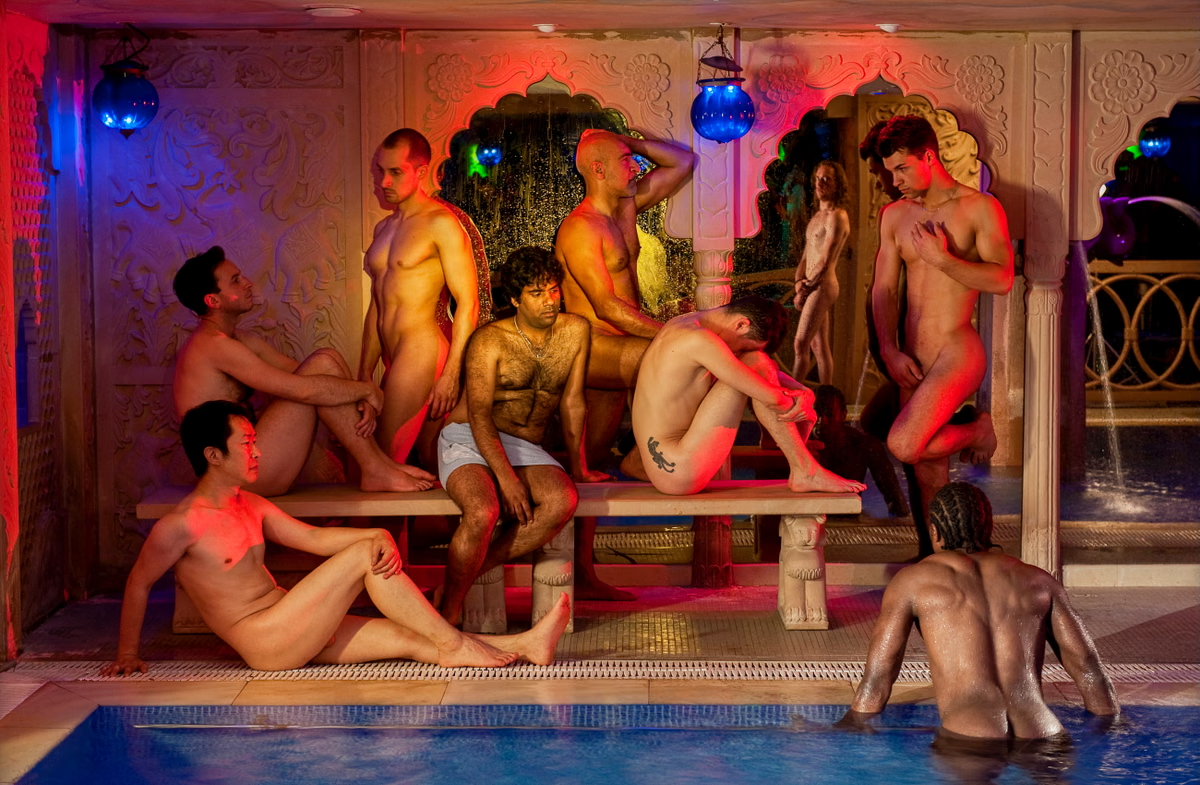
The central image for his upcoming show, “Sun City,” serves as a synthesis of a queer photographic history he pieced together independently. Referencing Chris Marker’s film “La Jettée,” each pose within the work acts as an homage to historical images ranging from the works of Robert Mapplethorpe and George Platt Lynes to French Romantic paintings and Wilhelm Von Gloeden. This focus on heritage was also present in his 1986 “The Black Experience” series, commissioned by the Greater London Council. At the time, the project highlighted a struggle within the queer community, as he felt forced to document South Asian identities that were being ignored by other factions of the artistic movement. That specific exhibition proved to be the founding moment for the Autograph gallery.
As he approached his 50th birthday, Gupta faced a period of profound personal difficulty, marked by his HIV diagnosis and the decline of his professional and social life. During this low point, a three-year fellowship in Southampton allowed him to create his “Homelands” series. These images, including one taken at St Thomas’ hospital during his treatment, documented his identity as a person living with HIV and his connection to the landscape. His retrospective also revisits his “Exiles” series, commissioned in 1986-87 by the Photographers’ Gallery. By returning to Delhi, he sought to document gay men in cruising spots, blending his photographs with transcripts from recorded conversations with his subjects. The report also notes that in his work, he’s quietly tried to find new ways of seeing, exploring the potential of photography to blur fiction and reality, public space and intimate, clandestine moments. The report also notes that set against the ever-shifting tides of politics and society, his work explores the ways we love and relate to one another. The report also notes that he photographs with love – but it hasn’t been without risk. The report also notes that and in his early days in the UK, when he was working with fellow photographer Tessa Boffin, he recalls curators “physically shrinking away when we walked in the room – two queers in leather were too much for them, an exhibition in India was once shut down by the government. The report also notes that we weren’t shy about it.”, but we were quite aggressively upfront with our sexualities. The report also notes that ahead of his retrospective exhibition at Kettle’s Yard in Cambridge, Gupta talks through 10 landmark images from across his career. The report also notes that this is almost the only photograph in this series that prominently features a person of colour; it was unusual to see Asian people on Christopher Street in New York at the time, and I saw myself a little bit in the person on the right. The report also notes that and you find someone to hang out with, these two in the foreground are very much what I remember from that time: you get the hair and clothes because you want to look the part.





Comments