
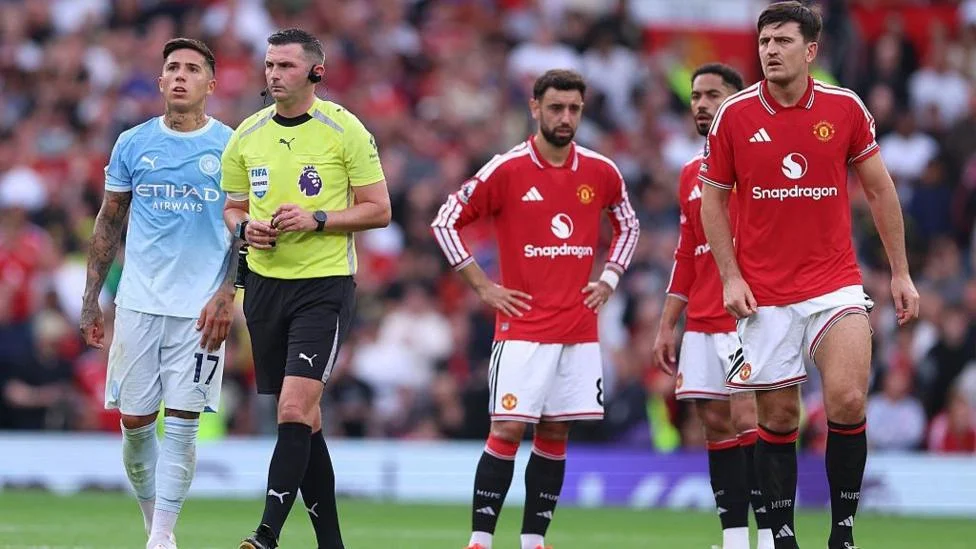
A critical oversight by video assistant referee Matt Donohue and his assistant, Blake Antrobus, resulted in one of the Premier League’s most significant officiating errors during the Manchester derby. The decision to validate Erling Haaland’s winner, which secured a 1-0 victory for Manchester City over Manchester United, was labeled ‘baffling’ by Wayne Rooney. Central to the controversy was a failure to identify that Enzo Fernandez stood three yards offside before his attempt to head the ball.
Audio of the incident reveals an atmosphere of intense pressure, with Donohue repeatedly shouting, “Quick, quick, quick, quick! Go, go, go, go, go!” The frantic communication between the VAR and the replay operator underscored a departure from the calm, methodical process expected in such situations. While Donohue aimed for efficiency, the outcome was chaotic, highlighting the risks of prioritizing velocity over accuracy.
The league has made “more efficient application of VAR to reduce delays” a primary objective for the season, a directive echoed by stakeholders including managers, players, and fans. This mandate has successfully lowered average review times from 46 seconds to 36 seconds season-on-season. However, critics argue this push for rapid decisions creates an environment where critical errors become more likely, similar to a separate instance where a penalty for Arsenal against Aston Villa was missed after a similarly hurried review.
City manager Enzo Maresca acknowledged the difficulty of the officials’ task, noting that decisions made in under 20 seconds are challenging and mistakes are inevitable for all parties involved. Despite this, the process failure during the derby was stark. Donohue focused initially on Josko Gvardiol’s cross, triggering the semi-automated offside system before viewing the full sequence of play. By failing to assess the entire attacking phase, the team overlooked Fernandez’s critical positioning.
The involvement of assistant VAR Blake Antrobus has also drawn scrutiny. His primary contribution during the review was a brief “no, yeah” regarding Fernandez’s potential touch—an intervention occurring just one second before the decision was finalized. Antrobus, who previously faced criticism for a four-minute delay during a Brentford-Sunderland match, had successfully identified an offside against Kevin Danso in that game, raising questions about whether his past experience influenced his desire for speed during the derby.
Referees’ chief Howard Webb continues to navigate the balance between efficiency and precision. Observers noted that the error was compounded by the fact that the situation remained salvageable until the match restarted. With no intervention from the support VAR at Stockley Park, a significant opportunity to rectify the mistake was missed, leaving the match result defined by a flawed procedural oversight. The report also notes that heightened by the introduction of VAR, refereeing has always been a goldfish bowl of scrutiny and pressure. The report also notes that rushed and chaotic rather than calm and collected. The report also notes that the urgency in Donohue’s voice was all too apparent. The report also notes that the opposite of how a video official should operate. The report also notes that pundits, radio phone-ins and newspaper columns – that VAR has to be quicker, officials hear repeatedly – from fans. The report also notes that though he was of course the beneficiary of the gaffe, city boss Enzo Maresca had some sympathy speaking on Wednesday. The report also notes that to make a decision in 10, 20 seconds is not easy for them,” said Maresca. The report also notes that but it is still a balancing act, referees’ chief Howard Webb has taken the desire for quicker reviews on board.





Comments