
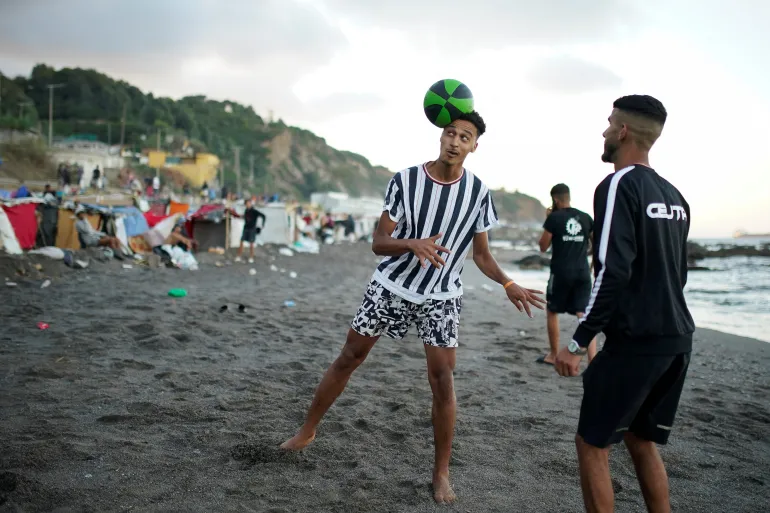
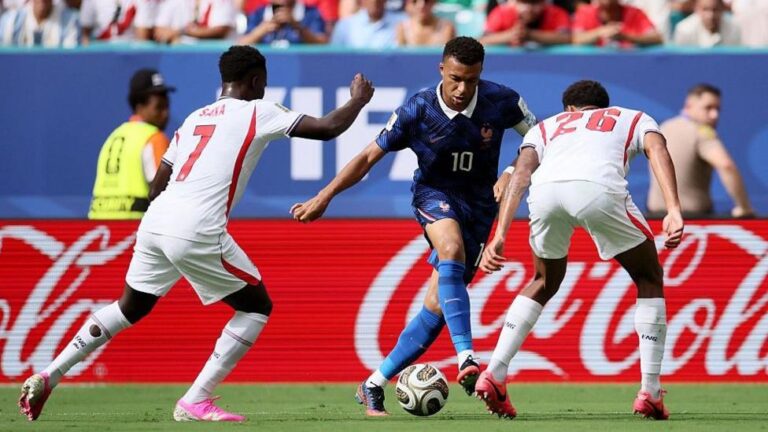
A high-profile dispute involving Real Madrid players has thrust Spanish football into the center of a volatile national debate regarding the influx of migrants into Ceuta, a Spanish territory on the North African coast. During a recent match against Elche, Real Madrid stars Kylian Mbappe, Vinicius Junior, and Ibrahima Konate appeared in shirts bearing a message of solidarity with the enclave. The gesture drew immediate scrutiny, sparking a wave of public and political reaction that persisted through Sunday’s Madrid derby.
At the Metropolitano Stadium, tensions were palpable as fans unfurled a banner stating, “Ceuta es Espana. Ni se arruga, ni se tapa,” which translates to, “Ceuta is Spain. It is neither rolled up, nor covered.” This was a direct rebuke of the Real Madrid players’ choice to roll up their shirts. Despite the hostility, supporters from both sides momentarily united to chant “Ceuta no se vende, Ceuta se defiende” (Ceuta is not for sale, Ceuta must be defended) before the derby’s intense rivalry resumed.
The controversy stems from a humanitarian crisis that began in late July, when a record 72,000 migrants crossed the border from Morocco into Ceuta over just two days. The sudden surge overwhelmed local infrastructure, and the NGO Caminando Fronteras reported that 141 individuals lost their lives on both sides of the border during the aftermath. Seven weeks later, government figures indicated that between 9,000 and 10,000 migrants remained in the city. Recent data from September 20 suggests 8,300 people are currently housed in various facilities, while over 4,000 remain on the streets, with a new port-based facility reaching its 1,700-person capacity within hours of opening.
Regarding his participation in the shirt initiative, Mbappe emphasized that his actions were not intended to undermine the enclave. “I also wanted to think about all the people who are suffering, because in the end I am human and I don’t want to prioritise the suffering of one group over another,” the forward stated. He noted that he intended to acknowledge the migrants who endured hardships or perished during the crisis. Real Madrid later confirmed they respect the players’ individual freedom to engage in such initiatives, while Barcelona opted not to wear the shirts during their own fixture against Levante.
The initiative was launched on September 11 by the Asociacion Valenciana de Empresarios (AVE), a business group led by former Real Madrid interim president Vicente Boluda, whose company operates in Ceuta. AVE characterized the campaign as an expression of solidarity with the city’s residents and a call for national social cohesion. However, the move faced pushback; La Liga president Javier Tebas publicly criticized the players involved, while David Aganzo of the AFE footballers’ union argued that athletes were not being adequately briefed on the significance of the cause they were supporting.
Luhay Hamido, president of the AD Ceuta football club, noted that the crisis has had practical consequences for his team. The club has faced collapsed contract negotiations as potential players and their families grew anxious after viewing televised footage of the border events. To combat this, the club now pays for prospects to visit the city personally. Despite these difficulties, Hamido views the solidarity from Spanish football as vital “fuel” that provides the city with essential hope and energy, serving as an “amplifier” to ensure the region is not overlooked.
Hamido also stressed the need for empathy toward those making the crossing. “These people, in the end, are not to blame,” he told journalists. This sentiment is reflected in the neighborhoods of Ceuta, where children are often seen playing football in the streets with makeshift gear, sometimes wearing jerseys featuring the names of players like Mbappe, Hakimi, or Yamal—athletes whose own family backgrounds reflect the complex intersection of cultures and borders.
Opinions on the players’ actions remain divided. Jorge Garcia, an Atletico Madrid supporter, described the protest as disrespectful to both the country and the enclave. Meanwhile, Spain-based Moroccan journalist Youssef Temsamani argued that players are in a difficult position, caught between appearing political or indifferent. Temsamani warned against the use of terms like “invasion” or “occupation” in public discourse, urging that migrants be included in the conversation rather than excluded from it. The report also notes that while France captain Mbappe grew up in Bondy, outside Paris, to parents who came from Cameroon and Algeria, konate was born and raised in Paris by parents who migrated from Mali. The report also notes that jorge Garcia, a 32-year-old Atletico Madrid supporter, believed they deserved the jeering. The report also notes that declaring: “This is Spain, this is Ceuta, spain coach Luis de la Fuente travelled to Ceuta with the World Cup trophy. The report also notes that “We cannot force anyone to identify with a cause they do not understand,” he told, suggesting footballers are sometimes simply told to put on a shirt in the tunnel without having received a full explanation. The report also notes that the scale of the crisis that prompted the solidarity campaign remains difficult to quantify precisely. The report also notes that spain’s Interior Ministry put the number of people who irregularly crossed into Ceuta on July 30 and 31 at 72,000, saying more than 70,000 initially returned to Morocco. The report also notes that football is also played in the neighbourhoods in Ceuta, where migrants had gathered in the largest numbers, away from the stadiums and political arguments.


Comments