
The landscape of the English women’s game faced a notable shift during the 2025-26 season opener when the London City Lionesses fielded a starting XI devoid of any English players against Manchester United. This event marked a milestone for the Women’s Super League (WSL), as it was the first time a team had begun a season campaign without a single homegrown starter. Shortly thereafter, a similar trend emerged when Tottenham faced West Ham, with Scotland striker Kirsty Hanson being the lone British player in the starting line-up.
These developments highlight the increasing ability of WSL clubs to attract elite global talent, a trend that has helped elevate the league’s reputation as one of the world’s most competitive. However, the rise in foreign investment and international recruitment has sparked concerns among some observers, including The Guardian’s Tom Garry, who described the situation as alarming for the future of the home nations.
The current state of the game is a far cry from a decade ago, when Manchester City secured the league title using an entirely British starting XI. Since the league transitioned to full professionalism in 2018, the success of the Lionesses has driven massive growth in audience and revenue. This financial boost has empowered clubs to expand their scouting networks and acquire talent from across Europe, Japan, and Australia, while high-profile signings like Alexia Putellas have further bolstered the league’s global profile.
Birmingham City manager Amy Merricks acknowledges the league’s growth while noting the negative impact on local pathways. She pointed out that while attracting world-class athletes is necessary for progress, it simultaneously creates barriers for young players attempting to break into the senior squads. Merricks emphasized the need to find a balance that supports both the league’s commercial evolution and the development of domestic talent.
Statistical data underscores the severity of the trend, showing a consistent decline in the proportion of homegrown starters—defined as players from England, Scotland, Wales, or Northern Ireland who start at least 11 matches per season—over the last three years to below one-third. While the first three weeks of the 2026-27 season showed a slight increase in homegrown participation, analysts largely attribute this to the league expanding from 12 to 14 teams and the inclusion of promoted sides like Birmingham City, Crystal Palace, and Charlton Athletic.
In contrast to the WSL, other major European competitions have maintained higher thresholds for domestic players. During the 2025-26 season, 61% of starters in France’s Premiere Ligue were French, 63% of Frauen Bundesliga players were German, and 69% of Spain’s Liga F participants were Spanish.
For managers, the pressure to deliver results remains the primary driver of squad selection. Manchester City boss Andree Jeglertz stressed that while clubs have a responsibility to nurture young prospects, his primary objective is fielding the most competitive side possible. Jeglertz stated that his selection process is driven by the necessity to win games, regardless of whether that entails fielding several young English prospects or none at all.
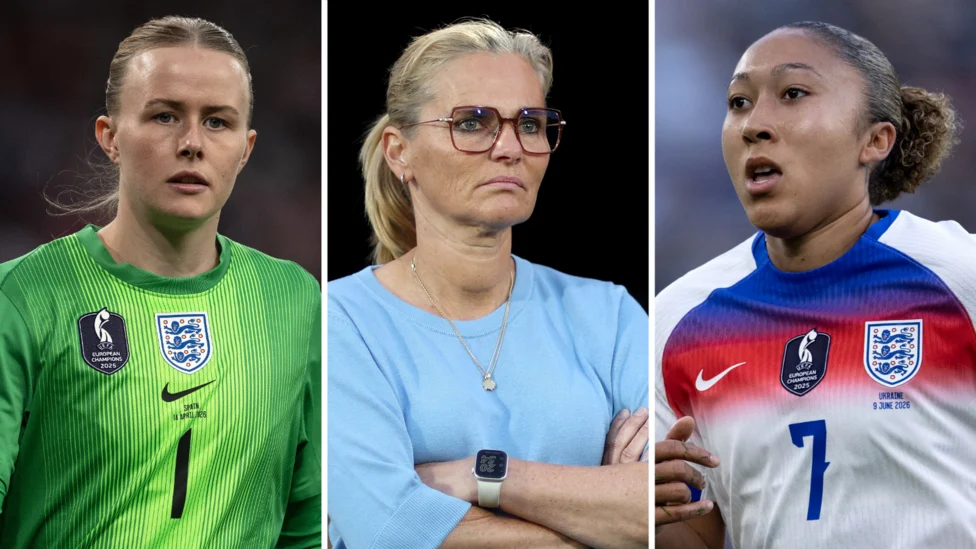
As the Women’s Champions League returns this week, the debate over whether the WSL’s current trajectory serves the long-term interests of the home nations continues to intensify. Fans can follow the upcoming matches, including Arsenal against HB Koge on Tuesday, 22 September, at 20:00 BST, through Radio 5 Live commentary and live text updates on Sport website. The report also notes that hannah Hampton and Lauren James are two players that have established themselves in the England starting XI under Sarina Wiegman (centre). The report also notes that creating a league many now view as the world’s best, both instances speak to the increasing ability of WSL clubs to attract top talents from across the globe. The report also notes that in 2018, the WSL went fully professional, the subsequent success of the Lionesses in the 2020s rapidly grew the game’s audience and revenues have increased accordingly. The report also notes that as a result, clubs have expanded their scouting pool and been able to attract players from a wider variety of nationalities – with transfer fees exploding since the turn of the decade.








Comments