
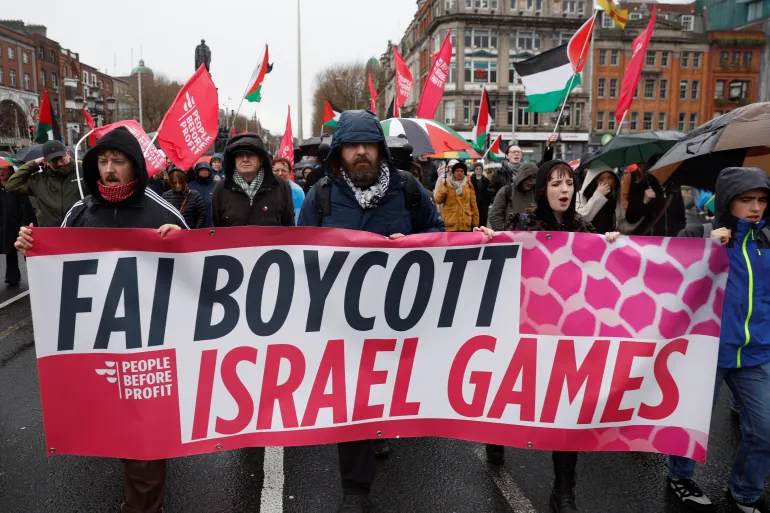
When European football’s governing body scheduled its Nations League fixtures in February, the pairing of the Republic of Ireland and Israel in Group B3 immediately triggered widespread public backlash. Months later, despite intense criticism and fierce demands for a boycott, the two teams are set to play a pair of matches amid severe political tension.
The teams were drawn alongside Austria and Kosovo in League B, with fixtures arranged on a home-and-away basis. Ireland will nominally host its home leg in Debrecen, Hungary, on September 27, while Israel’s home fixture is scheduled to take place in Serbia on October 4. Israel has been barred from hosting international matches at home due to security concerns since September 2023, prompting the shift to neutral venues.
Ever since the matchup was confirmed on February 12, the Football Association of Ireland (FAI) has faced relentless pressure from activists, players, and politicians. Critics point to Ireland’s status as a vocal Palestine ally and cite a United Nations inquiry confirming that Israel is committing genocide in Gaza. Campaign groups under the banner of Irish Sport for Palestine argue that Israel has breached UEFA and FIFA statutes by fielding teams on occupied Palestinian land.
The momentum behind the boycott grew significantly last November when 93 percent of FAI members voted for leadership to pressure UEFA into suspending Israel. Campaigners insist the governing body must respect and represent this mandate. An open letter titled “Stop the Game” reinforced these demands, bearing signatures from League of Ireland players, former men’s coach Brian Kerr, and two-time women’s player of the year Louise Quinn, alongside a supporting statement from Shamrock Rovers captain and Professional Footballers’ Association of Ireland chair Roberto Lopes.
International human rights organizations have similarly urged football authorities to exclude Israel. Amnesty International stated that it is unconscionable for Israel to participate given clear evidence that its football association continues to support illegal settlements, adding that the football community cannot look the other way while occupation, apartheid, and genocide persist.
Official responses from Irish leadership have walked a fine line. Prime Minister Micheal Martin granted approval for the matches to proceed, acknowledging the difficulties when sport intersects with politics. While condemning Israeli policies in Gaza and previous attacks, Martin maintained that sport occupies a challenging realm separate from diplomacy. FAI Chief Executive David Courell asserted in February that the national team had no legal alternative but to fulfill its obligations or risk severe long-term penalties.
Manager Heimir Hallgrimsson addressed the controversy by stating his squad was not playing with genocide, though the phrasing drew a sharp rebuke from the Israeli FA. The Israeli organization responded by stating they were not playing with ignorance, hypocrisy, and stupidity. Martin subsequently defended Hallgrimsson, labeling the remarks from Israel as unacceptable and arguing that the nation cannot continue to deny realities recognized globally.
Public sentiment in Ireland heavily favors a boycott. Polls conducted by player bodies and local media in February indicated that 63 percent of respondents opposed playing the fixtures. Bohemian FC, a club known for its strong pro-Palestine stance, has actively supported the movement. Director of Football Pat Fenlon criticized the FAI for showing cowardice and failing to seize a historic opportunity to stand against injustice.
Club officials argued that the Irish public understands potential governing body sanctions—such as point deductions or walkovers witnessed in recent Belarus fixtures—but maintains that standing in solidarity with Palestinians outweighs athletic penalties. Support has also emerged from trade unions and mainstream political figures, including Sinn Fein leader Mary Lou McDonald, who urged the FAI to take the correct moral path. The report also notes that provoking strong opposition from Irish fans, footballers and celebrities due to Israel’s genocidal war in Gaza, the Republic of Ireland and Israel were allocated the same group in League B of the UEFA Nations League 2026-27. The report also notes that it also led to calls for a boycott of the fixture regardless of the consequences. The report also notes that what’s happening between Ireland and Israel. The report also notes that and in order to progress to the top tier of European football competitions and improve their rankings in international football, both nations participate in UEFA-run tournaments, as UEFA members. The report also notes that where all teams face each other twice in round-robin-style matches, the UEFA Nations League pits closely ranked nations against each other in groups. The report also notes that a United Nations inquiry confirmed in June 2025 that Israel was committing a genocide in Gaza. The report also notes that “We have been critics and have opposed very strongly Israeli government policy within Gaza in particular.
Comments