
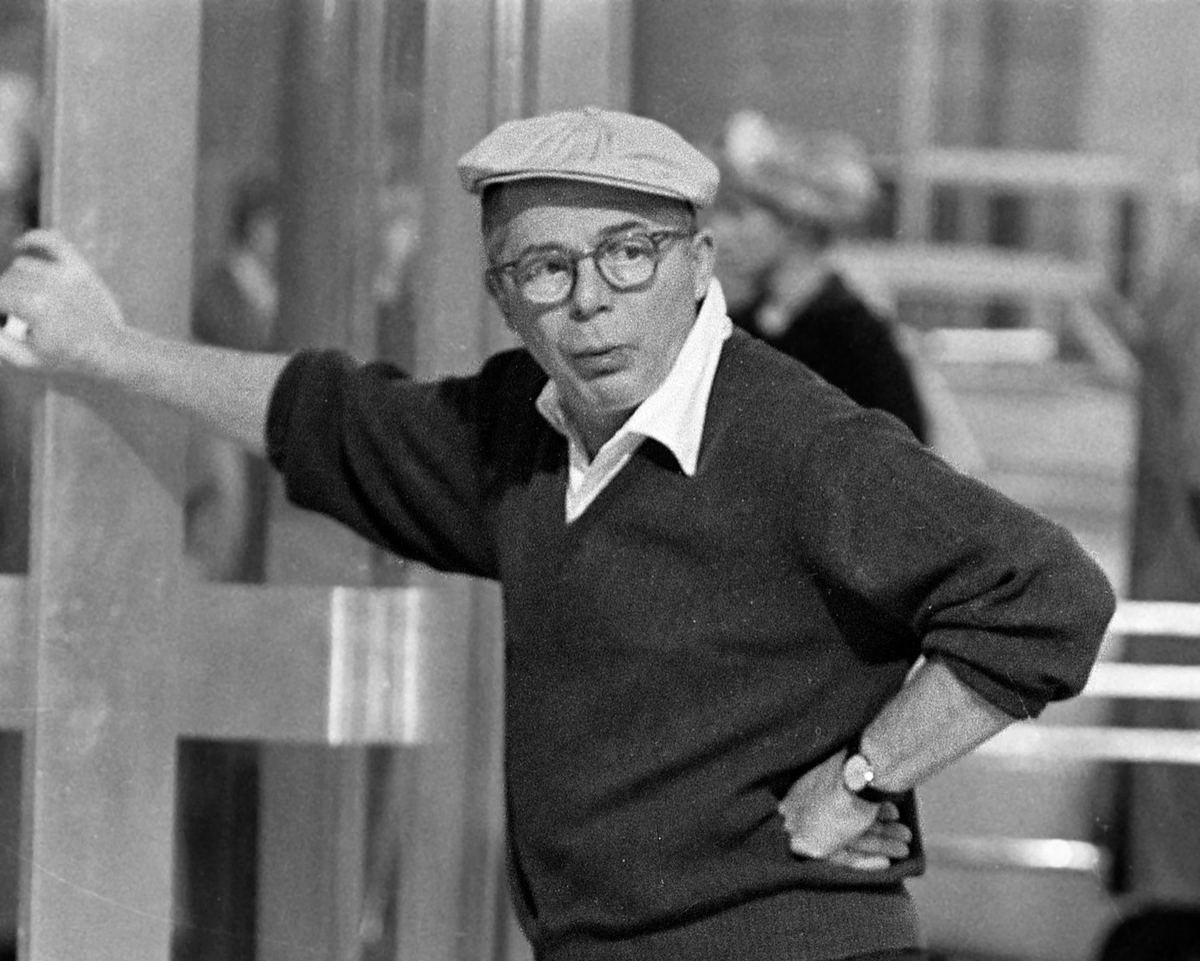
Billy Wilder, a titan of 20th-century cinema whose career spanned from his early days in Austria-Hungary to his final years in California, is the subject of a comprehensive new retrospective. Titled Almost Perfect, the exhibition at BFI Southbank runs from October 19 through the end of the year, celebrating a director who possessed a unique ability to craft flawless narratives. Fittingly, his gravestone bears an inscription referencing his most iconic line: “I’m a writer but then nobody’s perfect.”
Wilder was known as an inveterate self-mythologizer, often framing his own life story with calculated wit. He famously recalled his struggling early years in Berlin, where he was kept awake throughout the night by “a toilet that was on the blink.” Rather than seeking a simple repair, the young artist chose to reimagine the sound as a beautiful waterfall, using his fertile imagination to transform mundane frustration into the creative fuel that would define his legendary career. Twenty-five years later, he finally visited an Austrian spa and experienced an actual waterfall, which he described as the most beautiful in the world.
His filmography stands as a testament to his versatility and genius, encompassing genre-defining classics like Double Indemnity, the definitive film noir, and Some Like It Hot, which is frequently cited as the greatest comedy in cinematic history. His body of work also includes Sunset Boulevard, widely recognized as the preeminent film about the industry itself, and The Apartment, often regarded as his magnum opus. Like his contemporary Stanley Kubrick, Wilder moved fluidly between genres, delivering the scathing industry satire Ace in the Hole, the influential courtroom drama Witness for the Prosecution, and The Lost Weekend, which approached the subject of alcoholism with a raw honesty that was unprecedented in the 1940s.
Born Samuel Wilder in 1906, he did not change his name to assimilate; rather, he adopted the name “Billie” from his mother, who was enamored with Buffalo Bill’s Wild West shows after a visit to New York. Before his directorial rise, he worked as a journalist and a taxi dancer, experiences that sharpened his lifelong obsession with human complexity. His screenwriting journey began in Berlin during the silent era with People on Sunday, a project he collaborated on with future Hollywood colleagues Robert Siodmak and Edgar G. Ulmer. All three would eventually flee the rise of Nazism, finding their way to America, where their collective experience of tragedy likely influenced the fatalistic tone of the film noir movement they helped pioneer.
When he arrived in Hollywood in 1934 after a brief period in France, Wilder remained pragmatic about his identity, noting, “It seemed like the wise thing for a Jew to do.” Early in his tenure there, he faced a precarious moment at a consulate where he feared deportation back to a continent controlled by the Nazis. When asked about his profession, he succinctly replied, “I write movies.” The official, after some hesitation, stamped his passport with the encouragement to “write some good ones.” Wilder never forgot that encounter and maintained until the end of his life that he “did not want to disappoint that dear man in Mexicali.”
His Hollywood ascent saw him collaborating with Charles Brackett on screenplays for directors like Ernst Lubitsch, whom Wilder idolized, keeping a sign on his desk that asked, “What would Lubitsch do?” While the shadow of the Holocaust loomed over his work on Double Indemnity—where he channeled his survivor’s guilt into intense, dark storytelling—he continued to produce high-quality work for decades. Even his late-career, underappreciated masterpiece, The Private Life of Sherlock Holmes, demonstrated his enduring command of the medium.
Wilder’s final years were marked by a feeling of being out of step with the industry. His film Fedora, which centered on an aging star dismissing the “kids with beards” of the 1970s, inspired Jonathan Coe’s 2020 novel, Mr Wilder & Me. Currently, an adaptation of that novel is in development by screenwriter Christopher Hampton and director Stephen Frears, despite challenges in securing funding. This struggle for appreciation feels fitting for a filmmaker who lived by the motto that he was, above all, a writer whose work could never quite escape the imperfect nature of reality. The report also notes that he was born Samuel Wilder in 1906 to a Jewish family but the name change in this case was not an attempt at assimilation. The report also notes that he made his directorial debut there in 1934 with Mauvaise Graine although nothing about that film suggested what was to come once he arrived in Hollywood later in the same year. The report also notes that it was not just his febrile imagination that led Wilder to conclude he would ultimately end up “shipped off to Dachau” unless he could convince this interlocutor of his worth. The report also notes that a film-maker with a brand long before there were opportunities for promotion through Instagram accounts and chicken shop dates, wilder was an inveterate self-mythologiser. The report also notes that “I would lie there and listen to it, and since I was young and romantic, I’d imagine it was a beautiful waterfall – just to get my mind off the monotony of it and the thought of it being a can.”. The report also notes that even a lesser work like The Seven Year Itch contains one of the century’s defining images: that of Marilyn Monroe standing on a subway grate as her dress is blown upwards. The report also notes that wilder was undeniably an egotist but he had much to be egotistical about. The report also notes that all three men would end up in Hollywood having fled their home countries due to the rise of nazism and are among the most significant players in shaping the film noir movement, the fatalism of the genre surely a byproduct of the fates of their families.





Comments