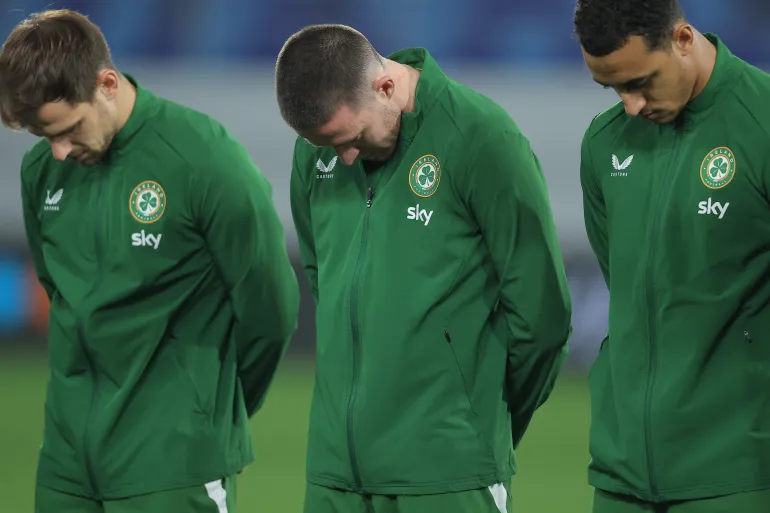
A politically charged UEFA Nations League fixture between Ireland and Israel concluded in a 1-1 draw at the TSC Arena in Backa Topola, Serbia, on Sunday. Despite the match being held behind closed doors at a neutral venue, the event was defined by significant tension, building on the confrontational atmosphere from their first meeting on September 27, which Ireland won 3-0. Will Ireland and Israel face each other again.
Reports surfaced during the match suggesting an altercation occurred at halftime, with claims that an Irish coach, Damien Doyle, was spat at by an Israeli player. Ireland manager Heimir Hallgrimsson declined to provide specific details on the incident when questioned by reporters, stating, “I was there. I’m not going to comment. It’s something a disciplinary committee will look at.” Conversely, Israel coach Ran Ben-Shimon denied witnessing the event, explaining that he had been in the dressing room with his staff at the time and intended to investigate the matter further. When I’m going to see and check, I will get back to you with the answer,” he told reporters. The Icelandic coach went on to talk about the toll it took on his players.
The sporting encounter was heavily influenced by the ongoing conflict in Gaza. Throughout the two-match series, the Football Association of Ireland (FAI) implemented several protest measures. Players notably opted out of the traditional pre-match handshake with their Israeli counterparts and did not exchange pennants, a decision accepted by UEFA beforehand. Furthermore, Irish players bowed their heads during the playing of the Israeli national anthem and wore black armbands to honor Palestinians killed in Gaza. During the same period, Irish players donated their match fees to charitable causes. It was one of several protest measures unveiled by David Courell, FAI CEO, at the pre-match news conference.
The Israeli team also wore black armbands, featuring the numerical reference “7.10” to mark the October 7 Hamas attacks in southern Israel. Ahead of the second match, the pressure on the Irish squad remained intense, with Hallgrimsson noting previously that he felt the strain of the situation reaching a “breaking limit.” He emphasized that while there is strong support for Palestine in Ireland, he does not believe teams should be drawn into such difficult political situations in the future. “I wouldn’t wish for any national team to go through what we have gone through these two weeks,” he said, suggesting that UEFA may need to intervene in future scheduling. What are the spitting allegations against Israel. According to “I’m absolutely delighted this is finished,” Hallgrimsson, After Sunday’s match, according to Ireland’s national broadcaster RTE.
The decision to exclude Irish player Finn Azaz from both fixtures was also attributed to the heightened emotional environment. Hallgrimsson explained that because Azaz has family with Israeli heritage, the situation was particularly challenging for him. “I just felt it was better to leave him out than play him,” the manager stated. The coach confirmed that Sunday’s match was the final scheduled encounter between the two nations in this tournament cycle.
UEFA’s current disciplinary stance remains unclear, as both the governing body and the FAI have not provided comments regarding potential inquiries. While UEFA operates a computer-generated draw system, it does maintain specific separation policies for teams due to geopolitical or travel restrictions; however, the Ireland-Israel matchup was not designated as a “prohibited clash” for this cycle. The only such restriction applied was between Bosnia and Herzegovina and Kosovo. Yes, while UEFA uses a computer-generated system to sort the 54 nations into four pots to create groups, it has certain draw conditions in place to keep certain teams apart due to geopolitical or travel restraints.
The use of black armbands in international football has precedent, with various teams utilizing them for tributes. Portugal previously wore them to honor midfielder Diogo Jota following his death in 2025, while Premier League clubs observed moments of applause for Pele in 2022. Additionally, AC Milan and Torino paid tribute to Kobe Bryant with armbands in 2020. Despite these historical examples, the specific atmosphere surrounding the Ireland-Israel fixtures remained unique in the current tournament landscape.