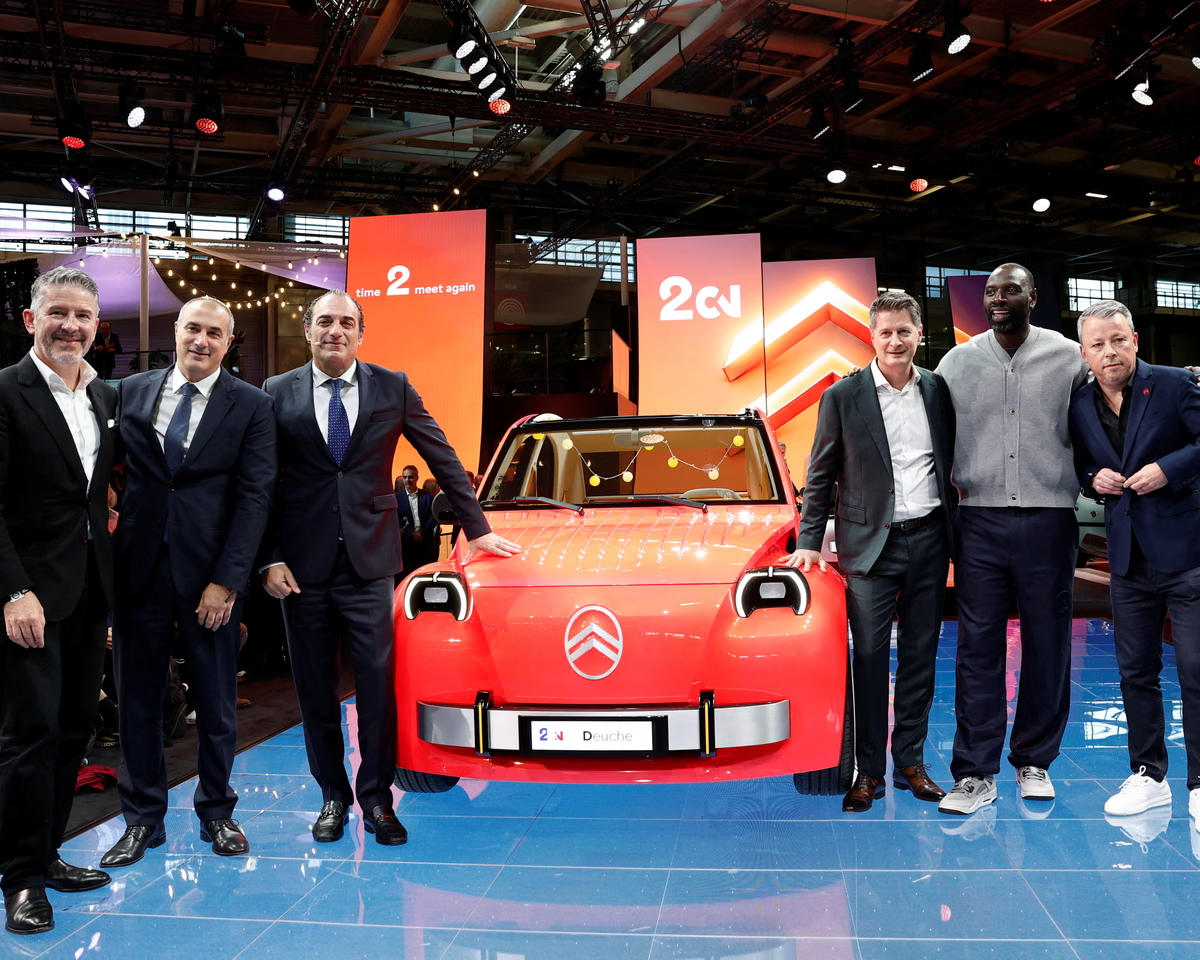
Top executives from Stellantis and Renault have called for the United Kingdom to be included in the European Union’s proposed “Made in Europe” industrial legislation, while insisting that Britain must also curb Chinese vehicle imports to safeguard its automotive sector. Emanuele Cappellano, head of Stellantis’s European brands—including Citroën, Fiat, Opel, and Vauxhall—and Renault CEO François Provost argue that for the purpose of these regulations, the UK should be treated as one of the EU’s 27 member states. Brands including Li Auto, GAC and Chery were among a host of Chinese manufacturers exhibiting in Paris with ambitious European expansion plans. However, automotive manufacturers and politicians are haggling over the details. According to “I think that UK somehow needs to be equalised to the EU 27,”, Cappellano, referring to the bloc’s 27 member states. “We have a lot of relationship, we have footprint.
The proposed Industrial Accelerator Act (IAA) seeks to prioritize European industry by ensuring that only vehicles “made in Europe” using sufficient local parts and materials qualify for EV grants and public procurement contracts. Proponents fear that a narrow definition of “European” would exclude Britain, a move that has sparked intense lobbying from the UK automotive sector. Stellantis, which maintains a factory in Ellesmere Port, Merseyside, is particularly invested in the outcome. Rather than helping manufacturers from other countries, the new rules aim to ensure EU subsidies and government procurement benefits Europe’s industry. While also investing tens of billions of euros in shifting production to electric vehicles (EVs), europe’s car industry is under enormous pressure as it copes with lower demand than before the coronavirus pandemic. The Made in Europe rules are another plank of the EU’s response to the rise of China in key manufacturing industries such as carmaking and chemicals.
While industry groups like ACEA and Clepa support UK inclusion, some European officials, including France’s industry minister, have questioned the move due to Brexit. Provost stated that there is “no other choice” but a formal agreement between the UK and EU to maintain a strong shared automotive footprint. However, he emphasized that this integration requires the UK to take a firmer stance against the current influx of Chinese vehicles.
The pressure comes as the EU implements its own measures to combat the rising market share of Chinese manufacturers. On Monday, the EU confirmed a new quota limiting hybrid electric vehicle imports from China to 350,000 units annually. This policy, stemming from a landmark four-year agreement reached in Beijing last week, is expected to halve China’s current 6% market share when it takes effect in December. At the same time, Chinese carmakers’ market share has soared as the transition to EVs opens the door to new entrants.
Discussing the broader competitive landscape at the Paris motor show, Provost noted that while the goal is not to close off the market, firms operating in Europe must demonstrate deep investment across the entire value chain. He suggested that if the UK intends to join the IAA ecosystem, the volume of imports must be addressed. London has traditionally resisted calls for unilateral tariffs on Chinese vehicles, though Business Secretary Jonathan Reynolds recently confirmed the government is reviewing that position.
Cappellano was more direct in his call for protective action, stating that the UK must clarify its priorities. He argued it is unsustainable to protect a domestic industrial footprint while maintaining completely open borders to imports, presenting the options as a binary choice. He also expressed doubt regarding the inclusion of nations like Japan, Turkey, or Morocco in the “European” scope.
To support the transition, Cappellano proposed allowing manufacturers to source 30% of materials from outside the EU. Additionally, he called for an extension until 2030 for regional battery sourcing requirements, noting that China’s current dominance in the global battery supply chain makes immediate local production scaling difficult.