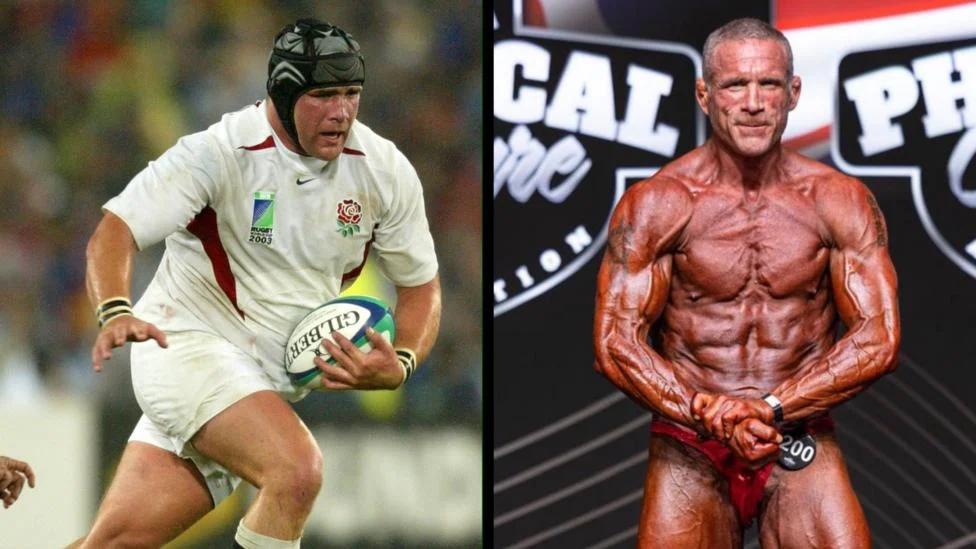
Waiting backstage at the Physical Culture Show in Hull earlier this month, Phil Vickery experienced a surge of familiar adrenaline. The former prop forward, who won the 2003 Rugby World Cup with England in Australia, stepped into bodybuilding competitions at the age of 50, posing on stage to the sound of World in Union. It’s 23 years since Phil Vickery was part of the England team that won the Rugby World Cup final in Australia. It could have been deep in the bowels of English rugby’s national stadium in Twickenham.
Recalling the atmosphere in Hull, Vickery admitted the pre-stage tension mirrored his former playing career. “It reminded me of being in the changing room before the big game, your nerves – are you going to be sick, you’re happy, you’re not happy, I can do this, this is raw,” he stated, noting that the memory still makes his hair stand on end. “That nervous energy and waiting and then, oh, it’s just a horrific feeling. All the girls and boys can relate to that, because that’s the same at whatever level of sport you play.”
Despite second-guessing his presence, Vickery reassured himself that he had put in the necessary labor. “I’m questioning myself, should I even be there? But then you go, actually, do you know what? I’ve done the work. I’ve done the graft,” he remarked.
His venture into competitive bodybuilding began following a challenge from his friend Lee Powell and guidance from physical trainer Dave Campbell. The transition ignited a familiar mindset from his professional rugby days. “What it probably did for me is ignite that ex-pro rugby player in me of detail, discipline, turning up when it’s dark and dingy and cold, competing, and we went from there,” Vickery explained.
During his rugby career, the former Gloucester and Wasps front-rower earned 73 caps for England and five for the British and Irish Lions. Outside of sports, he has achieved success as a businessman and won Celebrity MasterChef. However, ongoing personal difficulties and a diagnosis for probable chronic traumatic encephalopathy (CTE)—for which he is engaged in an active legal battle—have required careful attention to his mental health. He posts regularly on his social media channels about his health and fitness.
Finding a post-retirement purpose proved challenging for the former international. “We all deal with things differently,” he observed. “I think having the gym and having that space to be able to work is really important for my mental health, but also for my body physically, because it is broken, so I use it in that sense. I think the one thing I really struggled with when I finished playing is I trained to play and I couldn’t find that reason to train afterwards.”
He noted that committing to a complete fitness transformation provided structure. “And although you should train for yourself or your wellbeing, it probably took a low point or something to actually trigger it. But, probably, the bodybuilding – or doing the show or doing the original transformation – I have to close the circle. You know, you have a plan, you make a plan, you implement it, you commit to it, see it through, and then it’s over and it’s done. And then you move on.”
When competing on stage in Hull, Vickery weighed roughly 99kg—considerably lighter and more defined than during his playing career, when his weight fluctuated between 118kg and 135kg. “[On stage] you look the best version of you that you could look, but you feel the worst. It’s kind of a silly sport but it’s amazing what the human body can do,” he noted, adding, “Age, for me, doesn’t bother me at all. I still think I’m 27. My body tells me different.”
To maintain his conditioning, Vickery’s current schedule includes three or four weightlifting sessions per week, daily fasted walking, and a high-protein diet. While he hopes to participate in future competitions, he views the discipline as a tool for personal growth rather than a secondary elite career. He actively documents his journey online, though he rejects being called an “influencer.”
“What I’ve fallen in love with, with the bodybuilding, it’s a very singular, isolated sport, because it is you against you. It’s not about anyone else. There is no out. You can’t hide behind a keyboard. You are stood on stage. Your physique and what you look like is a direct reflection of your effort and what you have done, and that is quite scary,” Vickery reflected.
“I can’t do what I used to do and I think the battle for me, certainly when I finished [playing] and even to this day, is you cannot get back those feelings that you had when you used to do what you do,” he concluded. “I think doing things which can get you outside, test you physically and mentally, and put you in those uncomfortable positions. It’s repurposing the skills that you’ve learned. You’ve just got to use them in a different way. I don’t think everyone should go bodybuilding. My message is trying to be positive. Get out, do something, make a plan. I know I will never be a top bodybuilder. But it doesn’t stop me, it doesn’t stop me having a go and being the best version of me that I can be.”