Born in Manchester, Jamaica, in 1991, Delton Barrett grew up on the island of New Providence in the Bahamas, where he currently resides. His transition into professional photography began while working in construction with his father. After initial experiments with a flip phone capturing nature and flowers at work sites, he invested in his first DSLR camera in 2010 to begin a process of self-teaching. These early years were defined by landscape work, often captured during sunrise or sunset, before he began incorporating human subjects into his compositions. For the first couple of years, I used my flip phone, playing with images of nature and flowers on the sites we were working on, but in 2010 I bought my first DSLR (digital single-lens reflex) camera and started teaching. After leaving school, I worked with my dad in construction, and that’s where I started taking photos.
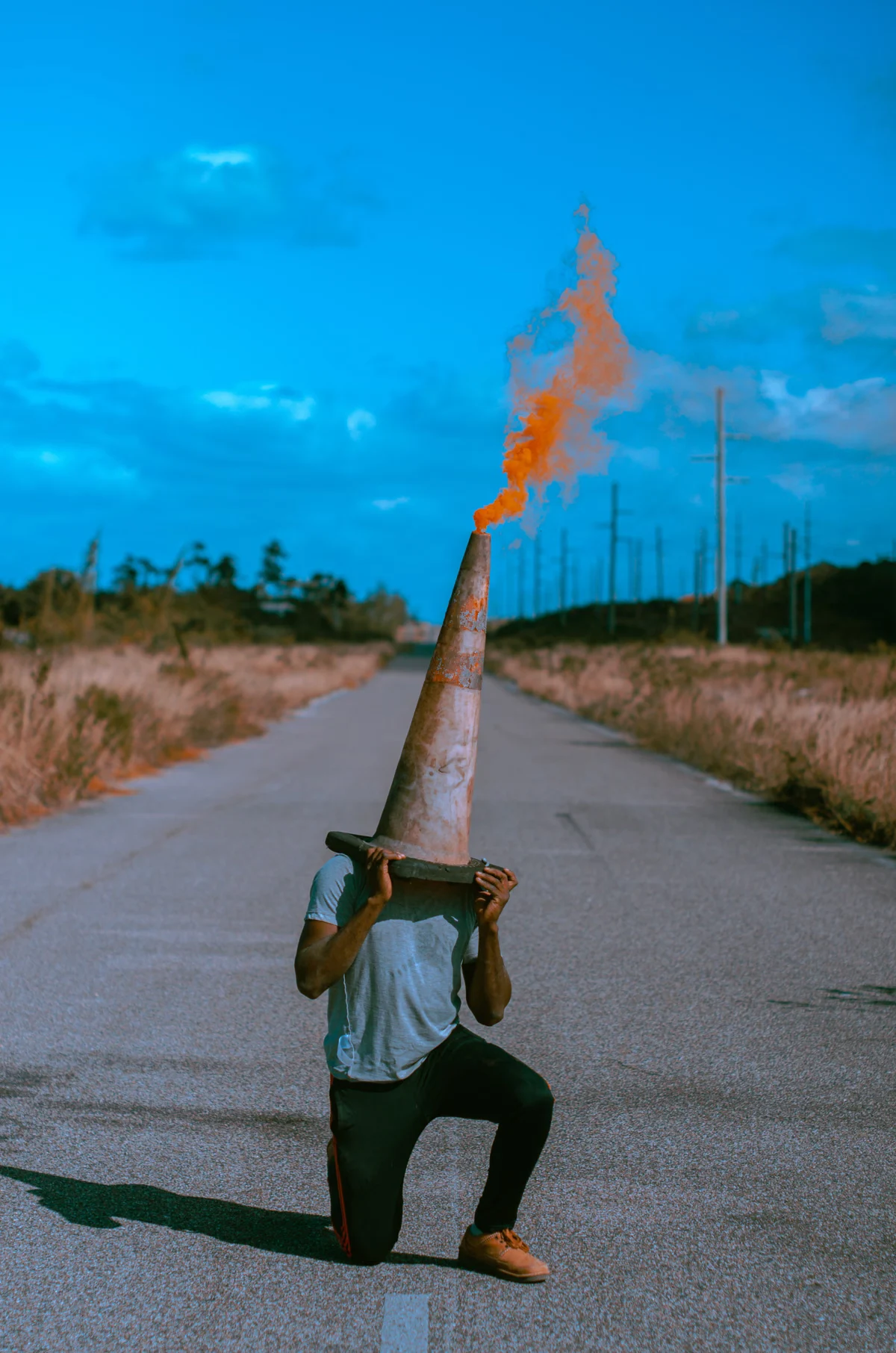
Barrett frequently features himself in his photography, utilizing a tripod and timer to place his figure into fantasy-inspired landscapes. One of his most notable works, titled Stop the Madness, originated from an experimental session on a secluded dead-end road on the western side of the island. Seeking to test new ideas, he arrived with several props and outfits, including a road cone he had retrieved from his collection of found objects. During the session, he decided to wear the cone on his head, a choice he admits was quite suffocating. Because I didn’t have a model, I used a tripod and a timer to include myself in these very fantasy-looking naturescapes.
The intensity of the final image was heightened by the addition of a smoke bomb that happened to fit perfectly into the cone’s tip. As he struggled with the device and the heat, Barrett realized the scene captured a feeling of someone losing their mind or going ballistic. He describes the resulting tension in the photograph, noting that his grip on the cone remains ambiguous—it is unclear whether he is fighting to remove it or clutching it to stay inside. He suggests the smoke could be a distress signal, a metaphor for the struggles people often hide from the public.
Barrett notes that his surroundings in the Bahamas, which are rich in color and vegetation, act as a primary catalyst for his work. This connection was cemented in his mind following a 2024 trip to Madrid, where he noticed the striking contrast between the urban development of Spain and the lush, natural backdrop of his home. His creative process varies from image to image; some pieces, like his homage to Michelangelo’s Creation of Adam, involve meticulous digital manipulation, while others like Stop the Madness require only framing and minor adjustments to lighting and contrast. In 2024, I went to Madrid, which is highly developed compared with the Bahamas.
Throughout his career, Barrett has focused on creating evocative, thought-provoking imagery. A significant milestone occurred in 2018 with his first solo exhibition at the D’Aguilar Art Foundation in Nassau. Reflecting on his journey, he offers advice to fellow creators: focus on personal expression rather than the pressure of the shoot itself. He encourages artists to sit with their concepts and identify the right method for execution, ensuring the final image captures the desired feeling without becoming lost in the technical rush. In a nutshell I would say: “Take the pressure off shooting and focus more on what you want to shoot and how you want it to feel”.