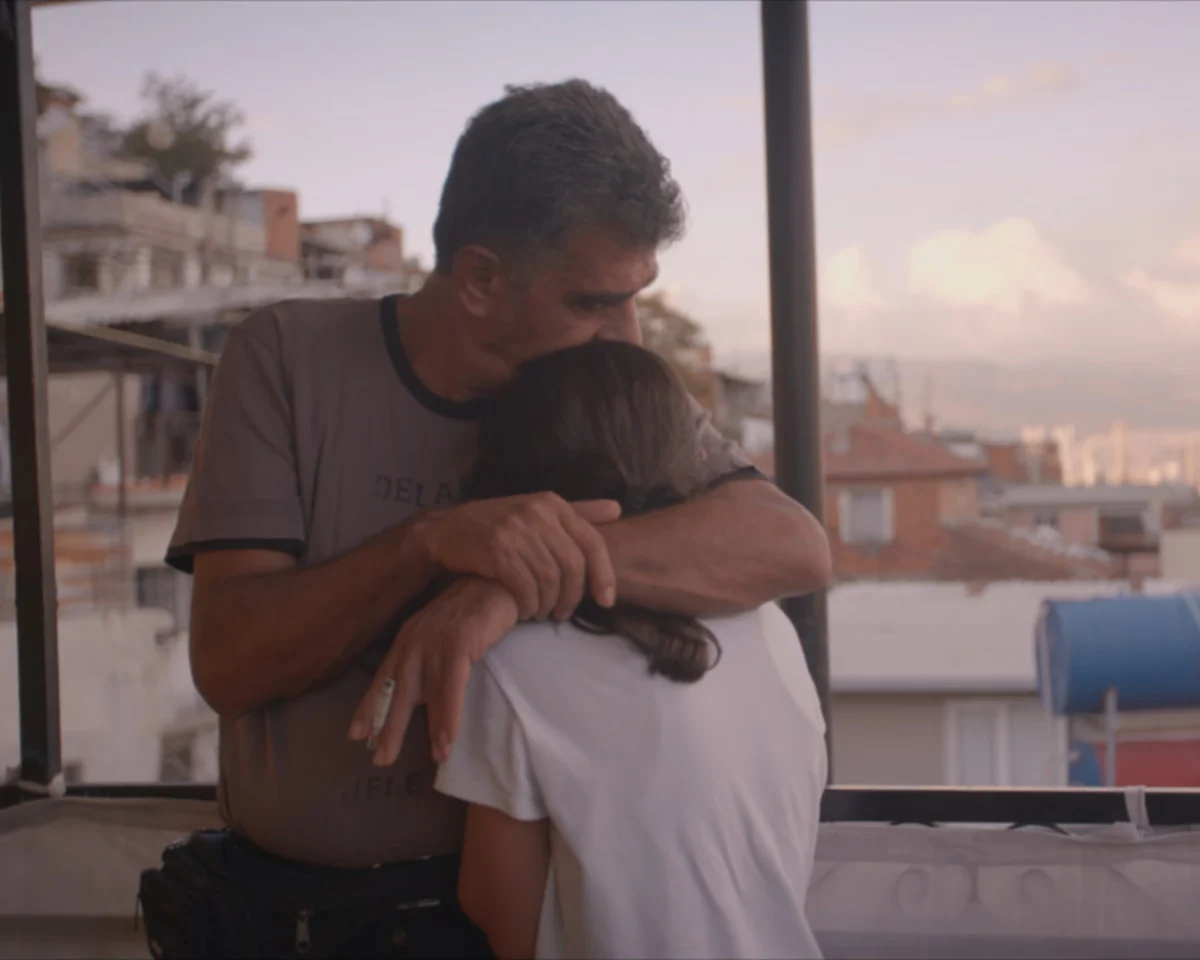
In 2015, an 11-year-old Syrian girl named Israa described with unsettling composure how her family planned to survive if their rubber dinghy sank during the perilous crossing from Turkey to Greece. She explained that her father would secure her disabled sister, her mother would attend to the baby, and she would rely on her own ability to survive, telling filmmakers, “I know how to rescue myself.” This interaction marked the beginning of a decade-long project for documentary filmmakers Itab Azzam and Jack MacInnes. Enthusiastic and positive, she was so bubbly. Too young to understand the risks, eleven-year-old Israa joked about the dinghy sinking. The body of the three-year-old Syrian boy Alan Kurdi washed ashore in Turkey, just a few months earlier. While her parents pushed her sister in a wheelchair, israa trudged through mud and freezing rain carrying her baby brother. Her once close relationship with her father became antagonistic.
The married couple first encountered Israa and her father, Tarek, in İzmir, a coastal Turkish city serving as a major hub for human smuggling. They were selling cigarettes to raise money for the journey. Azzam, who is Syrian herself, described the encounter as love at first sight, noting, “This ray of sunshine appeared in front of us.” While Israa remained lighthearted about the trip, Tarek expressed deep internal conflict, stating, “I’m gambling with the lives of my children.” The filmmakers witnessed the harrowing reality of the trade in İzmir, where families purchased fake life jackets for their children, a practice that horrified the crew. They invited us back to their flat. Sitting next to him in the restaurant of a London hotel, Azzam brushes aways tears as she remembers filming in İzmir, a hub for the people-smuggling trade. “It was absolutely heartbreaking. I’m not sure we could have filmed it if we’d had children at that point.”. Aged 12, she chose not to wear the hijab, a decision she later revisited. It was Europe’s biggest movement of people since the second world war.
The couple, who met while working together in 2010, initially moved to Damascus to establish a production company but relocated to London in 2011 following the start of the Syrian uprising. But the film-makers found it impossible to walk away.
They now live in London with their six-year-old son.
When they began filming their BBC series Exodus, they intended to document the migration crisis. Following Israa’s family across refugee transit routes, they found themselves integrated into the family’s life. After the family reached Germany, the filmmakers continued their work, driven by a bond that grew beyond professional boundaries. Israa specifically asked if they would visit, to which the filmmakers promised they would.
As the family settled in Cologne, the project evolved into a deep look at integration and personal transformation. In Germany, Israa mastered the local language within five months, navigated the complexities of teenage life, and experienced shifting dynamics with her father. Tarek, who had been a prominent falafel restaurant owner in Aleppo, struggled to reconcile his lost status as a provider and community figure with his new life as an immigrant. Meanwhile, Israa’s mother, Nisreen, evolved from a peripheral figure into a central, resilient force, which MacInnes described as a genuine hero’s journey.
The filmmaking process was not without personal and ethical challenges. The crew faced financial strain, at times accruing 40,000 pounds in debt while relying on credit cards to fund the documentary. During a particularly difficult period when Israa was 14, she disclosed that her father had been physically abusive. MacInnes immediately stopped filming to prioritize safeguarding, recognizing that the family’s welfare far outweighed the importance of the production. They handled the situation with extreme sensitivity, eventually continuing the project as a portrait of love and resilience. How bad did it get? “I think we were at least 40 grand in debt at a one point,” McInnes replies grinning. “But we were young freelancers.”. He switched off the camera and into safeguarding mode: “We suddenly realised something much more important was happening than the film,” he remembers.
The scope of the film expanded as the filmmakers followed the family’s life through marriage and beyond. Although they initially planned to stop when Israa turned 18, they continued as she married Mohammed, a fellow Syrian refugee. In late 2024, following the unexpected fall of the Assad regime, the film captured the poignant moment of Israa returning to Aleppo. This journey home offered a stark contrast to her life in Germany. She adds: “When we started, the idea was: let’s document this journey, it also didn’t feel like the end of the story. Made friends and fell in love with Justin Bieber, she started school.
For Azzam, the experience of being a refugee is a constant, underlying struggle. Despite being settled in the UK for 14 years, she acknowledges the persistence of anti-immigrant sentiment but maintains she has never personally experienced racism. Her own connection to Syria remains fraught with loss; as a member of the Druze religious minority, she recently saw footage of her home village destroyed after clashes between armed tribes and Druze fighters following the collapse of the Assad government.
The documentary, titled One in a Million, serves as an intimate chronicle of survival. MacInnes reflects on the early days of the crossing with emotion, noting that at the time, they were fully aware of the possibility that the family might not survive the journey. Tarek’s final words to the filmmakers before they departed on the boat—”If anything bad happens to us, you have to tell our story”—remained a driving force for the duo throughout the decade. Their documentary, One in a Million, is extraordinary – with echoes of Richard Linklater’s Boyhood and the Up! series, ten years in the making. And that would be it.”, mcInnes still finds the scene emotional to watch: “At the time we knew there was a chance that we would say goodbye to them.