A record number of maritime attacks has been recorded in and around the Strait of Hormuz, according to a recent analysis of UK Maritime Trade Operations (UKMTO) data. Between October 5 and 11, twelve vessels were targeted, marking the highest weekly frequency of strikes since the onset of the US-Israeli conflict with Iran. This surge follows the previous week’s total of 10 attacks and includes a single-day high of six incidents occurring on Sunday. The previous week saw 10 ships reporting attacks.
As these strikes intensify, the recovery in oil shipment volumes observed last month has begun to falter. Trade intelligence from Kpler indicates that daily oil transit through the strait dropped to approximately 12.6 million barrels by October 13, down from 15 million barrels at the end of September and significantly below the pre-war baseline of 17 million barrels. So-called assisted transits were a key factor in helping drive oil flows from the Middle East back towards pre-war levels in September. The aim here is to stop the ships going through and to deter others,” he added.
US military Central Command maintains that commercial traffic continues to transit the area with coordinated protection from regional partners and US forces. Data from the US Navy suggests that assisted navigation efforts surged, with the number of vessels receiving support during the first ten days of October rising by 85% compared to similar activity in August. This assistance typically utilizes a shuttle system where smaller vessels traverse the strait before transferring cargo to larger tankers in the Gulf of Oman, often following routes near the Omani coastline—a path Iran deems unauthorized.
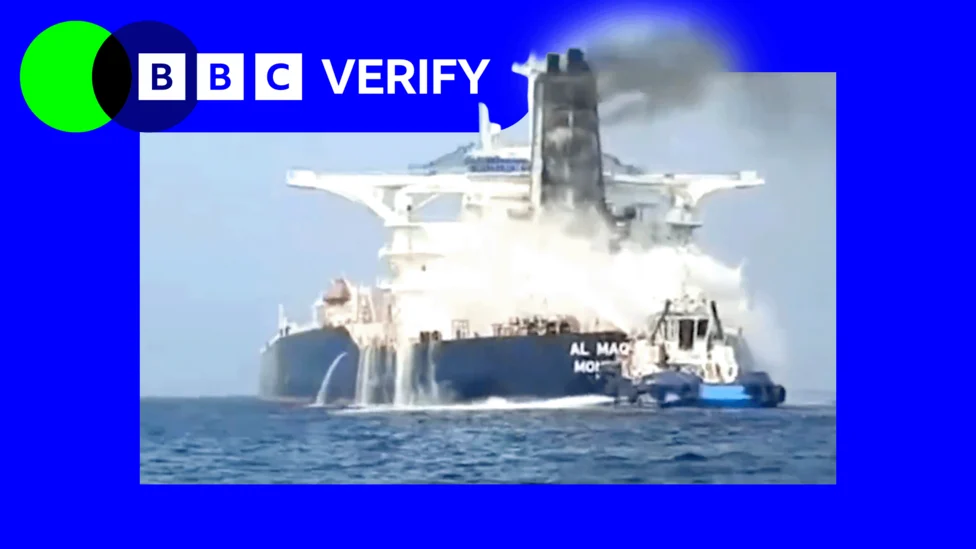
The human cost of these incidents remains severe. During one of Sunday’s strikes, the Nicaragua-flagged tanker Petro Dolphin was set ablaze near Oman’s Sohar Anchorage. While 11 Indian seafarers were rescued, the Forward Seamen’s Union of India confirmed that two crew members remain missing. Additionally, the container ship GFS Pride sank in the strait on Tuesday after being hit by an unknown projectile, though all 21 crew members were safely evacuated. Verified footage shows crew members running across the deck and putting on lifejackets as a large cloud of black smoke rises over the ship.
Iranian state media and the Islamic Revolutionary Guard Corps (IRGC) have alleged that the GFS Pride was involved in illegal activity, claiming the ship carried contraband on an unauthorized route. The IRGC has explicitly stated that strikes will not be confined to the Strait of Hormuz, announcing a new deployment formation across the broader region. According to it, The vessel was carrying “2,500 containers of contraband” and had taken an “unauthorised route”.
Security analysts observe that Tehran is actively broadening its operational scope to assert control over the waterway. Martin Kelly, CEO of Orbital Risk Intelligence, notes that Iran has evolved its strategy to include near-daily, multiple-strike events aimed at deterring maritime traffic. These attacks are increasingly occurring well beyond the strait itself. For instance, a tanker was struck by multiple projectiles north of Qatar on October 8, resulting in reported casualties, and another vessel was attacked near the UAE’s Al-Jazirah al-Hamra on October 9. Another vessel was hit by a drone near Sohar, more than 250km away from the strait, while the incident north of Qatar took place over 500km from the waterway. According to verify collated incident, Published by the UKMTO on its website and created a timeline based on the first date cited in each report. This is approximate because some incidents use the date of the attack and some the date on which it was reported. The vessel was struck by a drone close to the Sohar Anchorage, Oman, more than 250km (150 miles) from the strait, according to the maritime intelligence firm Vanguard. According to a tanker was struck by multiple projectiles north of Qatar on Thursday 8 October, more than 500km (310 miles) from the strait, resulting in multiple, Casualties, according to Vanguard.
With Iran’s own exports stalled due to US blockades, the ongoing volatility and the expansion of these attacks toward the coasts of Gulf Arab states and the Gulf of Oman continue to strain regional logistics and maritime security. Graphics by Tom Shiel and Mark Edwards.