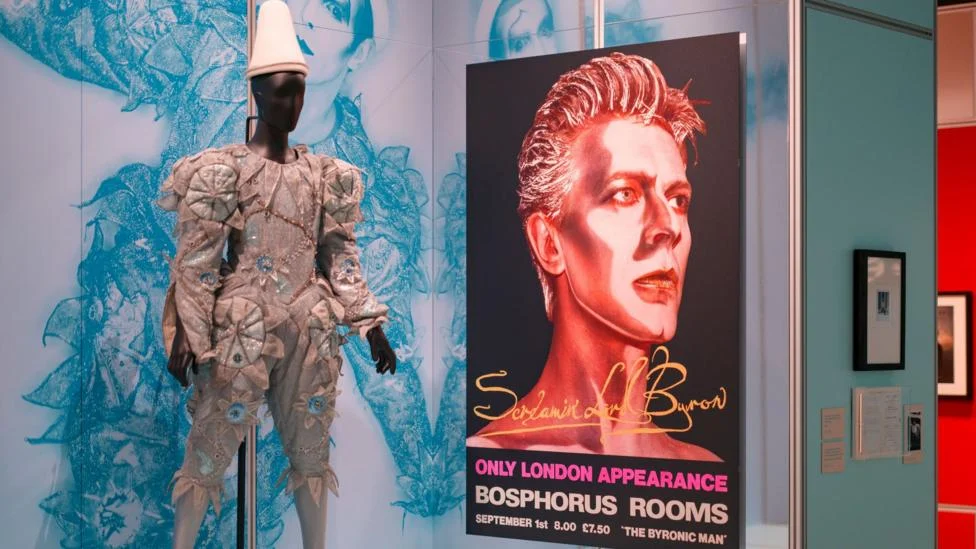
Musician Nile Rodgers once remarked that David Bowie did not merely create art—he was art himself. Reflecting that legacy, the V&A Dundee is hosting a major new exhibition celebrating the iconic artist’s life, work, and enduring relationship with Scotland. Situated within earshot of the venue where Bowie performed with his band The Buzz in 1966—a night where they were not even the headline act at the Palais de Danse—the showcase marks the ongoing bond between the musician and his Scottish fanbase.
TitledDavid Bowie: On Tourthis is the very first exhibition to feature items directly from the singer’s personal archive, which was acquired by the V&A in London in 2023. Out of 90,000 items preserved inside the dedicated David Bowie Centre built to house the collection, around 100 objects have been selected for display. Many of these historical items have never previously been shown to the public.
Key Archive Artifacts
- First InstrumentA saxophone purchased for Bowie by his father for Christmas in 1961.
- Personal DocumentsBowie’s official passport from 1988 alongside a stopwatch he used while writing songs.
- Rare RecordsAn advance copy of The Velvet Underground’s 1967 albumI’m Waiting for the Man.
- Neighbourly ComplaintA written note sent to “Mr Bowy” by his London neighbours in December 1973, reading: “We would be very grateful if you would be considerate enough to have the music played much more softly and stop at a reasonable hour.”
- Film HistoryRare Polaroid images documenting costume fitting tests for the 1986 movieLabyrinth.
Leonie Bell, director of the V&A Dundee, highlighted the unique nature of the display, saying: “It offers something very special, the chance to encounter personal and intimate objects which reveal how David Bowie thought, worked and continually reinvented himself.”
Bowie meticulously preserved materials from the earliest stages of his career, documenting his progression into one of the world’s most influential and enigmatic musicians. Later in life, he collaborated with professional curators to catalog and organize his archive, using it to revisit and rework previously abandoned projects as well as replace personal items that had been lost or given away over the decades.
The exhibition also focuses heavily on Bowie’s history of live performances across Scotland. In January 1968, he appeared alongside Lindsay Kemp in Edinburgh performingPierrot in Turquoisea theatrical blend of mime, music, and dance. When he later brought his legendary Ziggy Stardust tour to the capital, fans at the former Empire Theatre—now the Festival Theatre—had to wait until 23:30 for the show to begin while staff cleared out the bingo hall that supplied the venue’s primary income.
Curator Svetlana Panova noted that Bowie performed in Scotland numerous times throughout his career. She added that the dedication of local fans made it possible to tell the cherished story of his 17 May 1973 concert as part of the Ziggy Stardust tour, when approximately 2,500 fans packed into Dundee’s Caird Hall.
Another famous Scottish appearance occurred in June 1978 at the Glasgow Apollo. In an interview with reporter Fidelma Cook forReporting ScotlandBowie named the Apollo as one of his favourite venues, citing its “exceptionally excited audiences, intoxicated with the idea of a theatrical show.”
Fan Connections and Personal Stories
At the center of the exhibition, images of Bowie wearing a striking Kansai Yamamoto bodysuit are displayed above a case containing Polaroids and memorabilia from the 1973 Dundee show. Much of this material was gathered by self-confessed super-fan John Reilly, a former Dundee United footballer.
John was just 11 years old when Ziggy Stardust played Caird Hall in May 1973. Although he collected extensive memorabilia from the gig, he was unable to get inside the packed venue. “I thought it would be like a football match, and I’d just crawl in under the turnstiles behind my dad,” John, now 64, recalled. “I’ve got a couple of pals who were there and frequently remind me of what I missed out on but I like to think I made up for it after that.”
John went on to see Bowie live 49 times before the singer’s death in January 2016, though he still considers the Dundee gig the one that got away. His devotion ran so deep that he gave his daughters the middle names Bowie and Dalglish to honor his two greatest passions. His collection started early: “The girls in my class would save pictures from their Jackie magazines and I’d collect them in scrapbooks,” he said. “Then it was records and posters and tour programmes.”
For John, having Bowie’s legacy celebrated in his hometown is deeply emotional, serving as a reminder of the escape the music provided over the years. “I’ve made friends from all over the world and something like this brings the whole Bowie family together,” he noted. “Only this time, instead of travelling around to see him, I can get the bus into Dundee and the bus back home again and see it all on my own doorstep.”