
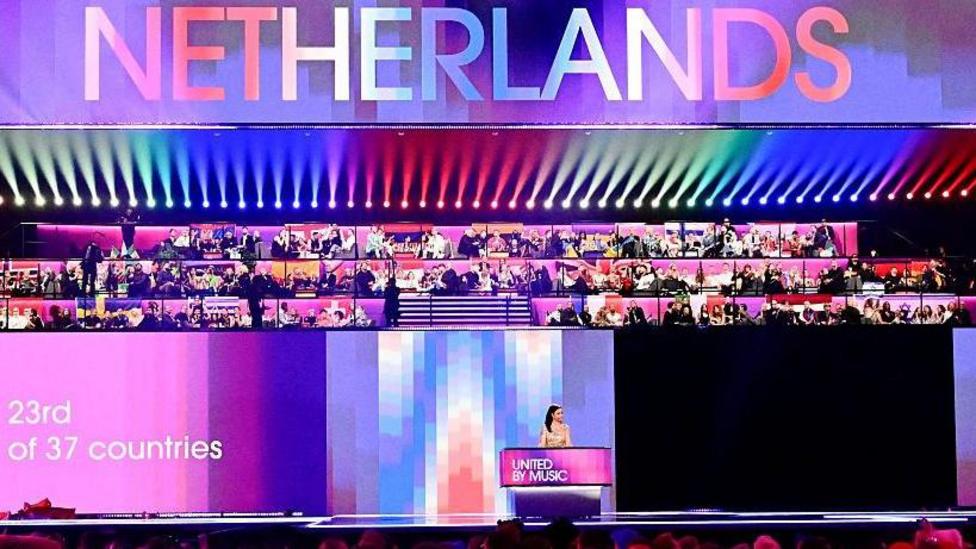
Dutch public broadcaster Avrotros has officially withdrawn from the 2027 Eurovision Song Contest. In a statement released on Monday, the organization cited a lack of clarity from the European Broadcasting Union (EBU) regarding the criteria for assessing which nations are permitted to compete, arguing that the contest can no longer be viewed as neutral while countries involved in large-scale military conflicts remain participants.
Taco Zimmerman, director general of Avrotros, stated that while the competition was originally intended to unite people and nations, it has evolved into a “platform for division.” He noted that international conflicts are increasingly undermining the event’s neutral character, adding that the decision to step away was painful but necessary to remain committed to the broadcaster’s core values.
The broadcaster specifically highlighted that the ongoing humanitarian crisis in Gaza and restrictions on press freedom have fueled recent tensions surrounding the contest. Although the EBU recently updated its rules to disqualify winning countries from hosting if they are involved in armed conflict or face “sensitive geopolitical” instability, Avrotros maintains that these changes “do not provide sufficient confidence that the independent and neutral character of the Eurovision Song Contest has been restored.”
Martin Green, the contest’s director, expressed regret over the decision but noted that the EBU respects the broadcaster’s perspective. He emphasized that the event remains a venue for celebrating diverse communities and fostering hope, even during difficult times. The EBU is currently in dialogue with the NPO, the umbrella organization for Dutch public media, to explore whether another broadcaster might take over the country’s participation.
The withdrawal specifically concerns the 2027 event in Burgas, Bulgaria, though it does not definitively rule out future Dutch participation. The Netherlands previously boycotted the 2026 contest in Vienna, Austria, following the inclusion of Israel. That year, five broadcasters—including those from Spain and Ireland—also boycotted the event after a failed attempt to suspend Israel from the competition.
Despite these protests, Israel’s representative Noam Bettan secured second place in 2026 with the song “Michelle,” marking the second consecutive year the nation finished as runner-up. Some broadcasters have privately raised security concerns regarding the prospect of hosting the contest in Jerusalem or Tel Aviv should Israel win in the future.
The EBU’s new hosting restrictions are expected to impact more than just Israel; they also apply to Ukraine, which has been involved in a protracted war since the Russian invasion in 2022. Notably, the Ukrainian group Kalush Orchestra won the contest that same year in a display of public support. As one of the most successful nations in Eurovision history, the Netherlands trails only Ireland and Sweden in total victories. The report also notes that even when that means stepping away from an event that is very close to our hearts, he added: “They guide us in everything we do. The report also notes that that is painful as we would have very much liked to be part of the contest again next year. The report also notes that safety or stability of their state or immediate region”, it stated that winning countries will also be disqualified from hosting if a “sensitive geopolitical situation” affects the “security. The report also notes that it will also affect Ukraine, which has been engaged in a protracted war since it was invaded by Russia in 2022, although Israel will undoubtedly be seen as the target of the rule change.







Comments