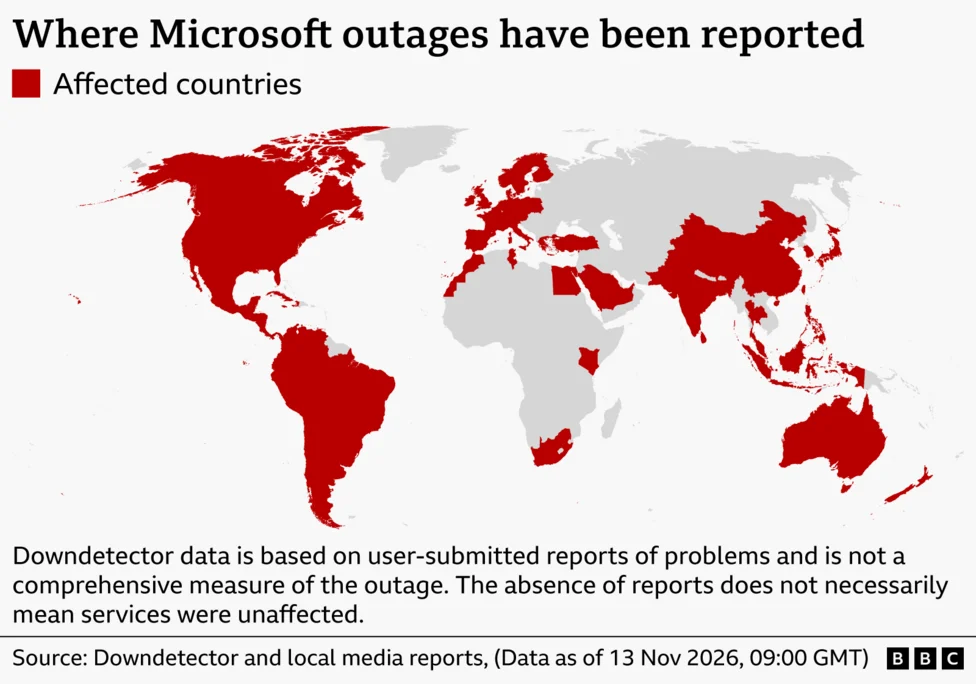
Microsoft is working to restore its suite of online services following a massive global outage that disrupted operations for schools, healthcare systems, and government agencies for nearly 24 hours. The technical failure impacted critical tools such as Microsoft 365, Teams, Outlook, and the AI software Copilot, with issues reported in at least 74 countries worldwide. Watch: What we know so far about the Microsoft outage. Services including Teams, Outlook and AI software Copilot, are being restored almost 24 hours since issues first surfaced. Messaging and online meeting functions without issues, but some users were able to use Teams. The trouble is that this kind of failure snowballs. We know the trust they place in our services and take that responsibility extremely seriously.
By Friday afternoon, the company announced it had achieved encouraging recovery progress across Europe and noted significant improvements in North America. Microsoft clarified that the disruption was caused by a technical issue during a network capacity upgrade and was not the result of a cyber-security incident. The company has formally apologized for the widespread disruption to its partners and customers. Disruption across the globe has been widespread, from city governments in the US to Australian spy agencies.
While services are beginning to resume, Microsoft warned that some users might still face intermittent access problems. The company is specifically monitoring email queues, which it says are significantly reduced and approaching normal levels. To prevent the loss of data, Microsoft extended its email timeout window to 48 hours, ensuring that messages held up during the outage will eventually be delivered as the system catches up.
The impact of the outage has been felt globally, affecting more than 430 million people who rely on Microsoft 365.
In the United Kingdom, the disruption hit GP surgeries, pharmacies, police forces, and schools.
Some medical practices advised patients to avoid submitting online messages, while police departments asked the public to call directly to make reports.
Similar issues were noted in Japan, where the government’s shared IT platform was disrupted.
In North America, courts from Los Angeles to Texas issued warnings regarding delayed communications. Canadian broadcaster CBC reported that a hospital network in Toronto faced email failures, though patient care remained unaffected. The outage also created a domino effect for other tech companies; OpenAI reported that its ChatGPT service faced connectivity issues linked to Microsoft’s infrastructure, causing some tools to malfunction.
Experts suggest the length of the outage—lasting over 20 hours—is exceptionally rare for business-critical systems. Prof James Ferryman from the University of Reading explained that the failure occurred when servers responsible for secure connections became overwhelmed and stopped responding. The outage has so far lasted for more than 20 hours – in outage terms that is considered a long time, although email service Outlook appears to be resuming. And once that happens the server just stops answering,” he said, what Microsoft has told us is that the part of its servers that sets up secure connections is getting swamped. Its work gets passed to the next one, and meanwhile huge numbers of phones and laptops keep trying to get back in, one server falls over.
He noted that the recovery process must be gradual because a sudden surge of millions of devices trying to reconnect could cause the system to crash again.
Gergely Orosz, a former software engineer at Skype and Uber, described the event as potentially the most disruptive business email outage of all time. Cyber-security expert Troy Hunt emphasized that the incident serves as a reminder of how critical Microsoft is to the internet’s backbone, impacting everything from work schedules and medical appointments to account verification and retail purchases.
Microsoft stated that it remains focused on addressing the remaining areas of disruption and is seeing broad stability across its network. The company noted that when delayed emails finally arrive in inboxes, they will carry a timestamp reflecting their delivery time rather than the original time they were sent. The technology giant continues to monitor the situation to ensure a full restoration for all remaining customers and regions. According to from late on Thursday, customers, Varying levels of access – many were unable to send or receive emails, view certain files or details on their calendar apps. It is not quite safe to assume every email you send is going to arrive in its intended recipient’s inbox right away, in other words. Additional reporting by Henry Moore.