

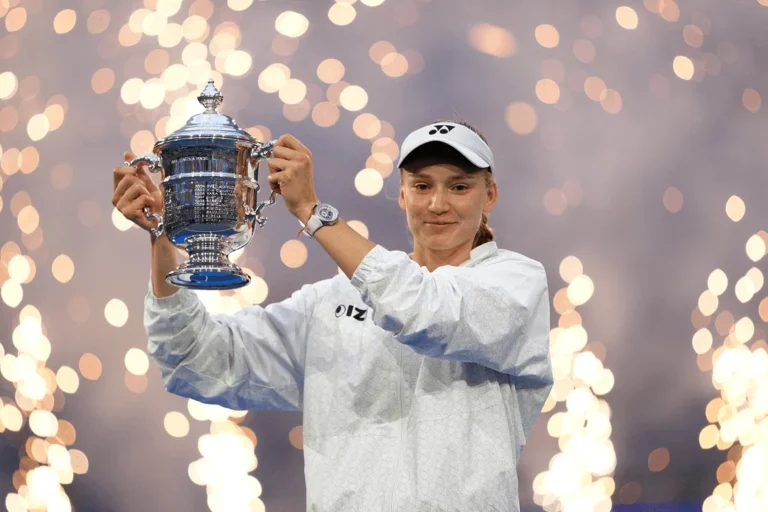
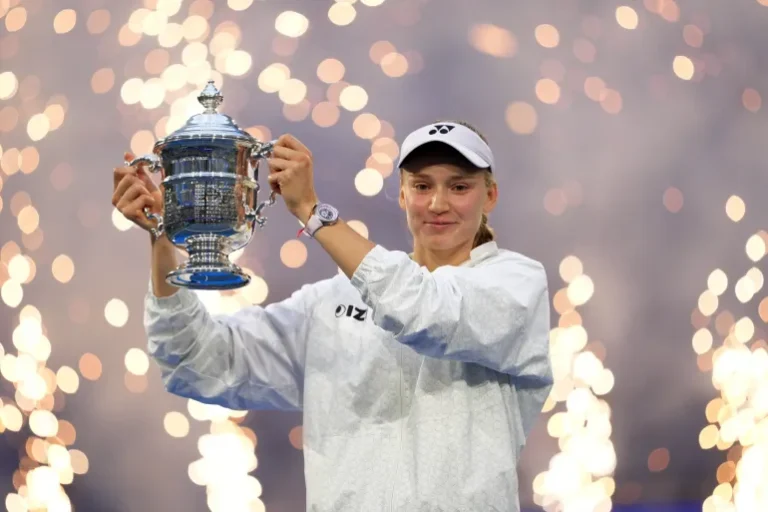
Elena Rybakina has solidified her position as the premier force in women’s tennis, overcoming her primary rival Aryna Sabalenka in a tense 6-4, 5-7, 6-2 battle to clinch the US Open title. This victory marks a significant shift at the top of the sport, as the 27-year-old effectively snatched the world No. 1 ranking from the two-time defending champion, establishing herself as the new standard-bearer for the game.
The path to this triumph was far from straightforward. Rybakina entered the tournament hampered by an Achilles injury that sidelined her for a week, leaving her competition status in doubt. Her run to the final saw her navigate a gauntlet of four consecutive Grand Slam or Olympic champions, proving her mental resilience under immense pressure. Even when her serve—typically her most potent weapon—struggled early in the final, she relied on superior baseline play to neutralize Sabalenka. When pushed into a decider, Rybakina recalibrated, hitting her stride in the third set and firing her 12th ace of the match to cement her legacy.
Reflecting on her ascent, an understated but emotional Rybakina admitted the feat was still sinking in. She expressed pride in the hard work that carried her through a grueling fortnight, noting that it was difficult to put the magnitude of her recent achievements into words. By winning in New York, Rybakina now holds three of the sport’s most prestigious hard-court titles—the Australian Open, the US Open, and the WTA Finals—placing her alongside legendary figures like Lindsay Davenport and Ash Barty as a three-time Grand Slam champion.
For Sabalenka, the loss was a difficult pill to swallow. While she displayed sportsmanship at the net, her post-match demeanor revealed the weight of the moment as she expressed frustration over failing to secure a third consecutive US Open title. Having reigned as the world No. 1 for 99 consecutive weeks—the sixth-longest streak in history—Sabalenka conceded that she is currently in a difficult spot if Rybakina continues to perform at this level. “If she continues to play like that? Then, yeah, I’m in trouble,” she admitted with a laugh.
The rivalry between the two has become the defining story of the current season. Since the Australian Open transitioned to a hard-court format in 1988, this marks only the second instance where the same two players have squared off in both that tournament’s final and the US Open decider within the same calendar year. Furthermore, it represents the third time the top two ranked players have met in a Grand Slam final where the No. 1 spot was on the line.
While Sabalenka struggled to contain her emotions following the defeat, acknowledging that she needed to let her aggression and disappointment dissipate to remain composed, the result leaves her with a 4-6 record in Grand Slam finals. As the tour moves forward, the pressure shifts to the former top seed to return to the practice court and find a tactical solution to bridge the gap with the new world No. 1. The report also notes that the Kazakhstani showed her toughness in another spectacular tussle with her great rival, nervelessly closing out a 6-4, 5-7, 6-2 victory over Sabalenka, the top seed an, as she has done throughout this unforgettable week. The report also notes that even after she had won grand slam titles and conquered all surfaces, Elena Rybakina has always been considered lesser than the greatest players of her era. The report also notes that but there were always a couple more consistent and mentally tougher players above her, she has long been one of the most devastating shotmakers in the world. The report also notes that she cleared every hurdle without hesitation.
Comments