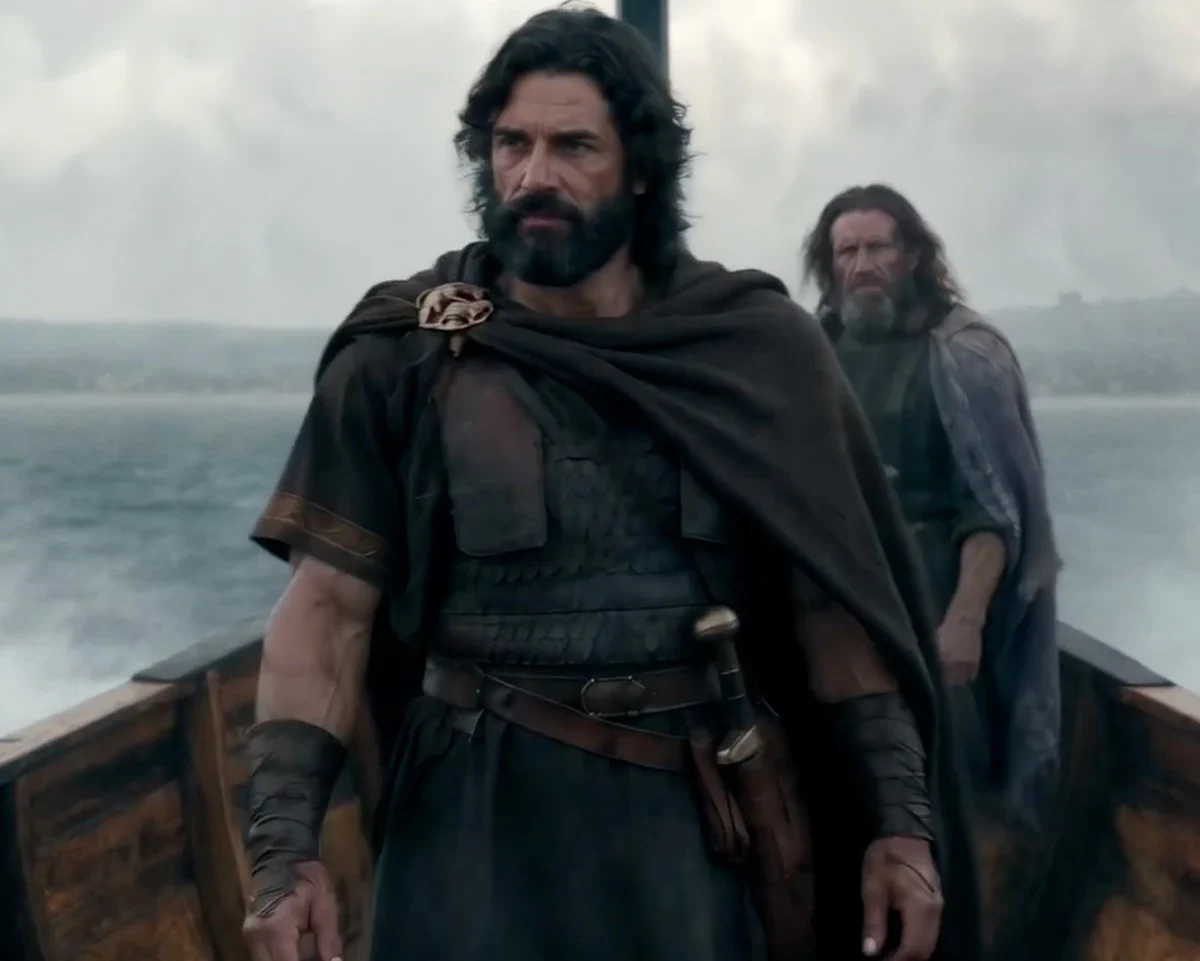
Elon Musk has released the inaugural seven-minute episode of his own interpretation of The Odyssey, generated via his Grok AI platform. The move follows a public outburst in which Musk criticized Christopher Nolan’s film adaptation—specifically the casting of Elliot Page and Lupita Nyong’o—and claimed he could produce a more authentic version of the classic epic. And now he has released the first online seven-minute “episode” to a world that has long since forgotten about this claim and didn’t care in the first place. As the plaudits and the box-office receipts for Nolan’s Odyssey piled stratospherically up, Musk showed that being a good loser is not among his qualities.
The current release captures a narrative prologue absent from the Nolan film, depicting Odysseus feigning madness to evade the Trojan War. In this sequence, Palamedes and Agamemnon force the issue by placing Telemachus in the path of a plough to test the hero’s resolve. Once Odysseus reveals his true intentions, the story shifts forward ten years to the brink of the Trojan horse assault. Despite the intent, the visual quality remains characterized by inert, stock-footage aesthetics reminiscent of video game graphics. And an intertitle tells us we have cut to a 10-years-later flashforward; the siege is about to escalate into the fake-horse attack, the expeditionary force arrives at Troy. As the tale begins Odysseus is – off screen – pretending to be mad to avoid fighting in the Trojan war, in Musk’s version. Grim-faced Palamedes and Agamemnon are shown testing this ruse by taking his baby boy Telemachus and placing him in the harm’s way of a plough in a field; Odysseus instantly rushes to save his child, showing that he isn’t mad, and agrees to fight. With Penelope and Telemachus (soon to grow to a little boy) left behind, we see him join the armada.
Technical execution has drawn criticism for its monotonous tone, with the AI-generated characters delivering lines in a rigid, declamatory style. Every dramatic beat—from the protagonist’s departure to the tactical decisions of the siege—is rendered with a lack of emotional weight, resulting in an experience that critics have compared to a standard laptop screensaver.
Musk’s project appears driven more by his desire to win a previous argument than by artistic ambition. Observers suggest that while the technology may improve with future episodes, the current results highlight a persistent skepticism regarding the artistic merit of AI-generated content compared to its financial efficiency. The release serves as a reminder of the vast quality gap between human-led productions and automated alternatives. Of course, as we are always being told, AI is continuously improving.
For now, the AI-powered adaptation remains a point of contention that further underscores the divide between Musk’s vision and conventional cinematic storytelling. Whether further installments will manage to evolve remains to be seen, but the initial response suggests the project has gained little traction with an audience largely indifferent to Musk’s long-standing grievances regarding the film industry.