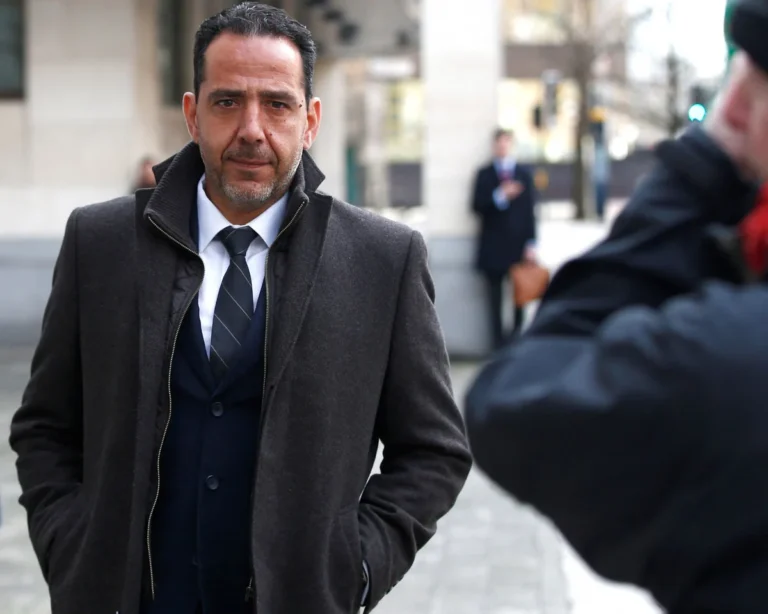
The Court of Appeal has overturned the conviction of former Deutsche Bank trader Christian Bittar, who was imprisoned in 2018 for his role in manipulating the Euribor benchmark interest rate. Bittar, who watched the proceedings via video link from Switzerland due to being denied a visa to attend in person, remarked that he had waited a very, very long time for this day.
This ruling follows a significant week for legal challenges related to the post-2008 financial crisis prosecutions. On Wednesday, the same court quashed the convictions of five former Barclays bankers—Jay Merchant, Jonathan Mathew, Alex Pabon, Colin Bermingham, and Philippe Moryoussef—after a decade-long legal battle. Sending huge economic shockwaves across the world and triggering recessions in many countries, the financial crisis began in 2008. Held by many to be responsible for the crisis, while the financial sector was protected by taxpayer-funded bailouts, there was a public backlash against bankers. On Wednesday, Jay Merchant, Jonathan Mathew, Alex Pabon, Colin Bermingham and Philippe Moryoussef saw their convictions for ‘manipulating’ the interest rate benchmarks Libor and Euribor quashed after a 10-year struggle for justice.
These developments stem from a July 2025 Supreme Court decision, which ruled that trial judges had previously misdirected juries. Judges in earlier cases had established as a matter of law that any influence on interest rates for commercial gain was inherently unlawful. The Supreme Court concluded that this was a legal error, noting that such determinations should have been treated as questions of fact for juries to decide, rather than settled points of law. Judges in the subsequent eight trials followed suit. Instead, whether the requests were right or wrong was properly a matter of fact for the jury to decide, not the judge.
The scandal originally emerged in 2012, revealing that banks had misrepresented their positions during the interest rate setting process to boost profits and obscure financial difficulties. Between 2015 and 2019, approximately 37 traders and brokers were prosecuted in London and New York for allegedly rigging the Libor and Euribor benchmarks, which govern interest rates for millions of loans and mortgages. Of the 19 individuals convicted in the US and UK during that period, 18 have now been acquitted.
Only one individual remains convicted globally: former Barclays trader Peter Johnson, a whistleblower who had pleaded guilty based on advice that his prospects at trial were poor. The court has confirmed that Johnson has now submitted an application to appeal his conviction. All original convictions in the United States were overturned back in 2022 after an appeals court found insufficient evidence that the traders’ requests violated any laws.
Reflecting on the outcome, Bittar stated that the injustice he and others endured has finally been recognized, expressing gratitude to those who supported him throughout the ordeal. His wife, Caroline, noted that their family had lost 15 valuable years while dealing with the legal shadow hanging over them. I am so grateful for those who stood by me through this ordeal and those who worked so tirelessly to correct it. She added they were looking forward to “enjoying life with our family and friends without this shadow hanging over us”.
Former Conservative cabinet minister David Davis has described the exonerated traders as victims of a miscarriage of justice. Davis argued they were scapegoated as a result of government actions during the financial crisis, specifically alleging that central banks and the government engaged in their own lowballing of Libor rates to stabilize the economy after the 2008 crash.
Evidence has since emerged suggesting a much broader, state-led manipulation of interest rates under pressure from global central banks and governments, with reports indicating that information involving Downing Street and the Bank of England was suppressed during criminal trials. Consequently, lawyers and senior politicians are now pressing for the release of all records from the Bank of England and the Treasury concerning their roles during the crisis.
Tom Hayes, the first individual jailed for interest rate rigging in 2015, had his 14-year sentence reduced to 11 years before ultimately having his conviction quashed following the Supreme Court’s intervention. Hayes is currently pursuing damages from his former employer, UBS.