During his 1990s childhood in Birmingham, Keiran Goddard watched tower blocks crumble as a form of local entertainment. The controlled demolition of postwar council estates in Shard End signified more than just clearing space; it represented a profound rupture in the community’s social fabric. Now, Goddard’s second novel, I See Buildings Fall Like Lightning, has been adapted into a film directed by Clio Barnard and scripted by Enda Walsh. That’s what passed for entertainment back then. It was a dust-blown display of regeneration and progress. The people of east Birmingham would move on to better lives. Just as historic strains set to work on Rian’s close-knit gang of mates, the film shows it rising in time-lapse leaps and bounds.
Goddard, who left Birmingham to study at Oxford and eventually settled in London, admits that while he physically departed, his roots remain a constant presence. “So I feel quite splintered,” he observes. “I’m not sure anyone ever really leaves the world they grew up in.” His trajectory reflects the era of Blair-era social mobility, where academic success was framed as a path to leave one’s class behind. “That was always the story,” he notes. “To succeed meant to leave.” Goddard, specifically, moved on to study English at Oxford University. The group’s breakout star, who made a killing on the stock market and bought a sterile London flat, but he’s also like Rian. Rian is the chief investor behind a new apartment complex that is to be built on the bones of the old estate.
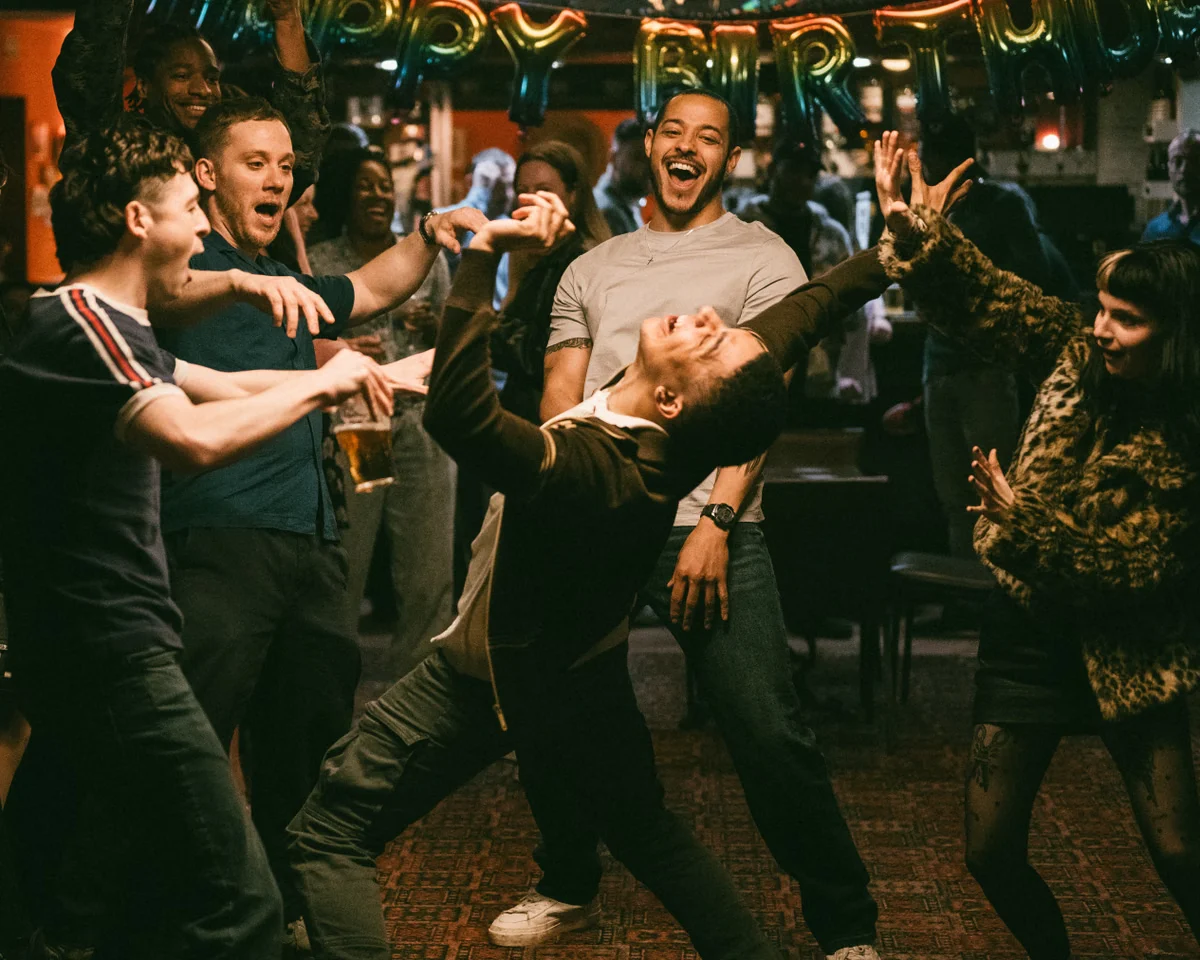
The film navigates this tension through five friends whose lives are disrupted by the destruction of their local tower block. The narrative balances an intimate story with broader social themes. Barnard explains that the ensemble dynamics are central, noting, “It feels to me that there is an equality in this group of friends, and that the antagonist is the system.” She emphasizes that she was drawn to the project by its political intensity and its authentic, humorous depiction of working-class resilience.
Adapting the book presented unique hurdles, primarily because the novel consists of interior monologues with little dialogue or external action. Goddard initially worried about the transition to screen, fearing various “flavours of wrong” like poverty porn or unearned misery. However, the film avoids these traps through a grounding in local reality. Shooting took place on the streets of Shard End, with the Crown social club acting as a production hub. An open casting call at the club successfully recruited 800 local residents, helping to ground the production in the area’s authentic community spirit.
Barnard’s approach to the story emphasizes compassion and agency. Contrasting with her earlier, darker works like The Arbor, this film—much like her 2021 feature Ali & Ava—aims to leave audiences feeling empowered. “With Ali & Ava, I wanted the audience to leave with the feeling that they were able to act,” Barnard says. She sees a sense of hope in characters like Patrick, an idealist who views housing as a fundamental human right. When writing the book, Goddard identified with the character of Patrick, the idealistic graduate turned zero hours delivery driver who argues that decent housing is a basic human right, not a capital asset.
Despite the current climate of global economic precarity, which Goddard notes is increasingly affecting middle-class demographics, he remains optimistic about the future of such storytelling. He suggests that these shared economic pressures might actually broaden the audience’s appetite for stories about social insecurity. Barnard agrees, stating that while the world feels imbalanced, “hope in itself can be an active resistance.”
Following a highly successful premiere at the Cannes Film Festival, the film has received significant critical acclaim. Goddard remains reflective about his journey, particularly the experience of returning to his childhood estate to film. Describing the process as deeply meaningful, he says, “There was something very moving about going through this whole journey and literally returning to the estate I grew up on. That was beyond special.”