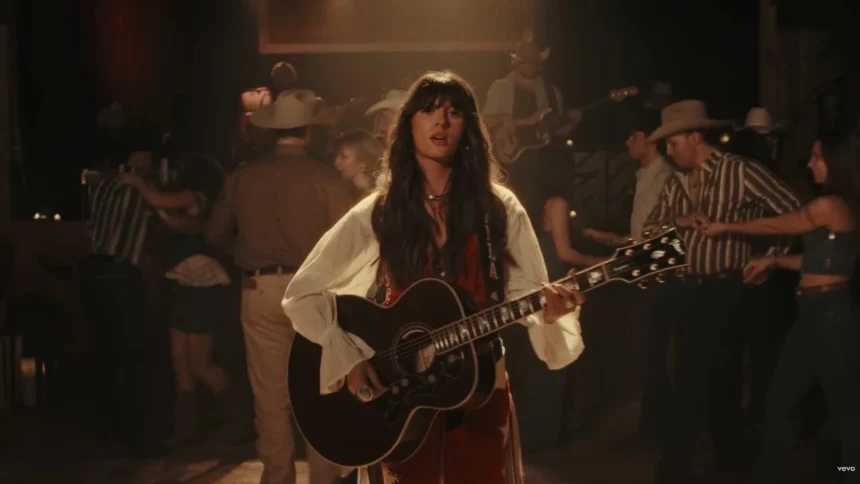
Ella Langley’s country anthem “Choosin’ Texas” has dominated the Billboard Hot 100 for 24 weeks, a run that has officially surpassed Mariah Carey’s “All I Want For Christmas Is You” to become the longest-running No. 1 single in United States history. Yet, despite its historic chart presence, a significant portion of the public claims they have never even heard the song. This disconnect has fueled an intense cultural debate: are these listeners simply ignoring country music out of snobbery, or has the music industry reached a point where even a chart-topping hit can no longer reach a broad, unified audience?
This friction highlights a larger trend—the ongoing erosion of the “monoculture.” Historically, the monoculture represented a collective frame of reference, a shared set of mass-cultural touchstones that allowed citizens to assume everyone else was consuming the same media. In the past, radio, television networks, and local cinema served as gatekeepers, forcing specific music or shows onto the public. Maria Rodas, an associate professor of marketing at the University of Illinois Urbana-Champaign, notes that a massive hit was once impossible to avoid. “Radio and TV put it in front of everyone whether you liked it or not,” Rodas explained. “Now, you can be one of the millions who had it on repeat all summer, or your feed just never showed it to you.” Much-discussed death of the “monoculture.”, it’s the newest case of the ongoing. The story goes, when a single piece of media could command the attention of everyone in the country: When everyone heard the same songs on the radio and MTV, watched the same few television networks and saw the same handful of movies playing in theaters, whether they liked them or not, there was some indeterminate time in the past. Though, is less clear, what exactly constituted monoculture and when exactly it died.
Cultural critics have attempted to pinpoint the death of this shared experience for years. As early as 2006, rock critic Robert Christgau lamented the loss of an era where everyone listened to the same radio programs. By 2011, journalist Touré argued that no one under 25 had experienced the “Massive Music Moments” that defined the success of artists like Michael Jackson or Nirvana. More recently, the timeline of this collapse has been a subject of intense speculation, with The Hollywood Reporter naming 2014 as the last year of truly shared content, while Rolling Stone music editor Jeff Ihaza suggested 2016 marked the final era of a coherent popular culture before everything fractured into algorithmic bits. As a recent argument-provoking Rolling Stone article suggested, are they merely snobs who want to show off their proud ignorance of country music. EDITOR’S NOTE: “Word of the Week” brings you the meaning behind the words in the news. The popularity and success of Lady Gaga, Adele and Kanye West, he wrote at the time, could not compare to the ubiquity once enjoyed by Michael Jackson’s “Thriller” or Nirvana’s “Nevermind.”. Music journalists are now waxing nostalgic about more recent eras, with the benefit of hindsight.
The term “monoculture” originates from agriculture, describing the practice of cultivating a single crop over a large area. While economically efficient, this technique carries inherent risks—such as the rapid spread of pests or soil depletion—that parallel the fragility of modern media landscapes. Historically, the monoculture of music and television was often alluring for its ability to create societal cohesion. However, this uniformity was largely enforced by top-down industry gatekeepers. Critics have pointed out that this system often excluded those with niche interests. As Noel Murray wrote for the AV Club in 2009, while shared culture offered common ground, it often left individuals who preferred alternative artists, like Hüsker Dü, feeling culturally isolated.
Moreover, the idea that the past was truly universal is often overstated. Even era-defining sitcoms like “Seinfeld” and “Friends” did not reach everyone, as pop culture correspondent Linda Holmes noted in 2024. Today, the landscape is dictated by bottom-up production, largely propelled by social media recommendation algorithms. Kyle Chayka, a staff writer for The New Yorker and author of “Filterworld: How Algorithms Flattened Culture,” explains that while this allows smaller artists to reach specific audiences, it also leads to extreme fragmentation. Users increasingly consume media that aligns only with their personal tastes, resulting in a landscape where fewer people share common experiences.
Paradoxically, this system creates its own form of sameness. Because algorithms are vulnerable to manipulation, artists and creators are often incentivized to engineer their work with specific features that cater to platform preferences to maximize reach. This results in a new, strange kind of monoculture where independent artists pursuing individual success inadvertently produce a homogenized product. As the digital era continues to evolve, the ability for any single piece of media to penetrate the entire consciousness of the public appears increasingly unlikely, leaving “Choosin’ Texas” to stand as a record-breaking monument in a culture that is moving in a thousand different directions at once.