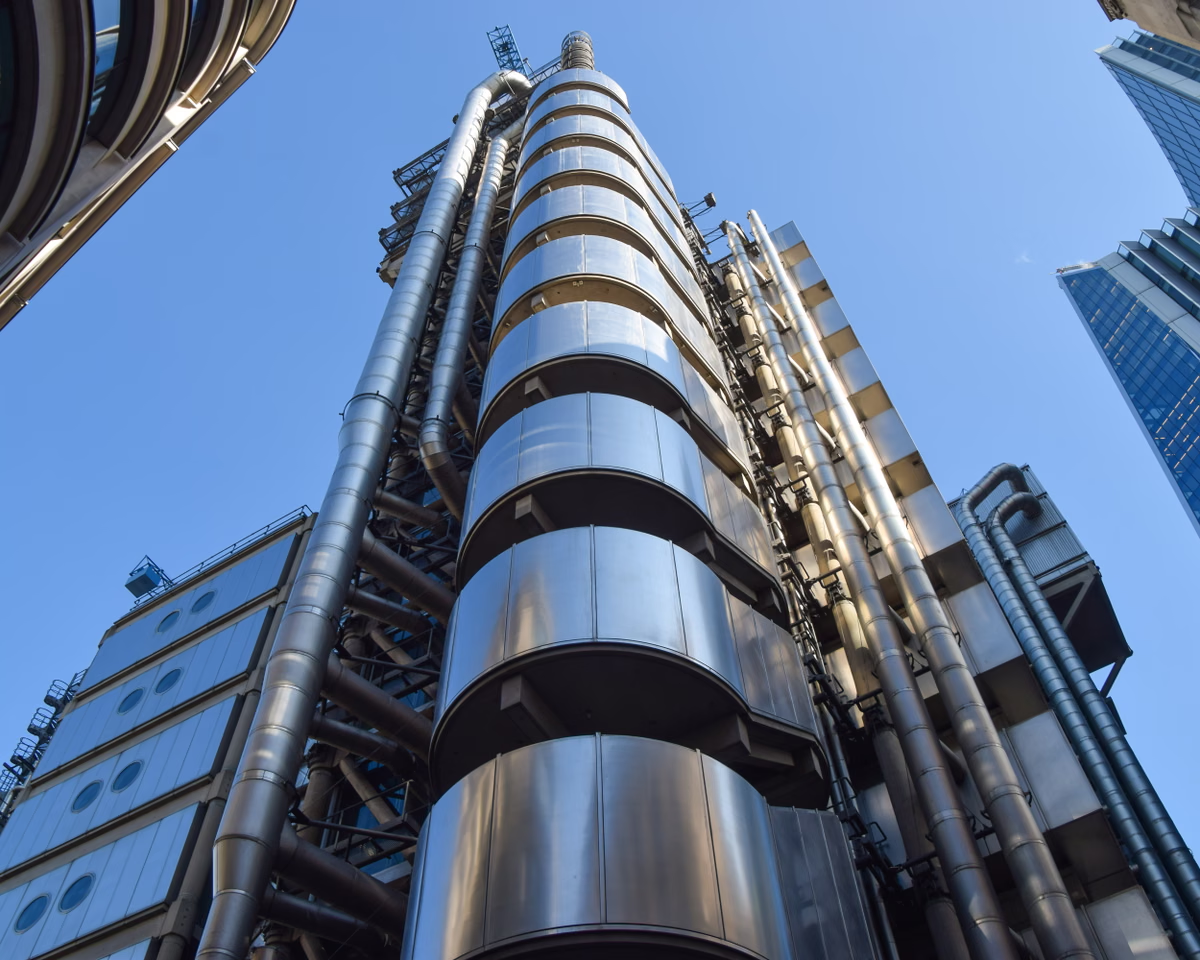
The Lloyd’s building, a polarizing yet celebrated masterpiece of British hi-tech architecture, is marking its 40th anniversary by opening its doors to the public for the first time since 2014. As part of the London-wide Open House festival, the landmark will host visitors on 19 September, with free tickets becoming available tomorrow. Festival director Celia Mead noted that the team was thrilled to secure the site, stating, “There was whooping in the office when the Lloyd’s building came in, because we know our visitors really, really want to get inside this landmark institution.”
Designed by architect Richard Rogers and opened in 1986, the structure has long divided opinion. Critic Owen Hatherley famously described it as “monstrous, compelling” and “utterly messed-up” in his 2012 book, A New Kind of Bleak, while the then-Prince Charles once compared its aesthetic to a North Sea oil rig. Despite such critiques, the building’s architectural significance is undeniable; in 2011, it became the youngest structure in the UK to receive Grade I-listed status.
The building serves as a prime example of the late modernist style, which prioritizes industrial engineering and prefabricated components. Its distinctive “inside-out” design features an exposed concrete frame and six external steel towers that house essential infrastructure, including lifts, staircases, and pipes. This configuration allows for a flexible, expansive interior, including a double-height trading floor and an atrium that rises 14 floors to a barrel-vaulted roof. Historian Reyner Banham once likened this soaring space to the Parthenon.
Beyond its futuristic exterior, the building houses significant historical artifacts. These include the 18th-century Adam Room, which was relocated from Wiltshire in 1958, and a library salvaged from the former Leadenhall Street headquarters. The main trading floor also features the historic Lutine Bell, recovered from the wreck of HMS Lutine and used since 1858 to signal maritime disasters or ceremonial events. Additionally, the interior contains a 1958 war memorial stained glass piece by artist Hugh Easton.
Historic England’s Geraint Franklin, who featured the building in his book High-Tech Britain, emphasizes its adaptability. He notes that the structure was designed to evolve, with recent renovations including the careful recutting of the original “sparkle glass”—textured panes that refract light to create a shimmering effect. “On paper, the plan is rational and diagrammatic, but it’s a dynamic, romantic exterior,” Franklin explains. “Lloyd’s was never intended to be taken in at a single glance but to be encountered in snatched views from the streets.”
The building’s debut in 1986 coincided with the deregulation of the City of London, a period that transformed the financial district into a global powerhouse. While its design invites complex discussions about power and capitalism, its status as a cultural icon remains secure. For the upcoming tour, guests will be granted access to the underwriting room and the Adam Room, offering a rare glimpse into a space that has shaped the skyline for four decades. As Mead concludes, “In our programme of over 730 buildings, Lloyd’s is perhaps the greatest statement building. It’s heavyweight, look-at-me and counterintuitive.” The report also notes that in 2011, the youngest ever building to be given Grade I-listed status in the UK, but none of this stopped it from becoming. The report also notes that and each tower is permanently topped with steel cranes – partly for maintenance but also to make the building look like a gothic cathedral, the building’s 12 glass lifts were the first of their kind in the UK. The report also notes that “It’s a masterpiece of radical, inside-out architecture,” says Mead, “representing London’s confidence and swagger.” From the street, she says, “it catches the attention and you wonder, ‘What could it be like inside?’” M. The report also notes that visitor galleries with a view of the trading floor have long been shut for security reasons. The report also notes that which aims to make architecture more accessible by inviting government offices, private properties and heritage buildings to let the public in, open House festival is organised by the charity Open City. The report also notes that “It’s a masterpiece of radical, inside-out architecture,” says Mead, “representing London’s confidence and swagger.” From the street, she says, “it catches the attention and you wonder, ‘What could it be like inside?’” Mead has experienced the building first-hand: “My mum was an economics teacher and I joined one of her school trips to Lloyd’s 38 years ago. The report also notes that i remember then thinking it was huge.”. The report also notes that historian Reyner Banham compared the atrium to the Parthenon when he presented Rogers with the Royal Institute of British Architects’ gold medal in 1985.