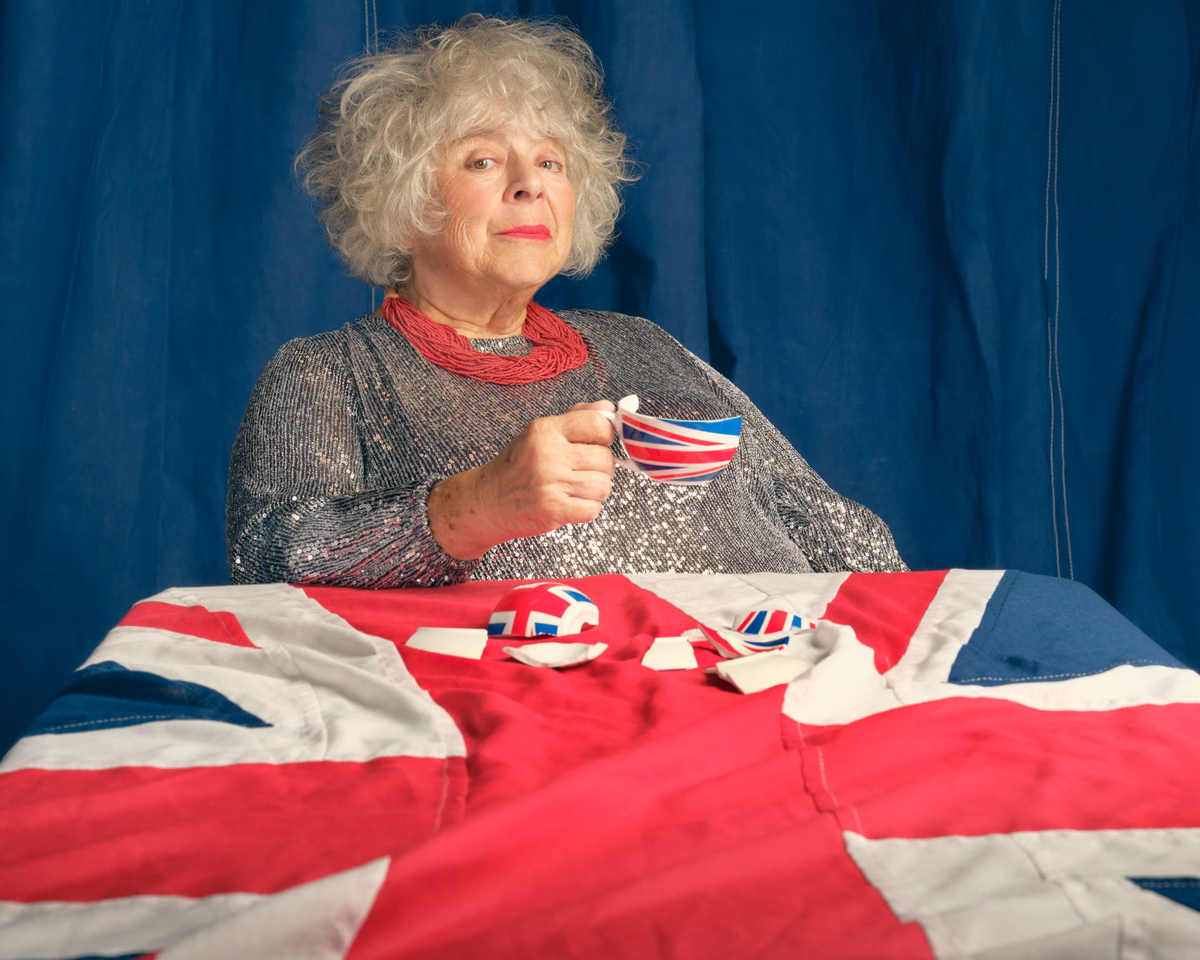
At 85, Miriam Margolyes finds herself reflecting on a world that has grown increasingly hostile. She notes that reaching this age has brought both personal physical changes and a sense that the political landscape has turned sour. While she acknowledges that she is currently enjoying a period of professional success and financial stability, she remains deeply concerned about the state of the nation.
Margolyes draws on the wisdom of the late historian Eric Hobsbawm, who observed that people often construct historical myths to serve their own agendas. She agrees with his assessment that the real past was far more complex than the narratives currently being sold. Her own life has spanned the rise and fall of significant 20th-century milestones, including the Berlin Wall, the premierships of Winston Churchill and Margaret Thatcher, the Falklands War, the emergence of the NHS, and the cultural impact of the Beatles and the IRA.
The actor expresses alarm at the erosion of public institutions and common services, such as the Post Office and local banking, which were once staples of British life. She views the current geopolitical climate with apprehension, describing the United States as an enemy and warning that global influence is being wielded by harmful oligarchs. This sense of decline is compounded by what she identifies as a pervasive, divisive campaign of misinformation orchestrated by politicians and media outlets.
To illustrate the strained relationships between the nations of the British Isles, Margolyes recounts a series of jokes that highlight historical tensions. In one, an Englishman driving in Wales asks a local, “Dai! Dai! which way is it to Cardiff?” only to be met with a retort about how he knew the man’s name. In another, a group consisting of an Irishman, a Scotsman, a Welshman, and an Englishman face a plane crash; the Scotsman and Welshman sacrifice themselves for their nations, while the Irishman pushes the Englishman out of the plane. She suggests these stories reflect a genuine, deep-seated resentment toward the English, fueled by perceived arrogance.
Margolyes explores the various derogatory nicknames historically applied to the British, noting that these labels reveal how the rest of the world views the nation. These include the Roman “Brittunculi” (wretched little Brits), the Australian “Pom” (possibly linked to pomegranates or prisoners of mother England), the Boer “Rooinek” (redneck) and “soutpiel” (salty penis), the American “Limey,” the German “Inselaffen” (island monkeys), and the French “les rosbifs.” She argues that these terms underscore the importance of listening to alternative perspectives rather than relying on nationalistic propaganda.
Reflecting on her own political evolution, Margolyes reveals that she was once a 14-year-old Conservative candidate in May 1955. She contrasts her growth into a “full-throated leftist” with the trajectory of politicians like Lawrence Turner, the Tory who won the Oxford constituency during her youth and later supported the Suez invasion. She remains critical of modern figures like Nigel Farage, dismissing their political stances as harmful.
The actor emphasizes that the post-World War II era was defined by the sacrifice of 70 million lives to secure freedom, a legacy she believes is being squandered. She points to the rise of the National Front in 1967 and Enoch Powell’s 1968 “Rivers of Blood” speech as pivotal moments when racism became impossible to ignore. She also criticizes public figures who pose as relatable while benefiting from immense wealth and legal maneuvers to secure citizenship for their families.
Despite her frustrations, Margolyes believes there is still time to save the country. She advocates for a society that embraces the diverse linguistic and cultural contributions of all its people. Her advice is to “speak as you find,” a lesson from her mother that she uses to distinguish between decent people and those she considers dishonest. She concludes that what unites the population is far more significant than what divides it, urging citizens to learn from the mistakes of the past to build a better future. The report also notes that a funny thing happened on the way to 2026: I got old and the world turned nasty. The report also notes that it happened very quickly and it’s to do with politics (the world) and pelvic floor weakness (mine). The report also notes that it’s a shock to see wrinkles and grey hair, because inside I am still that naughty Oxford High School girl, risking detention just for the joy of entertaining her friends, sometimes when I look in the mirror. The report also notes that but actually we remain who we have always been, only more so, and we need to make our peace with that and with each other, people assume that with great age comes great wisdom. The report also notes that though – that feels almost unrecognisable, and everyone I speak to says the same thing, the Britain I grew up in. The report also notes that they don’t understand or feel a connection to the place they thought they knew, people feel adrift. The report also notes that now at 85, I look around at my remaining friends and at my unique relationship with a woman of different qualities but luckily the same politics.