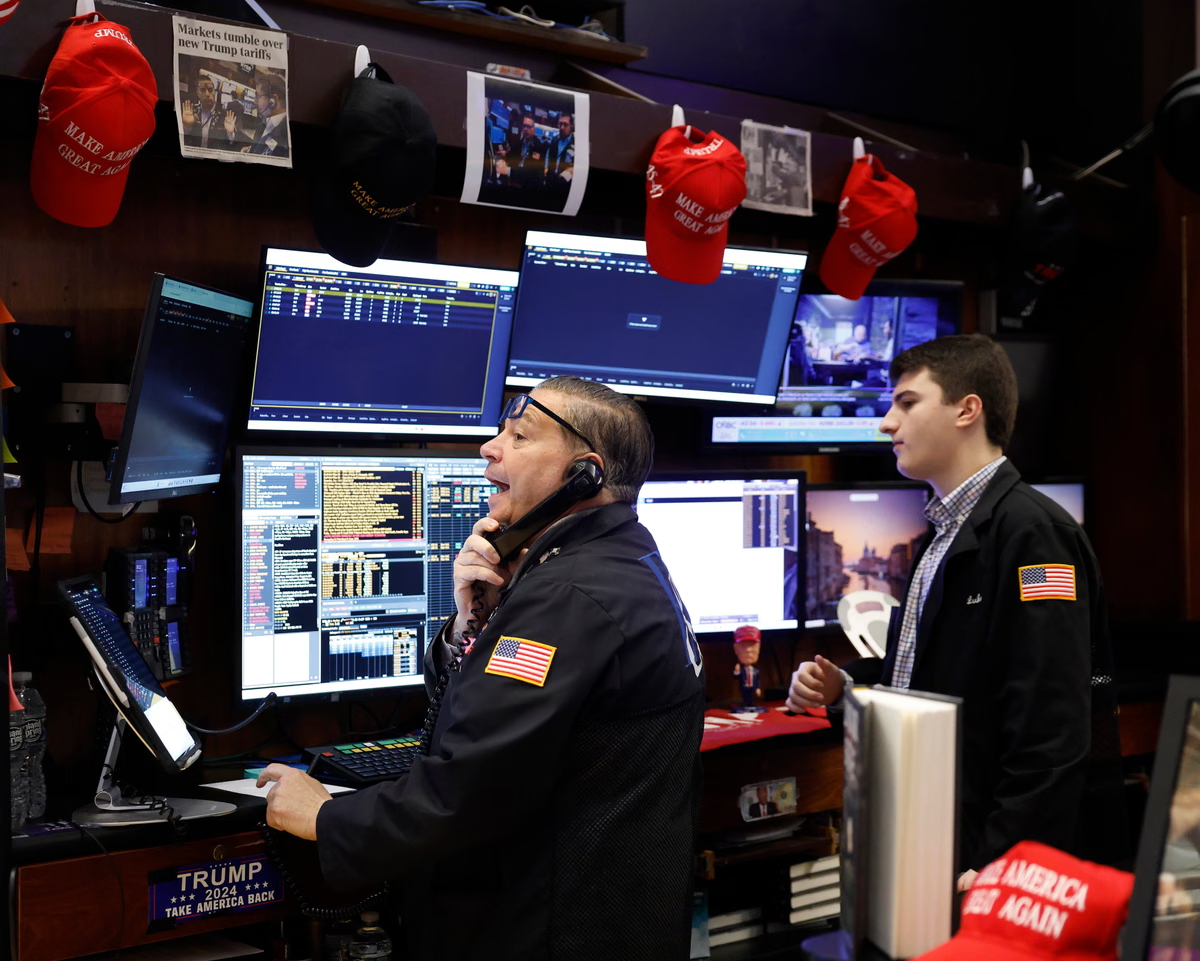
The Nasdaq share index suffered its worst daily performance in 18 months, slumping 5.5% on Thursday as markets reacted to the US midterm election results.
The index fell into “correction territory,” dropping more than 10% below its recent record peak, with investors pulling more than $2 trillion from its total valuation by the close of the session. This represents the index’s largest one-day decline since April 2025, when President Donald Trump announced his “liberation day” tariffs on trading partners.
The market downturn was driven by concerns that the Democratic party’s electoral gains, particularly in the Senate, will introduce significant legislative hurdles for the artificial intelligence industry. Analysts anticipate that a shift in power will likely lead to stricter scrutiny of AI datacentre expansion plans and increased regulatory pressure. Worries over massive AI spending gripped the New York stock market and rippled out to other bourses worldwide as investors anticipated tougher scrutiny of datacentre expansion plans. Analysts pointed to expectations that Democratic governors will clamp down on the rollout of new datacentres after the party won a series of gubernatorial races this week. US voters also rejected datacentres in a series of local ballots across the country.
Technology stocks bore the brunt of the sell-off, with chip manufacturers leading the decline. SanDisk shares tumbled 22%, while Western Digital fell by 17%. Nvidia, a central figure in the recent AI market rally, dropped 9.2%. Reflecting the sudden surge in investor anxiety, Wall Street’s “fear index,” the VIX, climbed 61%, marking its highest levels since the early stages of the Iran war. With memory maker SanDisk tumbling by 22% and hard drive maker Western Digital falling by 17%, chip stocks led the slump. Nvidia, the chipmaker at the heart of the AI boom, was the top faller on the DJIA – down 9.2%, followed by Goldman Sachs, which fell 3.7%.
The impact of this volatility spread globally. In Asia, Japan’s Nikkei 225 index retreated 6%, while South Korea’s Kospi index experienced an 8% drop during early Friday trading. European markets also felt the strain, with Britain’s FTSE 100 ending the day down 0.4% at 10,782.66. The Dow Jones industrial average (DJIA) of 30 large US companies was down more than 1,800 points by the end of the day, a fall of 3.4%, to 51,868 points. The S&P 500 was down 4.3%.
Neil Wilson, an investor strategist at Saxo UK, described the tech-sector sell-off as a “total momentum unwind” and a “complete capitulation-level event.” He noted that the market appears to be reacting specifically to the prospects of the Democratic party curbing datacentre development, though he cautioned that the “sell everything” environment might be overextended. “The fear is a total momentum unwind as Democrats pace the frontier and kibosh datacentre buildout … this looks totally overdone but the nature of ‘sell everything’ in this market means we need to look for some stability first,” Wilson said.
Dan Ives, a prominent tech analyst, echoed these concerns, stating that there is no way to minimize the impact of the midterm results on the sector. He noted that the new legislative landscape would likely slow the pace of AI infrastructure growth over the coming two years.
The market mood shifted dramatically from the previous day, when stocks saw their biggest gains in months on speculation that the election outcome would restrain the White House. President Trump had previously touted the stock market’s success on Truth Social, boasting that the index had hit record highs for 91 days during his second term and claiming that 401(k) accounts were thriving.
In contrast, market observers are now emphasizing a shift in focus. Ted Parkhill, founder and CEO of Incline Investment Management, observed that the market is transitioning from the “promise of AI to the price of AI.” While he maintained that AI remains a transformative technology for the long term, he warned that many AI-related stocks are currently overvalued and the market faces a period of significant turmoil. “There’s no question that AI is going to be transformative for the world in the long run.