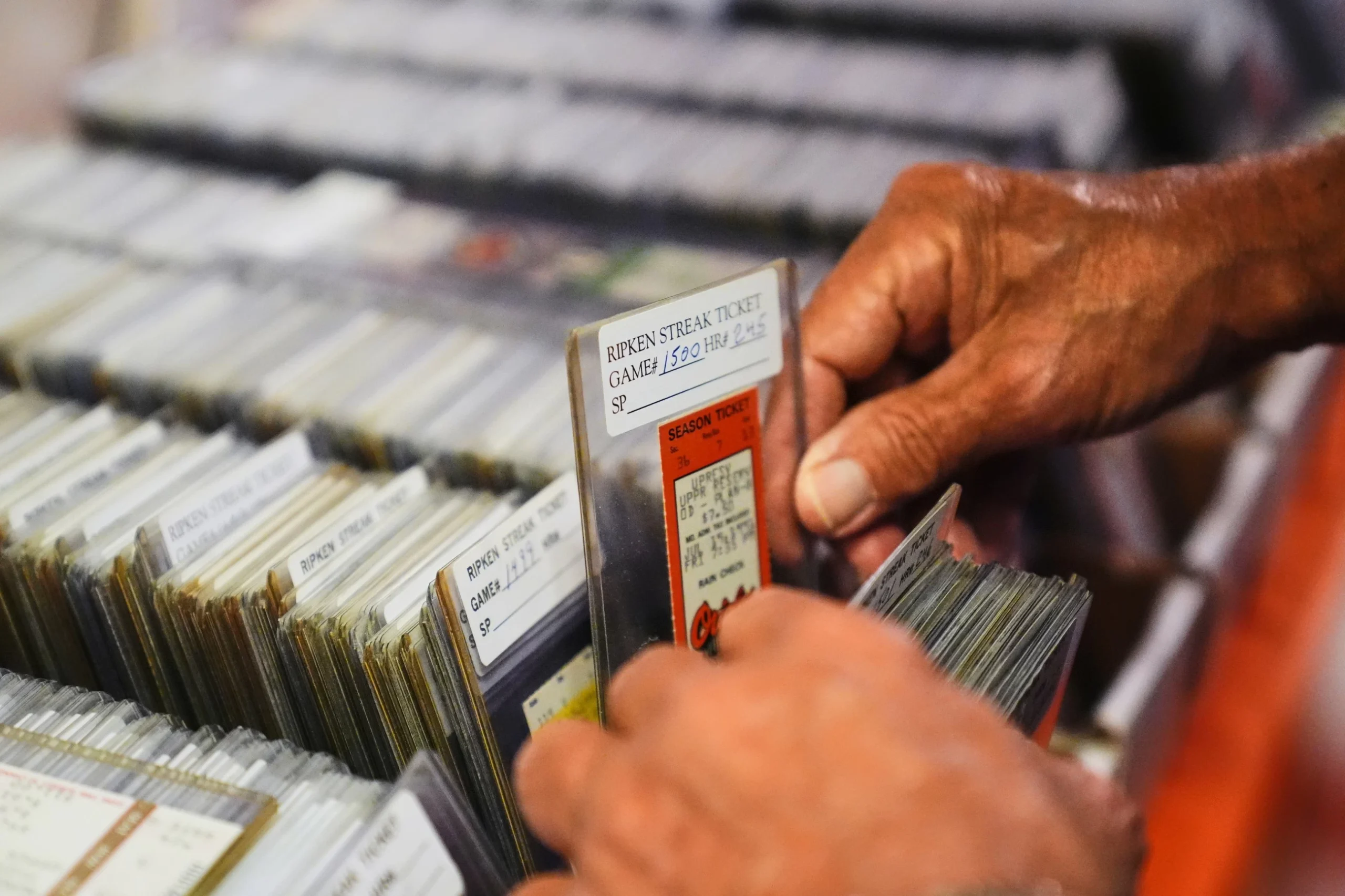
Cal Ripken Jr.’s historic 2,632-game consecutive streak remains one of baseball’s most iconic achievements. For 17 seasons, the Baltimore Orioles star never missed a day in the lineup. Inspired by this legacy, lifelong fan Rick Taylor has spent the last 28 years attempting to collect a physical ticket stub from every single game of that “Iron Man” run, which spanned from 1982 to 1998.
Today, Taylor is within reach of completing this exhaustive project, currently missing only eight tickets. His collection, which resides in 16 boxes inside his basement, serves as a tangible archive of a record many experts believe will never be matched. Each ticket is individually preserved in a protective hard plastic holder and labeled with its specific game number.
Reflecting on the milestone, the 69-year-old retired food industry salesman admitted he never expected to get this far. “Did I ever really think I would get this far? No, not really,” Taylor said. “But I always said to myself that if I could ever get down to single digits, I think I could do it.”
Mike Provenzale, a production manager at Heritage Auctions, described the effort as an astonishing feat of perseverance that rivals the record itself.
While Taylor initially set out to gather tickets only from games where Ripken hit one of his 431 career home runs, a suggestion from a fellow collector encouraged him to pursue the entire streak. Taylor began running advertisements in The Baltimore Sun to source missing stubs, eventually securing the first game of the streak—a May 30, 1982, ticket—for $4,400 in 1999. But when a fellow collector asked him if he had thought about expanding the search to encompass the Iron Man streak, Taylor was intrigued: “I said, ‘That would be crazy, but you might have something there.’”. As a local, finding a ticket from each home game was relatively easy, Taylor said, even if he had to pay $4,400 in 1999 to win an auction for the jewel of his collection: a May 30, 1982, ticket that marked the first game of Ripken’s streak. Taylor can recite the dates by heart: 6-4-82 in Minnesota. 4-25-84 vs. the Royals.
The search for road games has proven significantly more challenging. Taylor has frequented card shows, monitored eBay, and participated in a dedicated Facebook group called Booger’s Ticket Stubs to hunt down remaining items. Progress had slowed to a crawl in recent years, but a fresh push on social media helped him acquire five tickets in 2026 alone. The eight missing pieces all originate from the 1980s: four games against the Minnesota Twins, three against the Texas Rangers, and one against the Kansas City Royals. Things had slowed to a trickle: 2023 yielded one ticket, a few years ago. But then he got three in 2025. 8-21-82 against the Rangers.
Taylor believes the scarcity of the Twins and Rangers tickets stems from the relative lack of fan interest in those teams during that era, which resulted in fewer people holding onto stubs. He is currently offering $100 for each of the specific tickets he needs, hopeful that they remain tucked away in scrapbooks or desk drawers. Experts like Matt Fuller, head of ticket authentication at PSA, agree the items likely still exist. According to “It’s devastating,” Taylor said, lamenting that younger collectors will never be able to build similar collections that span the careers of today’s stars like Shohei Ohtani or Aaron Judge. “It would be impossible to put together a run like this today,”, Matt Fuller, head of ticket authentication at PSA, which authenticates and grades collectibles. Taylor partially attributes the difficulty in finding the Twins and Rangers tickets to the fact that both teams were mediocre in the mid-80s and did not command large crowds, further increasing their scarcity. Fuller, from PSA, agreed: “I have no doubt they’re out there, collecting dust in a desk drawer, a scrapbook or a shoebox.”. “To find somebody that held on to a ticket like that, it’s jaw-dropping,” Provenzale said.
However, the transition to digital-only entry is complicating the hobby for future generations. When Taylor recently attempted to purchase 10 bleacher tickets at the Orioles’ box office to help friends who collect Shohei Ohtani memorabilia, he said the staff refused to provide physical cardstock. “They turned down $350,” Taylor noted. “They can print the tickets; they just don’t want to.” Though, comes as physical tickets have largely become a thing of the past, with teams shifting toward digital passes and QR codes that offer little of the appeal of an old-fashioned ticket stub, taylor’s pursuit. Tickets to sporting events have been largely distributed digitally or via printable PDFs, neither of which has the appeal or style of a ticket on cardstock, for years now. Others have ceased the practice entirely. Knowing some of his friends collect Ohtani tickets, Taylor went to the Orioles’ box office to buy 10 bleacher tickets for $35 each.
In response, the Orioles organization maintained that digital ticketing reduces fraud, improves communication, and simplifies entry for fans. The team noted that they continue to issue physical tickets in specific circumstances, such as for minors without mobile devices. Despite these policy shifts, the declining availability of physical stubs has ironically fueled the secondary market, with collectors increasingly valuing the rarity and condition of paper tickets from earlier decades.