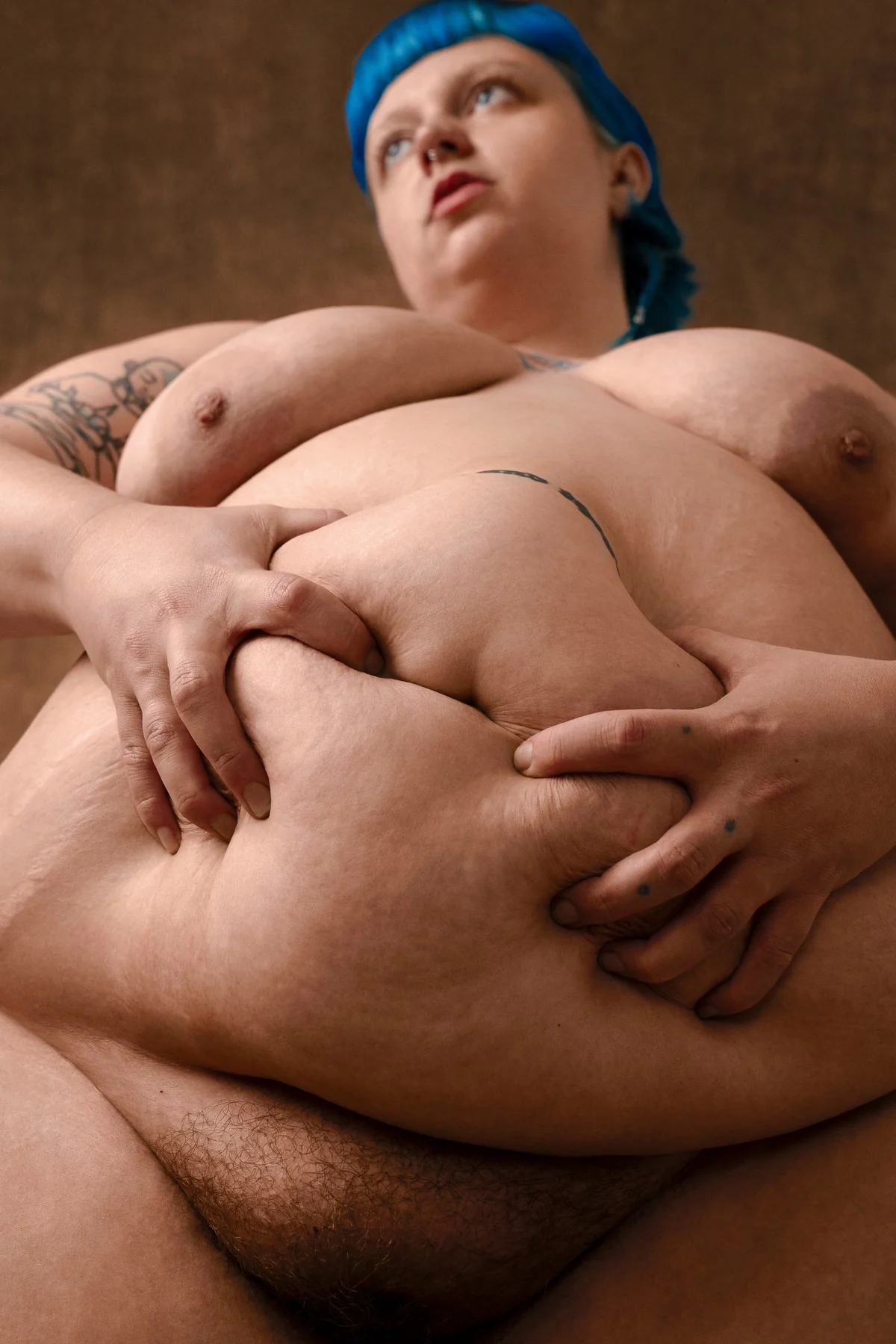
Blackpool-born photographer Siorna Ashby is currently seeing her work featured in the Winston Taylor photographic portrait prize exhibition at the National Portrait Gallery in London. Her selected image, titled “Body Like Mine,” depicts Meg Foster, a model and prominent TikTok activist known for her work raising awareness about overconsumption and landfill waste. The exhibition is open to the public until 17 January. Born: Blackpool, 1983 High point: Having my photograph of Meg Foster, Body Like Mine, selected for the National Portrait Gallery’s Winston Taylor photo portrait prize 2026 exhibition.
Ashby first encountered Foster at a nude life-drawing class, where she was immediately drawn to the model’s sense of freedom. “I wanted to explore how much of Meg’s presence and personality could come through her body and gesture,” Ashby explained. The series aims to challenge the external perceptions and societal assumptions placed on bodies, focusing instead on the subjective, lived experience of inhabiting one’s own form. By moving away from idealized imagery, Ashby seeks to present the body as inherently worthy of attention. This series explores the difference between how our bodies are perceived externally and how we experience them ourselves. The project aims to explore what it feels like to inhabit your own body, and to see it as worthy of attention without asking it to become anything else first, rather than portraying an idealised body. And Meg brought her own ways of moving and expressing herself, i brought some visual ideas to the shoot.
The photographic process was deeply collaborative. Influenced by the art historical traditions of Lucian Freud, Jenny Saville, and the physical intensity of Rubens’ paintings, Ashby and Foster worked together to determine the composition. Foster specifically suggested the gesture of scrunching her stomach, while Ashby chose to frame the shot from a lower angle to emphasize the physical presence of the figure. By instructing Foster to look away from the lens, Ashby shifted the focus from the eyes to the fleshy reality of the body itself. As I was photographing her, I found myself getting lower down.
Foster has been outspoken about the challenges of being a woman in the public eye, particularly regarding perceptions of body weight. “Fat women’s femininity is often stripped from them and I am masculinised and called brave for just existing in this body,” Foster said. “When I am life modelling, I feel the most feminine and deeply in touch with myself.” She added that she finds pride in occupying space and representing demographics that are often marginalized.
For Ashby, the project reflects a personal evolution. Her professional portfolio specializes in boudoir and nude photography, a field she entered after struggling with her own body image. Initially, being behind the camera served as a way to avoid being the subject of photographs. However, after taking self-portraits to confront her own insecurities, she discovered a newfound appreciation for her own image. This transition, she notes, allowed her to walk with more confidence and eventually inspired her to help others see themselves differently. I lit her in a painterly way and used a canvas backdrop.
Ashby remains critical of how beauty standards influence modern photography. She frequently questions the power dynamics within the medium, asking who defines beauty and whose perspective dictates the final image. “There is room for wanting to feel sexy, but whose idea of sexy are we working towards?” she asks. Her process involves asking participants to define their desired expression through words; for the portrait of Foster, the chosen descriptors were “real,” “joyful,” and “free.”
Looking ahead, Ashby plans to continue the “Body Like Mine” project by documenting individuals with diverse physical challenges, including memory loss and endometriosis. She emphasizes that her work is not a cure-all for body image struggles but aims to foster a greater sense of connection. For fellow photographers, she offers a tip: prioritize constant communication regarding boundaries during intimate shoots and remain ready to adapt or pause the process whenever necessary to ensure the model’s comfort.