
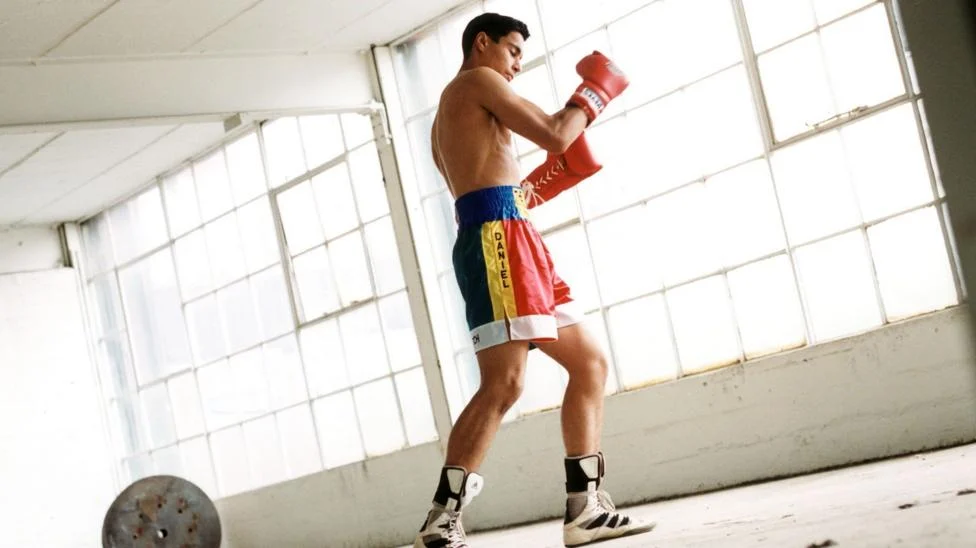
Daniel Teasdale was once the most talked-about teenager in the legendary Sheffield gym of trainer Brendan Ingle. With exceptional natural ability, the Rotherham fighter was frequently touted as the successor to Prince Naseem Hamed. Ingle, who developed a long line of world-class boxers, famously declared, “He’s better than Naz at the same age,” setting the bar for a career that many believed was destined for global stardom.
Photographer Simon Roberts, who initially visited the gym in 1997 to document Hamed, was redirected by Ingle to focus on the newcomer. “Brendan said ‘don’t worry about Naz, start photographing that kid in the corner. He’s going to be bigger than Naz’. That was Daniel,” Roberts recalled. Teasdale, who began boxing at six and cross-trained in ballet and gymnastics to hone his movement, seemed to possess every prerequisite for greatness: speed, power, confidence, and marketability.
As his professional debut approached, the anticipation grew into a media frenzy. Filmmaker Stuart Mitchell, who documented the rising star, noted that they were selling the project on the premise of discovering the next Prince Naseem. At the time, Teasdale was featured in national newspapers and books, frequently compared to elite fighters like Oscar de la Hoya. Former stablemate Amer Khan described him as “exceptional as a junior” who stopped everyone in his path.
However, the stability that defined his youth eroded once he turned professional. The contentious 1998 split between Hamed and Ingle proved a turning point; Teasdale eventually left the gym, teaming up with former world title challenger Herol ‘Bomber’ Graham. This transition, largely orchestrated by his father, was funded by a businessman with no previous boxing experience, creating an environment that lacked the professional insulation needed for such a high-profile prospect.
The career of the young talent became marked by instability and distractions. Teasdale admitted he was prone to outside influences, noting, “I was like catnip for cats, everybody wanted a piece.” His path was further complicated by a chaotic professional debut, which was abandoned due to a crowd riot, and a 2004 bout that was preceded by death threats. He later candidly acknowledged that his focus drifted, admitting, “Everybody has a weakness and mine was women. I lost the edge and my focus wasn’t where it should be.”
As the hype surrounding him faded, so did the interest from backers and filmmakers. Mitchell eventually shelved his documentary after losing faith in the trajectory of the boxer’s career during a training session at Graham’s garage. “There was so much clamour around him – then it just evaporated,” Mitchell said, adding that managing such immense expectations at a young age is an incredibly difficult burden for any athlete.
Teasdale’s professional tenure was brief, spanning just five fights over seven years. His career hit a low point in 2005 when he suffered his first professional defeat, a first-round stoppage that prompted him to walk away from the sport. He made a one-off comeback in 2010, reuniting with Ingle to win his final bout, but chose not to continue. “After that I just gave it up, I thought ‘I’m not going to be second best to the first me’,” he said. “At 27 I should have been a world champion defending my title.”
Looking back, Teasdale believes the lack of protection and bad management hindered his potential, forcing him to live for “other people’s dreams and ambitions.” Despite the outcome, he holds no regrets. Now working as a support worker, he has found the peace and routine that professional boxing never provided. “It’s made me who I am,” he reflected. “I’m doing the job that I love, it’s not the profile that I was but it’s all about being stable in your life.” The report also notes that pictured, was tipped for the top from an early age, daniel Teasdale. The report also notes that hamed had won his first world title aged 21. The report also notes that he guided both of the fighters from childhood. The report also notes that establishing himself as the next contender to emerge from the Ingle gym, he won a succession of national titles. The report also notes that hoping to capture his rise on camera, roberts began to follow the young sensation. The report also notes that teasdale’s early promise earned him plenty of headlines and column inches. The report also notes that and later accompanying him to an event gathering together the best British prospects from every sport for the new Millennium, he recalls Teasdale being the subject of similar headlines in national newspapers. The report also notes that teasdale learnt both ballet and gymnastics to develop his footwork and skills in the ring and was seemingly set for stardom.




Comments