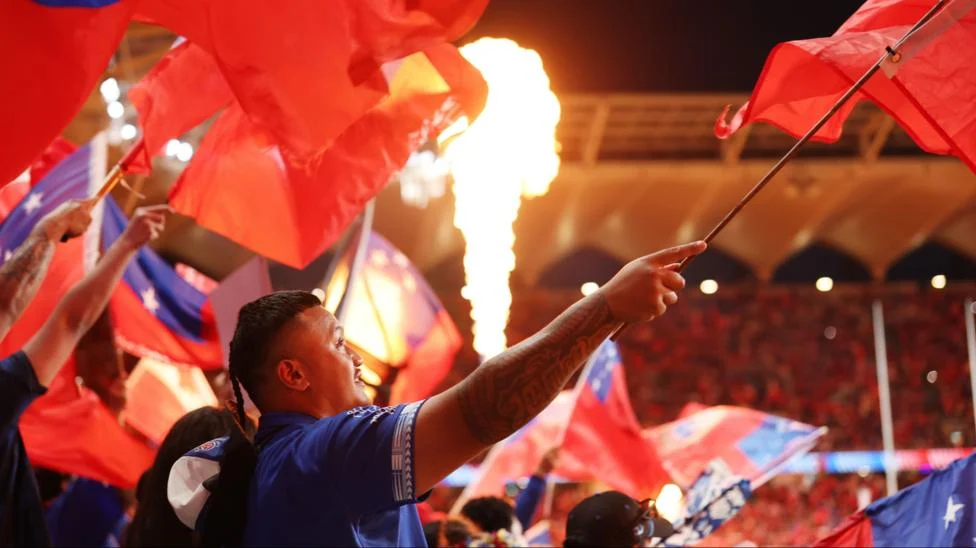
A pulsating group stage match in Sydney ended with Tonga securing a narrow 20-18 victory over Samoa in front of a passionate crowd, highlighting the growing force of Pacific nations in international rugby league. While Australia and New Zealand remain heavy favorites to meet in the final on 15 November, the rise of Tonga and Samoa has injected rare unpredictability into the 2026 Rugby League World Cup. The men’s group stage at the 2026 Rugby League World Cup did little to dissuade cynics about the unhealthy state of the international game, with blow out wins and a convoluted format. From Group A, Australia and New Zealand came through as expected and are widely tipped to face off in the final on 15 November. Of the outsiders, Samoa and Tonga can shake that up. It’s about fanfare and it’s about creating opportunities for our fans to come and watch our nations play. There are going to be some sore bodies out there.
Former Bradford Bulls head coach Matthew Elliott expressed hope that the two island nations could battle all the way to the trophy decider. Speaking to Radio 5 Sports Extra after Tonga’s nail-biting win, Elliott admitted he hopes for a Tonga-Samoa final, noting that such an outcome would mirror Wakefield’s Grand Final success in the Super League by proving elite rugby league still has room for major upsets. Two beacons of hope have emerged, but from the strange lands of Group B-C. I just want to thank from the bottom of my heart all the supporters. It’s unheard of, what the supporters have done for this game.
To reach the final, both Pacific teams must overcome established international giants in the semi-finals. Tonga face New Zealand in a fixture laden with dramatic history. The Tongans famously stunned the Kiwis 28-22 during the 2017 World Cup group stage before falling 20-18 to England in the semi-finals. Two years ago, Tonga defeated New Zealand 25-14 in the Pacific Championships to reach their first major final. However, last year’s meeting between the sides was marred by a serious head injury to Tongan back-rower Eli Katoa, who required emergency brain surgery following three concussions and has not played since. But not impossible, history suggests this scenario is unlikely. In the last four they were only narrowly defeated by England, 20-18, scoring three tries in the final seven minutes to give the English a huge fright in their best previous World Cup effort. Samoa have gone one further of course and were surprise runners-up four years ago having not previously gone beyond the quarter-finals since first appearing at the World Cup in 1995. In similarly exhilarating fashion, tonga won by the same scoreline three days ago. And have brought the quality and professionalism of the world’s best domestic league to bear fruit on their respective islands â with both talking about working on “emotional regulation” in big games, both have experience coaching in the NRL. We wouldn’t even sell out a game out of Campbelltown and now we’re sitting here on one of the biggest stages selling out, and it’s only going to get bigger, a few years ago.
Samoa face an equally daunting test against Australia in a replay of the 2022 World Cup final. Four years ago, Samoa bounced back from a heavy 60-6 opening defeat against England to shock the host nation 27-26 via a golden-point semi-final victory at Emirates Stadium. Although Australia eventually secured a 30-10 victory in the final at Old Trafford, Samoa made history by becoming only the sixth country to reach a men’s World Cup final alongside Australia, New Zealand, Great Britain, England, and France across 16 tournament editions.
Historically, Australia have dominated the global stage, winning 10 of the last 11 World Cups, including the past three editions, with New Zealand claiming the only other title during that span.
With the 2026 tournament reduced from 16 to 10 teams, concerns persist over a widening gap between elite nations and the rest of the sport.
Former England international Ryan Hall criticized the tournament’s current structure on Radio 5 Live, arguing that the World Cup should act as an inclusive showcase rather than a restricted competition, citing Italy’s strong showing in 2013 as proof that smaller nations belong on the world stage.
Financial backing for the region has also stepped up, with the Australian government announcing in July a A$250m (£130m) 10-year commitment to the Pacific Rugby League Partnership. Led by Australian officials, the initiative aims to build long-term pathways and opportunities across Papua New Guinea, Tonga, Samoa, and Fiji.
The intense rivalry between Tonga and Samoa remains remarkably balanced over 23 head-to-head encounters, yielding 11 wins for each team alongside a single draw. Their previous World Cup meeting saw Samoa claim a 20-18 quarter-final victory in Warrington, a scoreline Tonga exactly reversed during Sunday’s group clash. Reflecting on the vibrant atmosphere, Samoa head coach Ben Gardiner described the match as a sensational showcase driven by tremendous fan support. According to the occasion was unbelievable,” Samoa head coach Ben Gardiner, After the game. “I looked down at the start of the game and I’ve never seen so many people on the sidelines at a footy match in my life.
Both national setups benefit significantly from experienced Australian head coaches with NRL backgrounds. Gardiner has led Samoa since 2023, while Kristian Woolf has guided Tonga since 2014, instilling high professional standards and tactical discipline. Tongan half-back Isaiya Katoa praised Woolf’s leadership following their latest win, stating the intensity of the match far surpassed standard NRL fixtures and explaining that Woolf’s personal commitment inspires top-tier talent like Jojo Fifita and Rob Toia to represent Tonga. I think that was about five or 10 levels above NRL tonight,” Tonga half-back Isaiya Katoa told Premier Sports of the group match. “Every tackle felt like the first of the game. Something that goes so unnoticed is the impact Woolfy [Kristian Woolf] has as the coach.
Flexible eligibility rules established by the International Rugby League (IRL) in 2016 have further strengthened the Pacific teams. Under the tier system, Australia, New Zealand, and England are classified as tier one, while other full members fall under tier two. Players are permitted to represent both a tier-one and a tier-two nation, provided they limit their selection to a single country per calendar year or major tournament. Nine players in the recent Tonga-Samoa match featured in this year’s State of Origin series, demonstrating the high caliber of diaspora talent choosing to represent their ancestral heritage. This flexibility has allowed members of diaspora populations to represent their family heritage and national identities â particularly those with ancestors from Pacific islands, who may have had to move away in the past. They do so with gusto, these connections mean that when those with Tongan and Samoan heritage do represent their historic countries.
Tonga prop Addin Fonua-Blake emphasized the deep cultural pride driving the squad, describing the opportunity to represent his people on the international stage as the absolute pinnacle of his career while expressing gratitude for the immense fan support surrounding both Pacific teams. The amount of support that we had, that both teams had, you could feel it this whole week.